
← EncyclopediaEnzyklopädie der Lebensmittel
By Nikola · Precision Nutrition L1 · Updated 4 November 2026
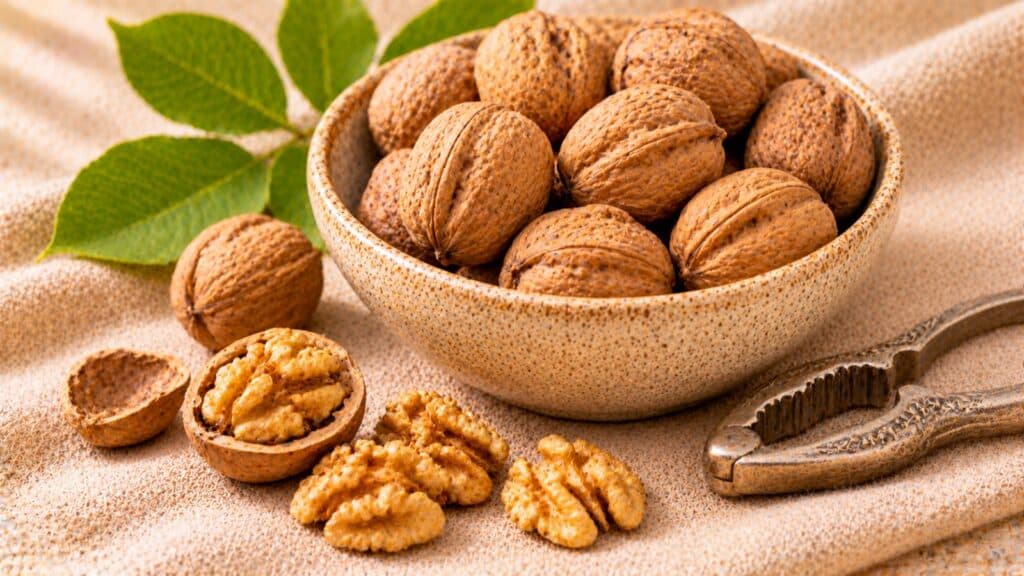
Walnuts are the seeds of the common or English walnut tree (Juglans regia). What sets them apart from other nuts is their fat profile: mostly polyunsaturated, with about 9 g of alpha-linolenic acid (ALA), the plant omega-3, per 100 g. A 28 g handful, about 7 whole walnuts or 14 halves, gives roughly 183 kcal and 2.5 g of ALA, which is more than the daily adequate intake NIH sets for adults. Walnuts also have an approved EU health claim of their own, linked to 30 g a day.
Walnut nutrition per 100 g and per handful
| Nährstoff | Walnuts, 100 g | Handful: 28 g (about 7 walnuts) |
|---|---|---|
| Energie | 654 kcal | 183 kcal |
| Eiweiß | 15.2 g | 4.3 g |
| Fat | 65.2 g | 18.3 g |
| of which polyunsaturated | 47.2 g | 13.2 g |
| of which ALA (omega-3) | 9.1 g | 2.5 g |
| of which linoleic acid (omega-6) | 38.1 g | 10.7 g |
| of which monounsaturated | 8.9 g | 2.5 g |
| of which saturated | 6.1 g | 1.7 g |
| Carbohydrate (including fibre) | 13.7 g | 3.8 g |
| of which sugars | 2.6 g | 0.7 g |
| Fibre | 6.7 g | 1.9 g |
| Manganese | 3.4 mg | 0.95 mg |
| Copper | 1.6 mg | 0.45 mg |
| Magnesium | 158 mg | 44 mg |
| Phosphor | 346 mg | 97 mg |
| Eisen | 2.9 mg | 0.8 mg |
| Folat | 98 µg | 27 µg |
Source: USDA FoodData Central, SR Legacy, “Nuts, walnuts, english” (FDC 170187), checked 4 November 2026. USDA’s household measures: 7 nuts = 28 g; 1 oz (14 halves) = 28.35 g; 1 cup shelled (50 halves) = 100 g. The 28 g column is calculated. NIH lists 2.57 g of ALA per ounce. Values rounded.
Against the EU nutrient reference values (Regulation (EU) No 1169/2011, Annex XIII), 100 g of walnuts provides about 170% of the reference intake for manganese (2 mg), 159% for copper (1 mg), 49% for phosphorus (700 mg) and 42% for magnesium (375 mg). A single handful covers almost half of the manganese reference intake.
Glycemic index of walnuts
Walnuts are not listed in the international GI tables (Atkinson 2008). They contain little carbohydrate and a lot of fat and fibre, so a handful has very little effect on blood sugar. Walnut cakes, brownies and candied walnuts are a different matter because of the sugar.
Health benefits: what the evidence says
- Elasticity of blood vessels. Regulation (EU) No 432/2012 authorises the claim “Walnuts contribute to the improvement of the elasticity of blood vessels”, on condition that the food provides a daily intake of 30 g of walnuts. That is a generous handful, about 7-8 whole walnuts.
- ALA and cholesterol. The same regulation allows the claim that ALA contributes to the maintenance of normal blood cholesterol levels, with the beneficial effect obtained at 2 g of ALA a day. 30 g of walnuts provides about 2.7 g.
- Blood lipids in trials. A meta-analysis of 26 controlled trials with 1,059 participants found that walnut-enriched diets lowered LDL cholesterol by about 5.5 mg/dL (about 0.14 mmol/L) and total cholesterol by about 7 mg/dL (about 0.18 mmol/L) more than control diets. Triglycerides and apolipoprotein B also fell. Body weight and blood pressure did not differ between groups (Guasch-Ferré and colleagues, 2018). The effect is modest: walnuts help as part of an overall diet, not as a medicine.
- Nuts and heart health in the long term. In a meta-analysis of 20 prospective studies, each extra 28 g of nuts a day was associated with a 29% lower risk of coronary heart disease and 22% lower all-cause mortality (Aune and colleagues, 2016). These are observational data, so they show an association, not proof.
- ALA is not fish oil. The body converts ALA into the long-chain omega-3s EPA and DHA only to a very limited extent, with reported rates below 15% (NIH). Walnuts are an excellent ALA source but do not replace oily fish wie zum Beispiel Lachs.
Ayurveda: walnuts in the traditional system
In Usha and Vasant Lad’s food guidelines, walnuts are favourable for Vata, like all nuts, in moderation. For Pitta and Kapha, they are on the list to avoid. This is a traditional view, not a clinical finding.
How to buy, prepare and use walnuts
- Frühstück: Greek yogurt with walnuts and a little honey, with the emphasis on the walnuts; or porridge with walnuts, grated apple Und cinnamon.
- Salads: walnuts with Spinat oder Rakete, roasted Rüben and a crumble of goat’s cheese or feta.
- Walnut pesto: swap pine nuts for walnuts and blend with Basilikum oder Petersilie, Knoblauch, lemon Und Olivenöl.
- Dips: muhammara, the roasted red pepper and walnut dip from Syria and Turkey, is a good way to use a whole handful.
- Snack: a handful of walnuts instead of biscuits or crisps.
- Buying and storage: walnuts in the shell keep longest. Store shelled walnuts in a closed jar somewhere cool, or in the fridge or freezer, because their polyunsaturated fats go rancid easily. A bitter, paint-like or soapy taste means they have turned; throw them away.
Who should be careful
- Tree nut allergy. Walnuts are among the nuts that must be emphasised in ingredient lists in the EU (Regulation (EU) No 1169/2011, Annex II). Tree nut allergies tend to last a lifetime and can cause anaphylaxis (MedlinePlus). If you are allergic, avoid walnuts, read labels on baked goods and talk to an allergist.
- If you are watching calories. At 654 kcal per 100 g, walnuts are among the most energy-dense foods. A portion is a handful (28-30 g), not a bowl.
- Mouldy or rancid nuts. Do not eat them. Discard the whole batch rather than cutting out the bad bits.
Related entries and articles
- Greek yogurt – with walnuts for breakfast
- Hafer – porridge with walnuts
- Lachs – for EPA and DHA, which walnuts do not supply
- Chia seeds – the other big ALA source
- Mandeln – a nut with more vitamin E and fibre
- All about high-quality fats
- Which foods reduce inflammation naturally?
FAQ
How many walnuts should I eat a day?
The EU health claim for walnuts refers to 30 g a day, about 7-8 whole walnuts or a full handful. That portion gives about 196 kcal and about 2.7 g of ALA, above the adequate intake NIH sets for adult men (1.6 g) and women (1.1 g).
How many calories are in one walnut?
About 26 kcal. USDA lists 7 walnuts as 28 g with 183 kcal, so one whole walnut (two halves) weighs about 4 g.
Do walnuts raise cholesterol?
No. In a meta-analysis of 26 controlled trials, walnut-enriched diets lowered total and LDL cholesterol compared with control diets, without changing body weight. Walnuts contain little saturated fat and a lot of polyunsaturated fat, including ALA.
Sources
- USDA FoodData Central, SR Legacy: Nuts, walnuts, english (FDC 170187). fdc.nal.usda.gov
- Commission Regulation (EU) No 432/2012, list of permitted health claims (walnuts; alpha-linolenic acid). EUR-Lex
- Guasch-Ferré M, Li J, Hu FB, Salas-Salvadó J, Tobias DK. Effects of walnut consumption on blood lipids and other cardiovascular risk factors: an updated meta-analysis and systematic review of controlled trials. Am J Clin Nutr 2018;108(1):174-187. PMC
- Aune D, Keum N, Giovannucci E, et al. Nut consumption and risk of cardiovascular disease, total cancer, all-cause and cause-specific mortality: a systematic review and dose-response meta-analysis of prospective studies. BMC Medicine 2016;14:207. PMC
- NIH Office of Dietary Supplements: Omega-3 Fatty Acids, Fact Sheet for Health Professionals. ods.od.nih.gov
- Regulation (EU) No 1169/2011, Annex II (allergens) and Annex XIII (reference intakes). EUR-Lex
- MedlinePlus: Food allergy. medlineplus.gov
- Lad U, Lad V. Food Guidelines for Basic Constitutional Types, from Ayurvedic Cooking for Self-Healing, 2nd ed. The Ayurvedic Institute. ayurveda.com
This page is for information only and is not medical or dietary advice.
Enzyklopädie der Lebensmittel
Greek yogurt Hafer Lachs Chia seeds Mandeln Äpfel Pomegranate Mandeln Flaxseed Hazelnuts Cashews Pistachios Erdnüsse Beets (beetroot)
 Deutsch
 English
 Español
 Français

