
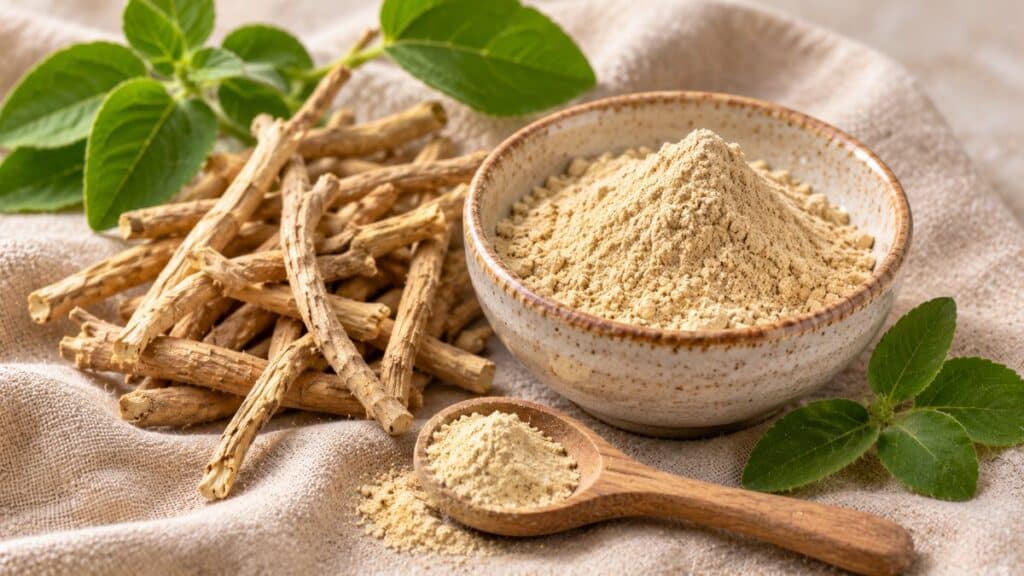
For most healthy adults, taking a standard ashwagandha supplement every day appears to be well tolerated for up to about three months, which is as long as most clinical trials have lasted. Whether daily use is safe for longer is simply not known. Rare cases of liver injury and an overactive thyroid have been reported, and ashwagandha is not recommended in pregnancy, while breastfeeding, with thyroid or autoimmune disease, or before surgery.
This guide is for you if you take ashwagandha for stress, anxiety or sleep, or are about to buy a jar: what trials tested, the known risks, who should skip it, and a careful way to use it.
Is it safe to take an ashwagandha supplement every day?
Ashwagandha (Withania somnifera) is a shrub whose root, and sometimes leaf, has long been used in Ayurveda. In research it is almost always taken daily as a concentrated extract, so “daily” is not the unusual part. The open question is “for how long”.
The US NIH Office of Dietary Supplements (NIH ODS) says ashwagandha appears well tolerated for up to about three months and its long-term safety is unknown. The National Center for Complementary and Integrative Health (NCCIH) agrees: likely safe short term, not enough data on long-term use.
In trials, side effects were mostly mild: upset stomach, loose stools, nausea and drowsiness. NCCIH also lists diarrhoea and vomiting. If your capsule makes you sleepy, do not drive.
So the honest answer has two parts. Short-term daily use looks reasonably reassuring for healthy adults. Long-term daily use has not been studied enough to call it safe or unsafe.
How long can you take ashwagandha?
Most trials ran for 6 to 8 weeks; in the studies summarised by NIH ODS, the longest lasted 90 days. NCCIH says some preparations may help with stress and insomnia, while the evidence for ashwagandha for anxiety is unclear. A 2021 meta-analysis on ashwagandha for sleep pooled five randomised trials with around 400 participants: it found a small but significant improvement in overall sleep, larger at 600 mg a day or more and after 8 weeks or longer, and no serious side effects reported.
But a few hundred people followed for two months reveal common side effects, not rare ones like liver injury, or slow ones that might appear after a year. That is why experts say “up to three months” and stop there.
What doses of ashwagandha have been studied?
Products vary: root only or root and leaf, standardised to different amounts of withanolides (the compounds researchers usually measure). Compare your label with what trials actually used.
| What was studied | Daily amount | Duration | Who took part |
|---|---|---|---|
| Stress and anxiety (review of 7 trials) | 240 to 1,250 mg extract | 6-8 weeks | 491 adults in India |
| Stress and sleep quality | 300 mg sustained-release root extract | 90 days | 130 adults aged 20-55 |
| Stress and fatigue | 400 mg root extract (200 mg twice) | 12 weeks | 120 overweight or mildly obese adults |
| Schlafen | 600 mg root extract (300 mg twice) | 8 weeks | 80 adults, half with insomnia |
| Schlafen | 120 mg root and leaf extract | 6 weeks | 150 adults with insomnia symptoms |
| Thyroid values | 600 mg root extract (300 mg twice) | 8 weeks | 50 people with subclinical hypothyroidism |
Source: NIH Office of Dietary Supplements, Ashwagandha fact sheet for health professionals (2025).
LiverTox notes that extracts are typically sold at 150 to 600 mg, taken one to three times a day. If your daily total is well above the table, you are outside what has been tested.
Can ashwagandha damage your liver?
Yes, rarely. LiverTox, the NIH database on drug and supplement liver injury, rates ashwagandha as a “likely cause of clinically apparent liver injury”. Here is the typical picture from the case reports:
- Symptoms usually started 2 to 12 weeks after starting the product.
- The injury was mostly cholestatic or mixed (bile flow is affected), with jaundice and itching.
- In most cases it settled within 1 to 4 months of stopping.
- Rare fatal cases and emergency liver transplants have been reported.
NIH ODS describes five of these cases in people aged 21 to 62 who took 450 to 1,350 mg a day for between one week and four months. Most improved after stopping. Some products were combinations or never independently tested, so it is not always clear what people swallowed. Still, LiverTox treats the pattern as real.
The practical message: if you notice yellowing of your skin or the whites of your eyes, or itching you cannot explain, stop the supplement and see a doctor.

Does ashwagandha affect your thyroid?
It can. In a trial of 50 people with subclinical hypothyroidism, 600 mg a day for 8 weeks lowered TSH and raised the thyroid hormones T3 and T4. In three men taking 500 mg a day of a root and leaf extract for 8 weeks, T4 rose slightly. There are also three case reports of thyrotoxicosis (an overactive thyroid state) in women aged 32 to 73, one of them taking 1,950 mg a day for more than two months. Their symptoms went away after they stopped.
This is why NCCIH advises people with thyroid disorders not to use it, and why it matters if you take levothyroxine or other thyroid hormone: the effects could stack.
Why did Denmark ban ashwagandha?
According to NIH ODS, a 2020 risk assessment by the Technical University of Denmark raised concerns about possible effects on pregnancy, the thyroid and sex hormones, and Denmark banned ashwagandha in 2023. In 2024 the French food safety agency ANSES recommended that certain groups avoid it, including pregnant and breastfeeding women and people with hormone-related (endocrine) conditions. That French advice is a recommendation, not a ban. Rules differ from country to country, so check your national food authority if you live in Europe.
The pregnancy concern is debated: the American Herbal Pharmacopoeia says there is no evidence ashwagandha causes miscarriage. With the evidence unclear, the sensible default in pregnancy is to avoid it.
What does Ayurveda say about ashwagandha?
In the traditional Ayurvedic view, ashwagandha is a rasayana, a rejuvenating herb meant to build strength and steadiness. Its tastes (rasa) are described as bitter, astringent and sweet, and its energy (virya) as heating. It is traditionally used to calm vata (the airy, restless dosha) and kapha, while too much may aggravate pitta, the hot dosha. If you are new to the doshas, our guide to the three Ayurveda doshas explains them.
Tradition also cares about how and for whom. Ashwagandha root powder was usually simmered in milk, often with a little ghee, and given for a defined period to a specific person, with attention to agni, the digestive fire. A heavy, sluggish digestion was a reason to wait. That is quite different from a high-strength capsule taken by everyone, indefinitely. Our article on how to use ghee covers the fat that often went with it, and ghee belongs to the wider family of hochwertige Fette.
This is tradition, not scientific evidence, but it shares one instinct with modern data: treat ashwagandha as a course, not a forever habit.
How can you use ashwagandha more carefully? A 12-week routine
If you have checked the precautions below and still want to try it, this routine keeps you inside what has been studied.
What you need:
- One single-herb ashwagandha product with the extract amount per capsule on the label
- A calendar or phone reminder
- A small notebook or notes app
- Talk to your doctor or pharmacist first, especially if you take any medicine on the interaction list below.
- Pick a single-ingredient product from a brand that uses third-party testing. Combination formulas make it harder to know what caused a reaction.
- Stay within the studied range, for example one 300 mg capsule a day with food, and never above the label dose.
- Put an end date in your calendar 8 to 12 weeks from today.
- Once a week, note your sleep, mood, stomach and energy. Stop and see a doctor if you notice yellow skin or eyes or unexplained itching.
- On the end date, stop and notice what changes over the next few weeks. There is no research on “cycling” schedules: the pause simply tells you whether it was doing anything. If you want to continue long term, discuss it with your doctor, who may suggest checking liver and thyroid blood tests.
No capsule fixes sleep on its own. The basics in Warum Schlaf der Grundstein für einen gesunden Lebensstil ist and our tips on balanced energy through the day do more of the heavy lifting.
Who should not take ashwagandha?
Based on NIH ODS and NCCIH, avoid ashwagandha or use it only with medical supervision if:
- you are pregnant or breastfeeding,
- you have a thyroid disorder (under- or overactive),
- you have an autoimmune condition, such as rheumatoid arthritis, lupus or Hashimoto’s thyroiditis,
- you have surgery coming up,
- you have hormone-sensitive prostate cancer, since ashwagandha may raise testosterone,
- you have had liver problems, given the case reports above.
Ashwagandha may interact with these medicines:
- thyroid hormone (for example levothyroxine),
- diabetes medicines,
- blood pressure medicines,
- immunosuppressants,
- sedatives, including sleeping pills and anti-anxiety drugs,
- anti-seizure medicines (anticonvulsants).
Natural does not mean gentle. Kurkuma Und Ingwer are mostly eaten in kitchen amounts. Ashwagandha extracts are concentrated, so treat them more like a medicine than a seasoning.
Related reading: our golden milk recipe, a warm evening drink.
FAQ
Can I take ashwagandha every day long term?
Nobody knows yet. Trials mostly lasted 6 to 12 weeks, and NIH ODS and NCCIH both say long-term safety is unknown. If you want to keep going past three months, do it with your doctor’s knowledge.
Does ashwagandha make you sleepy?
It can. Drowsiness is one of the side effects reported in trials, and some products were tested specifically for sleep. Many people take it in the evening for that reason, and you should not drive if it makes you drowsy.
Is ashwagandha banned in Europe?
Not across the whole EU. Denmark banned it in 2023, and France’s ANSES advised certain groups, such as pregnant women and people with endocrine conditions, to avoid it. Check the current rules in your own country.
Does ashwagandha raise testosterone?
NCCIH says limited evidence suggests it may raise testosterone and improve sperm quality in men after 2 to 4 months of use. For the same reason it is considered possibly unsafe for men with hormone-sensitive prostate cancer.
Sources
- NIH Office of Dietary Supplements. Ashwagandha: Is it helpful for stress, anxiety, or sleep? Fact Sheet for Health Professionals, 2025. ods.od.nih.gov
- National Center for Complementary and Integrative Health. Ashwagandha. NCCIH, 2023. nccih.nih.gov
- LiverTox: Clinical and Research Information on Drug-Induced Liver Injury. Ashwagandha. National Institute of Diabetes and Digestive and Kidney Diseases, updated 2024. ncbi.nlm.nih.gov/books/NBK548536
- Cheah KL, Norhayati MN, Husniati Yaacob L, Abdul Rahman R. Effect of Ashwagandha (Withania somnifera) extract on sleep: a systematic review and meta-analysis. PLoS One, 2021. PubMed 34559859
This article is for information only and is not medical advice. If you have a health condition, are pregnant or take medication, talk to your doctor or pharmacist before changing your diet or starting a supplement.


 Deutsch
 English
 Español
 Français

