
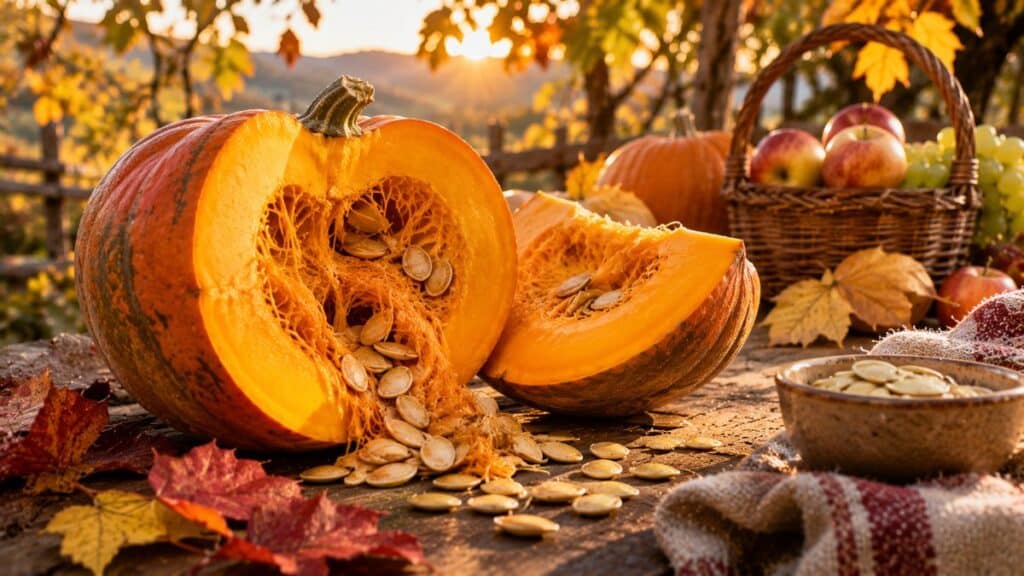
Calabaza seeds are one of the richest food sources of magnesium: a 28 g handful of roasted, shelled seeds gives about 154 mg, roughly a third or more of an adult’s daily need, plus about 8 g of protein, 2 mg of zinc and 2 mg of iron (USDA FoodData Central). A sensible amount is 1 ounce (28 g, about a quarter cup) a day. Studies on specific benefits, such as urinary symptoms in men or blood sugar after meals, are few and small, so treat pumpkin seeds as a nutrient-dense food, not a remedy.
Below: the real numbers per handful, what the few human studies show, how many to eat a day, raw versus roasted and salted, the Ayurvedic view and a five-minute spiced seed sprinkle.
What nutrients are in a handful of pumpkin seeds?
Most “pumpkin seeds” or “pepitas” sold are green kernels without the white shell. Whole seeds in the shell have more fibre but less magnesium and iron per gram. Here is 28 g of each, from USDA records.
| Per 28 g | Raw (dried) kernels | Roasted kernels, unsalted | Whole roasted seeds, in shell |
|---|---|---|---|
| Energía | 157 kcal | 161 kcal | 125 kcal |
| Proteína | 8.5 g | 8.3 g | 5.2 g |
| Fat | 13.7 g | 13.7 g | 5.4 g |
| Fibre | 1.7 g | 1.8 g | 5.2 g |
| Magnesio | 166 mg | 154 mg | 73 mg |
| Zinc | 2.2 mg | 2.1 mg | 2.9 mg |
| Hierro | 2.5 mg | 2.3 mg | 0.9 mg |
| Sodio | 2 mg | 5 mg | 5 mg |
Source: USDA FoodData Central, SR Legacy: pumpkin and calabaza seed kernels, dried (FDC 170556); kernels, roasted, without salt (FDC 170557); whole seeds, roasted, without salt (FDC 170188). Values per 100 g multiplied by 0.28 and rounded.
For context, adults need 310 to 420 mg of magnesium a day, 8 to 11 mg of zinc and 8 mg (men) to 18 mg (women aged 19 to 50) of iron.
What are the health benefits of pumpkin seeds?
The most solid benefit is plain nutrition: a small portion that covers a large share of several minerals.
Pumpkin seeds and magnesium
Magnesium is a cofactor in more than 300 enzyme systems, from energy production to muscle and nerve function, blood sugar control and blood pressure. In the NIH food table, pumpkin seeds come first: 156 mg per ounce (37 percent of the Daily Value), ahead of chia seeds (111 mg) and almonds (80 mg). For other good sources, see our guide to magnesium rich foods.
Zinc, especially for plant-based eaters
NIH lists 2.2 mg of zinc per ounce, 20 percent of the Daily Value. That matters most if you eat little meat: NIH notes that people on vegano and vegetarian diets usually take in less zinc, and that phytates in seeds, grains and legumes reduce how much is absorbed. Compare other zinc rich foods.
Plant protein, iron and healthy fats
About 8 g of protein per handful is generous for a plant snack. The iron is non-heme iron, absorbed less easily than iron from meat; NIH notes that vitamin C helps and phytate hinders. Seeds on a salad with pimientos and lemon juice is a smart pairing. Most of the fat is unsaturated, the kind covered in our entry on high quality fats.

What do studies show about pumpkin seeds?
Less than the internet suggests: a few interesting trials, none strong enough to call pumpkin seeds a treatment.
Prostate and urinary symptoms in men
This is the main search behind “pumpkin seeds benefits for men”. In the German GRANU trial, 1,431 men aged 50 to 80 with urinary symptoms from an enlarged prostate (benign prostatic hyperplasia) took 5 g of pumpkin seed twice a day, a pumpkin seed extract or a placebo for 12 months. The extract did no better than placebo. With the seeds, 58.5 percent of men had a meaningful drop in symptom score against 47.8 percent on placebo, but under the study’s statistical plan this counts only as descriptive, and the authors say it needs confirming.
The European Medicines Agency recognises pumpkin seed (Cucurbitae semen) only as a traditional herbal medicine for urinary symptoms of an enlarged prostate or overactive bladder, based on long use rather than proof, after a doctor has ruled out serious disease. The traditional dose is 2.5 to 7.5 g of whole or crushed seed twice a day.
Testosterone or fertility? We found no good human trials showing pumpkin seeds raise testosterone or improve sperm quality.
Blood sugar after a meal
In a small crossover trial, 15 healthy young adults ate a high-carbohydrate test meal (a muffin and a shake) with or without 65 g of crushed roasted pumpkin seed. With the seeds, the rise in blood glucose over two hours was about a third smaller. One short test, in people without diabetes, with a large portion: a hint, not proof.
Do the seeds themselves raise blood sugar? Hardly. They are not in the summary table of the international GI tables, and a 28 g handful holds only about 2 g of digestible carbohydrate. Glycemic load is GI multiplied by grams of available carbohydrate, divided by 100, so even the highest possible GI would give a load near 2, which is very low. For fruit, where GI matters more, see our list of low glycemic fruits.
How many pumpkin seeds should you eat a day?
There is no official daily amount. A practical portion is 28 g, roughly a quarter cup of kernels (USDA weighs a cup at 118 g): about 161 kcal and close to half of a woman’s magnesium RDA.
- Everyday eating: 1 to 2 tablespoons sprinkled on food, up to a 28 g handful as a snack.
- Amounts used in research: 10 g a day in the prostate trial; the traditional EU herbal dose works out at 5 to 15 g a day.
- Watching weight: measure the handful instead of eating from the bag.
Magnesium from food is not a concern for healthy people, as the kidneys excrete the excess; the 350 mg upper limit applies to supplements only (NIH).
Raw, roasted or salted: which pumpkin seeds are best?
Raw and roasted kernels are nutritionally close: in the USDA data, roasting moves magnesium from 166 to 154 mg per 28 g and leaves protein, zinc and iron much the same. Toasting at home lets you control the heat.
Salt is the real difference. USDA lists 256 mg of sodium per 100 g for salted roasted kernels against 18 mg unsalted, so about 72 mg in a handful. Brands vary, so check the salt per 100 g on the label. Whole seeds in the shell bring more fibre (5.2 g per 28 g) but less magnesium.
What does Ayurveda say about pumpkin seeds?
Pumpkin seeds are not a headline food in the classical texts, so this applies the tradition’s general principles. Seeds are seen as heavy (guru), oily (snigdha) and nourishing, with a mildly sweet taste (madhura rasa), a profile said to steady dry, light Vata. Pitta is advised to choose unsalted, lightly toasted seeds, since salt and strong roasting count as heating. For Kapha, small amounts dry toasted with cumin, jengibre or black pepper make a heavy food easier on agni, the digestive fire. These are traditional ideas, not tested claims.
How do you eat pumpkin seeds every day?
Keep a jar of toasted seeds on the counter and use a spoonful on soup, salad, porridge or roasted calabaza, or blend a spoonful into our no-bake energy balls with oats and dates.
Recipe: spiced pumpkin seed sprinkle
Makes about 100 g, enough for roughly a week of spoonfuls.
- 100 g raw shelled pumpkin seeds
- 1 teaspoon aceite de oliva
- 1/2 teaspoon ground cumin
- 1/2 teaspoon ground coriander
- 1/4 teaspoon ground cúrcuma
- a pinch of black pepper
- a small pinch of salt (optional)
- finely grated zest of half a lemon
- Heat a dry frying pan over medium heat and add the seeds in one layer.
- Toast for 3 to 4 minutes, stirring often, until they puff and start to pop. Do not let them turn dark brown.
- Take the pan off the heat, add the oil and spices and stir until every seed is coated.
- Tip onto a plate, stir in the lemon zest and let cool completely.
- Store in a closed jar and use 1 to 2 tablespoons a day.
Who should be careful with pumpkin seeds?
- Urinary symptoms. Do not self-treat before a doctor has checked you. The EMA advises seeing a doctor if symptoms worsen or with fever, blood in the urine, painful urination or urinary retention.
- Allergy. Seed allergies exist; hypersensitivity is the one contraindication listed by the EMA.
- Digestion. Mild stomach complaints were reported with medicinal pumpkin seed products.
- Kidney disease. A handful of kernels carries about 330 mg of phosphorus and 220 mg of potassium (USDA). If you have been told to limit these, ask your renal team about portions.
- Zinc supplements. The adult upper limit is 40 mg a day, and high doses over weeks can lower copper status. Food amounts are far below that.
- Children and pregnancy. Seeds as food are fine for most people, but the EMA does not recommend medicinal pumpkin seed products for under 18s or in pregnancy without clear need.
Related reading: chia seeds benefits y 7 alimentos saludables para desayunar.
FAQ
Are pumpkin seeds good for men?
They supply zinc and magnesium, and one large trial suggests they may modestly ease urinary symptoms of an enlarged prostate. The evidence is limited, and there is no good proof that they raise testosterone.
Is it OK to eat pumpkin seeds every day?
Yes, for most people a daily handful of about 28 g fits well into a balanced diet. Choose unsalted seeds most of the time and count them as part of your calories.
How much magnesium is in 100 g of pumpkin seeds?
USDA lists 592 mg per 100 g for dried raw kernels and 550 mg for roasted kernels. Whole seeds in the shell contain 262 mg per 100 g.
Sources
- U.S. Department of Agriculture, Agricultural Research Service. FoodData Central, SR Legacy: pumpkin and squash seed kernels, dried (FDC 170556); roasted, without salt (FDC 170557); roasted, with salt added (FDC 169415); whole seeds, roasted, without salt (FDC 170188). fdc.nal.usda.gov
- NIH Office of Dietary Supplements. Magnesium, Zinc and Iron: Fact Sheets for Health Professionals. Magnesio, Zinc, Hierro
- Vahlensieck W, Theurer C, Pfitzer E, Patz B, Banik N, Engelmann U. Effects of pumpkin seed in men with lower urinary tract symptoms due to benign prostatic hyperplasia in the one-year, randomized, placebo-controlled GRANU study. Urologia Internationalis, 2015;94(3):286-295. karger.com
- European Medicines Agency, Committee on Herbal Medicinal Products. Community herbal monograph on Cucurbita pepo L., semen. EMA/HMPC/136024/2010, 2012. ema.europa.eu
- Cândido FG, de Oliveira FCE, Lima MFC, et al. Addition of pooled pumpkin seed to mixed meals reduced postprandial glycemia: a randomized placebo-controlled clinical trial. Nutrition Research, 2018;56:90-97. Full text (UFV)
- Atkinson FS, Foster-Powell K, Brand-Miller JC. International Tables of Glycemic Index and Glycemic Load Values: 2008. Diabetes Care, 2008;31(12):2281-2283. PMC2584181
This article is for information only and is not medical advice. If you have a health condition, are pregnant or take medication, talk to your doctor or pharmacist before changing your diet or starting a supplement.


 Español
 English
 Deutsch
 Français

