
← EncyclopediaEncyclopédie de la nourriture
By Nikola · Precision Nutrition L1 · Updated 5 November 2026
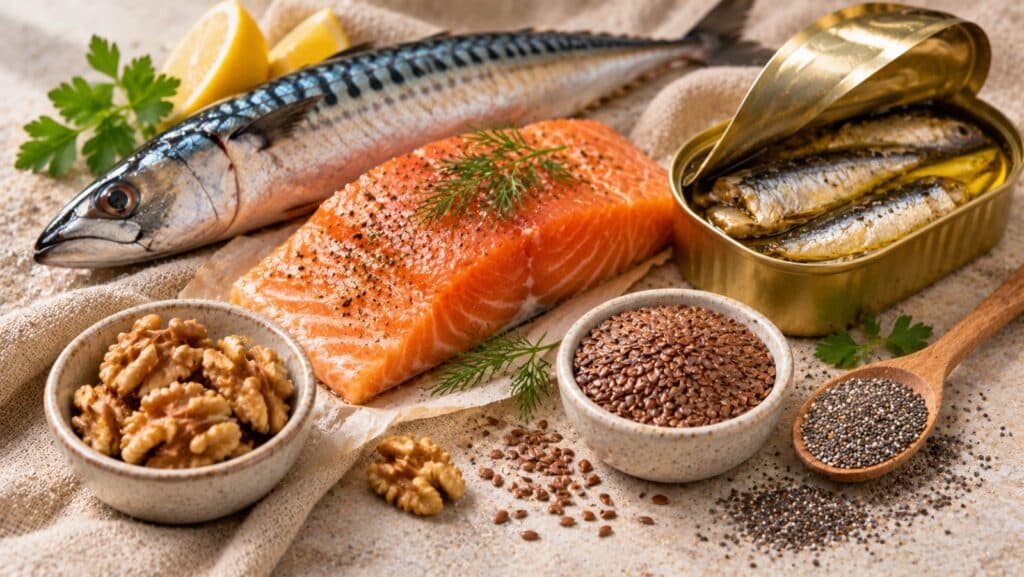
Omega-3 fatty acids are a family of polyunsaturated fats that the body needs but cannot make from scratch, so they have to come from food. Three matter most in nutrition. ALA (alpha-linolenic acid) comes from plants: walnuts, flaxseed, chia and rapeseed (canola) oil. EPA and DHA, the long-chain omega-3 fats, come mainly from fish and seafood, above all oily fish such as salmon, maquereau et sardines. EFSA sets an adequate intake of 250 mg of EPA plus DHA a day for adults and 0.5% of energy from ALA. The body can turn some ALA into EPA and DHA, but only a small share, which is why plant and fish sources are not interchangeable.
Omega-3 in foods: per 100 g and per portion
| Food | EPA + DHA, 100 g | ALA, 100 g | Portion | Omega-3 per portion |
|---|---|---|---|---|
| Atlantic mackerel, raw | 2.30 g | 0.16 g | 85 g | 1.95 g EPA + DHA |
| Atlantic salmon, farmed, raw | 1.96 g | 0.15 g | 85 g | 1.67 g EPA + DHA |
| Sardines, canned in oil, drained | 0.98 g | 0.50 g | 1 tin, 92 g | 0.90 g EPA + DHA |
| White (albacore) tuna, canned in water | 0.86 g | 0.07 g | 85 g | 0.73 g EPA + DHA |
| Light tuna, canned in water | 0.22 g | 0.002 g | 85 g | 0.19 g EPA + DHA |
| Flaxseed | – | 22.8 g | 1 tbsp ground, 7 g | 1.6 g ALA |
| Chia seeds, dried | – | 17.8 g | 28 g | 5.0 g ALA |
| Walnuts | – | 9.1 g | 28 g (about 7 nuts) | 2.5 g ALA |
| Rapeseed (canola) oil | – | 9.1 g | 1 tbsp, 14 g | 1.3 g ALA |
Source: USDA FoodData Central, SR Legacy, checked 4-5 November 2026: mackerel FDC 175119, salmon FDC 175167, sardines FDC 175139, white tuna FDC 175158, light tuna FDC 173709, flaxseed FDC 169414, chia FDC 170554, walnuts FDC 170187, canola oil FDC 172336. EPA + DHA is the sum of the two values in each record; “-” means the record lists no EPA or DHA. Portions are USDA household measures; values per portion are calculated and rounded. For flaxseed and walnuts USDA reports ALA as undifferentiated 18:3, which is almost all ALA in these foods.
The table shows why the type of omega-3 matters more than the gram figure. A tablespoon of ground flaxseed gives more omega-3 by weight than a portion of light tuna, but it is ALA, not EPA and DHA. One portion of mackerel or salmon gives roughly a week’s worth of the 250 mg a day reference amount for EPA and DHA.
ALA vs EPA and DHA
- ALA is the plant omega-3, with 18 carbon atoms. It is essential: the body cannot make it. EFSA’s adequate intake is 0.5% of daily energy, roughly 1.1 g a day on 2,000 kcal.
- EPA and DHA are longer chains, made in marine algae and passed up the food chain into fish. DHA is a structural part of the brain and the retina. EFSA’s adequate intake is 250 mg of EPA plus DHA a day for adults, with an extra 100-200 mg of DHA in pregnancy and breastfeeding.
- Conversion. The body can turn part of ALA into EPA and less into DHA, but the share is small. If you eat no fish, plant ALA sources still count, but they do not fully stand in for EPA and DHA.
What the EU allows foods to claim
- “Source of omega-3” needs at least 0.3 g of ALA or 40 mg of EPA plus DHA per 100 g and per 100 kcal; “high in omega-3” needs at least 0.6 g of ALA or 80 mg of EPA plus DHA (Regulation (EC) 1924/2006).
- Heart. “EPA and DHA contribute to the normal function of the heart”, with a daily intake of 250 mg of EPA and DHA (Regulation (EU) 432/2012).
- Brain and vision. “DHA contributes to maintenance of normal brain function” and “to the maintenance of normal vision”, for foods with at least 40 mg of DHA per 100 g and per 100 kcal, with a daily intake of 250 mg of DHA.
- Triglycerides and blood pressure. EPA and DHA contribute to normal blood triglyceride levels with 2 g a day and to normal blood pressure with 3 g a day; for supplements, the label must say that a combined intake of 5 g a day should not be exceeded, and these two claims may not be used for foods aimed at children.
- ALA and cholesterol. “ALA contributes to the maintenance of normal blood cholesterol levels”, for foods that are at least a source of ALA, with a daily intake of 2 g of ALA.
How to get enough omega-3 from food
- Oily fish once or twice a week. The NHS recommends at least 2 portions of fish a week, one of them oily; a portion is about 140 g. Oily fish include saumon, maquereau, sardines, herring and trout. Canned tuna does not count as oily fish.
- A daily ALA habit. A tablespoon of ground flaxseed dans porridge or yogurt, a spoon of chia, a handful of walnuts, or rapeseed oil in cooking. Flaxseed is best ground: whole seeds can pass through undigested.
- Vegetarian and vegan eating. Without fish, ALA foods cover the plant omega-3. Supplements made from algae oil provide EPA and DHA without fish; whether you need one is a question for your doctor or dietitian.
Supplements: a short note
Fish oil and algae oil capsules are common, but food comes first: oily fish also bring protein, vitamin D, B12 and selenium. If you take a supplement, check the label for the amount of EPA and DHA per capsule, not only the total “fish oil”. People on blood-thinning medicines, before surgery, or who are pregnant should talk to a doctor before high-dose omega-3. We do not recommend specific products on this page.
Who should be careful
- Pregnancy. EPA and DHA matter, and so does mercury. The FDA lists salmon, sardines, Atlantic mackerel and canned light tuna among the lowest-mercury “Best Choices”, while king mackerel and bigeye tuna are among the “Choices to Avoid”. The NHS advises no more than 2 portions of oily fish a week in pregnancy.
- Fish allergy. Anyone allergic to fish should avoid fish and fish oil; plant ALA sources and algae-based products are the alternatives to discuss with a doctor.
- Calories. Omega-3 foods are fatty foods. A tablespoon of oil is about 124 kcal and 28 g of walnuts about 180 kcal, so portions matter.
Related entries and articles
- Saumon, maquereau et sardines
- Canned tuna – light vs white
- Flaxseed, chia seeds et walnuts
- All about high-quality fats
- Flaxseed: benefits and how to eat it
- Chia seeds: benefits and how to eat them
- Which foods reduce inflammation naturally?
FAQ
What foods are highest in omega-3?
For EPA and DHA, oily fish: per 100 g, Atlantic mackerel has 2.3 g and farmed salmon 2.0 g (USDA). For ALA, flaxseed (22.8 g per 100 g), chia (17.8 g), walnuts and rapeseed oil (about 9 g each).
How much omega-3 do I need a day?
EFSA sets an adequate intake of 250 mg of EPA plus DHA a day for adults, plus 100-200 mg of DHA in pregnancy and breastfeeding, and 0.5% of daily energy from ALA, roughly 1.1 g on 2,000 kcal.
Can I get enough omega-3 without eating fish?
You can get enough ALA from flaxseed, chia, walnuts and rapeseed oil. The body turns only a small part of ALA into EPA and DHA, so people who eat no fish sometimes use algae oil, which provides EPA and DHA directly; ask your doctor if it suits you.
Sources
- USDA FoodData Central, SR Legacy: Fish, mackerel, Atlantic, raw (FDC 175119). fdc.nal.usda.gov
- USDA FoodData Central, SR Legacy: Fish, salmon, Atlantic, farmed, raw (FDC 175167). fdc.nal.usda.gov
- USDA FoodData Central, SR Legacy: Fish, sardine, Atlantic, canned in oil, drained solids with bone (FDC 175139). fdc.nal.usda.gov
- USDA FoodData Central, SR Legacy: Fish, tuna, white, canned in water, drained solids (FDC 175158) and Fish, tuna, light, canned in water, drained solids (FDC 173709). fdc.nal.usda.gov
- USDA FoodData Central, SR Legacy: Seeds, flaxseed (FDC 169414); Seeds, chia seeds, dried (FDC 170554); Nuts, walnuts, english (FDC 170187); Oil, canola (FDC 172336). fdc.nal.usda.gov
- EFSA NDA Panel (2010). Scientific Opinion on Dietary Reference Values for fats, including saturated fatty acids, polyunsaturated fatty acids, monounsaturated fatty acids, trans fatty acids, and cholesterol. EFSA Journal 8(3):1461. efsa.europa.eu
- European Commission, Knowledge for Policy: Dietary fats – reference values (EFSA 2010 row). knowledge4policy.ec.europa.eu
- Regulation (EC) No 1924/2006, Annex – nutrition claims. legislation.gov.uk
- Commission Regulation (EU) No 432/2012 – permitted health claims. legislation.gov.uk
- U.S. Food and Drug Administration: Advice about Eating Fish, content current as of 5 March 2024. fda.gov
- NHS: Fish and shellfish. nhs.uk
- NHS: Foods to avoid in pregnancy. nhs.uk
This page is for information only and is not medical or dietary advice.
Encyclopédie de la nourriture
Saumon Maquereau Sardines Canned tuna Flaxseed Chia seeds Walnuts Canned tuna
 Français
 English
 Deutsch
 Español

