
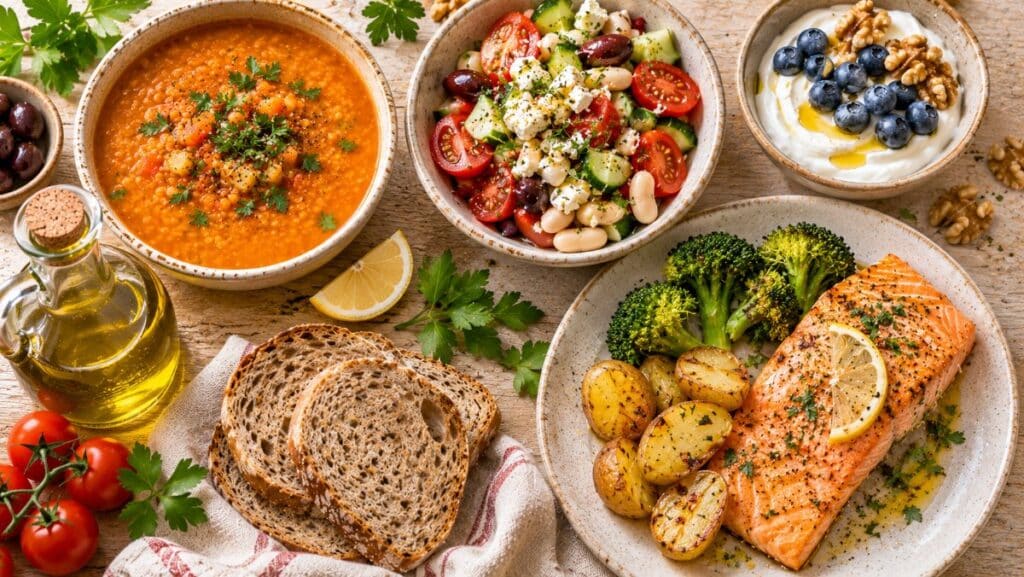
A 7-day Mediterranean meal plan at 1,800-2,000 kcal a day is a week of ordinary meals built on vegetables, fruit, lentils, chickpeas and beans, whole grains, Olivenöl, nuts, yogurt and fish twice a week. In the plan below every day comes out between 1,804 and 1,955 kcal, with 74-98 g of protein and 40-56 g of fibre, calculated from USDA FoodData Central values and weighed in grams.
Contents 10
- Is 1,800-2,000 kcal a day the right amount for you?
- How is this Mediterranean meal plan built?
- What does the 7-day Mediterranean meal plan look like?
- How many calories and how much protein are in each day?
- How do you cook the red lentil soup for days 1 and 2?
- What should you buy for the week?
- What does Ayurveda say about a Mediterranean week?
- Who should adapt this plan?
- FAQ
- Sources
This plan is for you if you want to know exactly what goes on the plate, and how much. Every ingredient has a weight, every meal has an approximate calorie figure and every day has a total. It suits many adults who want to keep their weight steady or lose it slowly, but it is a template, not a prescription. For the background on the diet itself, read our Mediterranean diet entry.
Is 1,800-2,000 kcal a day the right amount for you?
The NHS uses around 2,000 calories a day for women and around 2,500 for men as a rough guide for adults. That makes this plan close to maintenance for many women and a moderate deficit for many men. Your real need depends on your size, age and how much you move, so treat the numbers as a starting point:
- If you are hungry every afternoon, add a slice of wholemeal bread (about 80 kcal per 32 g slice) or a small handful of nuts.
- If you want less, halve the olive oil in the dinners and drop the snack bread first. A tablespoon of olive oil (13.5 g) is about 120 kcal.
- If you are very active, scale every portion up by about a quarter rather than adding extra snacks.
If you are trying to lose weight, our guide to the basal metabolic rate explains where your own number comes from.
How is this Mediterranean meal plan built?
The week follows the same few rules, so you can swap days around:
- Vegetables or fruit at every meal: between 630 g and about 1 kg a day, well above the WHO minimum of 400 g.
- Lentils, chickpeas or beans on six days out of seven.
- Wholemeal bread, oats, bulgur, brown rice or wholewheat pasta instead of white versions.
- Extra virgin olive oil as the main fat, 10-40 g a day and about 165 g over the week.
- Fish twice a week, one portion oily: Lachs on days 1 and 5, Sardinen on days 3 and 7. That meets the NHS advice of at least 2 portions of fish a week, one of them oily.
- Yogurt, eggs and a little feta, and chicken once.

What does the 7-day Mediterranean meal plan look like?
Weights are for food as it goes into the pan: dry lentils and pasta, cooked chickpeas, bulgur and rice. Day 1 and day 2 share one pot of red lentil soup (recipe below), and days 2 and 5 share one chickpea and Spinat stew, so you cook a proper meal on about five evenings.
Day 1
- Breakfast (about 614 kcal): oats 60 g, blueberries 100 g, walnuts 20 g, Greek yogurt 150 g, banana 60 g
- Lunch (about 521 kcal): red lentils (dry) 60 g, Zwiebel 60 g, Karotte 60 g, tomato paste 15 g, olive oil 10 g, lemon, juiced 20 g, wholemeal bread 60 g
- Dinner (about 572 kcal): salmon fillet 140 g, potatoes, baked 200 g, Brokkoli 150 g, olive oil 5 g
- Snack (about 180 kcal): apple 180 g, almonds 15 g
Day 2
- Breakfast (about 429 kcal): wholemeal bread 70 g, tomatoes 120 g, olive oil 10 g, eggs 100 g
- Lunch (about 440 kcal): red lentils (dry) 60 g, onion 60 g, carrot 60 g, tomato paste 15 g, olive oil 10 g, lemon, juiced 20 g, orange 150 g
- Dinner (about 624 kcal): cooked chickpeas 150 g, spinach 100 g, tomatoes 200 g, onion 50 g, olive oil 15 g, cooked bulgur 200 g
- Snack (about 350 kcal): almonds 25 g, banana 120 g, walnuts 15 g
Day 3
- Breakfast (about 513 kcal): Greek yogurt 200 g, oats 30 g, banana 120 g, walnuts 15 g
- Lunch (about 718 kcal): tomatoes 150 g, Gurke 150 g, red pepper 80 g, green olives 30 g, feta 50 g, cooked weiße Bohnen 150 g, olive oil 15 g, wholemeal bread 50 g
- Dinner (about 631 kcal): wholewheat pasta (dry) 85 g, tomatoes 200 g, Knoblauch 6 g, olive oil 10 g, sardines in oil, drained 90 g, spinach 50 g
- Snack (about 94 kcal): apple 180 g
Day 4
- Breakfast (about 468 kcal): Greek yogurt 200 g, blueberries 100 g, chia seeds 15 g, Honig 10 g, oats 30 g
- Lunch (about 456 kcal): wholemeal bread 80 g, hummus 60 g, Zucchini 100 g, red pepper 100 g, Aubergine 100 g, olive oil 5 g
- Dinner (about 605 kcal): eggs 150 g, spinach 100 g, feta 30 g, olive oil 5 g, wholemeal bread 80 g, tomatoes 150 g, cucumber 100 g
- Snack (about 275 kcal): walnuts 15 g, orange 150 g, banana 120 g
Day 5
- Breakfast (about 384 kcal): wholemeal bread 70 g, hummus 50 g, tomatoes 100 g, eggs 50 g
- Lunch (about 582 kcal): cooked chickpeas 150 g, spinach 100 g, tomatoes 200 g, onion 50 g, olive oil 15 g, cooked bulgur 150 g
- Dinner (about 605 kcal): salmon fillet 140 g, cooked brown rice 150 g, Grünkohl 100 g, olive oil 10 g, lemon, juiced 20 g
- Snack (about 254 kcal): Greek yogurt 150 g, honey 10 g, apple 150 g
Day 6
- Breakfast (about 421 kcal): eggs 100 g, tomatoes 100 g, red pepper 80 g, olive oil 10 g, wholemeal bread 60 g
- Lunch (about 586 kcal): cooked green or brown lentils 180 g, cucumber 100 g, tomatoes 100 g, olive oil 15 g, lemon, juiced 20 g, feta 30 g, wholemeal bread 50 g
- Dinner (about 612 kcal): chicken breast 150 g, potatoes, baked 250 g, courgette 150 g, carrot 100 g, olive oil 15 g
- Snack (about 209 kcal): almonds 20 g, apple 180 g
Day 7
- Breakfast (about 462 kcal): Greek yogurt 200 g, walnuts 20 g, banana 120 g, honey 10 g
- Lunch (about 736 kcal): sardines in oil, drained 90 g, tomatoes 150 g, cucumber 100 g, green olives 20 g, cooked white beans 150 g, olive oil 10 g, wholemeal bread 70 g
- Dinner (about 547 kcal): hummus 60 g, wholemeal bread 70 g, courgette 100 g, red pepper 100 g, aubergine 100 g, olive oil 5 g, cooked green or brown lentils 100 g
- Snack (about 148 kcal): orange 150 g, apple 150 g
How many calories and how much protein are in each day?
| Day | Energy (kcal) | Eiweiß | Fat | Fibre |
|---|---|---|---|---|
| Day 1 | 1888 | 91 g | 71 g | 40 g |
| Day 2 | 1843 | 74 g | 77 g | 53 g |
| Day 3 | 1955 | 94 g | 80 g | 47 g |
| Day 4 | 1804 | 86 g | 76 g | 42 g |
| Day 5 | 1825 | 93 g | 76 g | 42 g |
| Day 6 | 1828 | 98 g | 77 g | 43 g |
| Day 7 | 1893 | 96 g | 70 g | 56 g |
Source: our calculation from USDA FoodData Central, SR Legacy (main records: olive oil 171413, wholemeal bread 172688, red lentils 174284, cooked chickpeas 173757, cooked bulgur 170287, Greek yogurt 171304, farmed salmon 175167, sardines in oil 175139, eggs 171287, feta 173420, hummus 174289), checked 5 November 2026. Values are for the ingredients without added salt, rounded.
The week averages about 1,860 kcal, 90 g of protein and 46 g of fibre a day. That is close to double the 25 g of fibre a day that EFSA considers adequate for normal bowel function in adults, so if you usually eat little fibre, build up over a week or two and drink enough water. Fat gives 33-38% of the energy, most of it from olive oil, nuts and fish. That is higher than the WHO’s general limit of 30% for total fat, which is typical of Mediterranean eating, where olive oil is the base of cooking.
How do you cook the red lentil soup for days 1 and 2?
One pot gives the two lunch portions in the plan.
- 120 g dry red lentils, rinsed
- 120 g onion, chopped
- 120 g carrot, diced
- 30 g tomato paste
- 20 g olive oil
- 1 lemon
- about 900 ml water or vegetable stock, cumin, paprika, salt and pepper
- Warm the olive oil in a pot and soften the onion and carrot for 6-8 minutes.
- Stir in the tomato paste and a teaspoon of cumin for a minute.
- Add the lentils and water, bring to the boil, then simmer for about 20 minutes, until the lentils fall apart.
- Blend roughly if you like it smooth, season, and finish each bowl with the juice of half a lemon.
- Keep the second portion in the fridge for the next day.
The chickpea stew follows the same idea: onion softened in olive oil, tomatoes, cooked chickpeas and a big handful of spinach stirred in at the end, served with bulgur.
What should you buy for the week?
- Gemüse: about 1.5 kg tomatoes, 450 g cucumber, 350 g spinach, 360 g red peppers, 350 g courgettes, 200 g aubergine, 220 g onions, 220 g carrots, 150 g broccoli, 100 g kale, 450 g potatoes, a head of garlic.
- Fruit: about 840 g apples (5 medium), 540 g bananas (4-5), 450 g oranges, 200 g blueberries, 2 lemons.
- Legumes and grains: 120 g dry red lentils, 280 g cooked green lentils, 300 g cooked chickpeas, 300 g cooked white beans, 350 g cooked bulgur, 150 g cooked brown rice, 85 g dry wholewheat pasta, 120 g oats, about 660 g wholemeal bread.
- Protein and dairy: 280 g salmon, 2 tins of sardines in oil (about 90 g drained each), 8 eggs, 150 g chicken breast, 900 g Greek yogurt, 110 g feta, 170 g hummus.
- Pantry: about 170 g extra virgin olive oil for the week, walnuts, almonds, chia seeds, green olives, honey, tomato paste.
What does Ayurveda say about a Mediterranean week?
Ayurveda does not know the Mediterranean diet by name, but the two traditions meet in several places: warm, freshly cooked meals, legumes and grains every day, and spices such as cumin, garlic and black pepper to help digestion (agni). If you tend to feel cold or bloated, the tradition would favour the soups and stews here over the raw salads. This is a traditional view, not a clinical finding. Our Ayurvedic diet for beginners explains the basics.
Who should adapt this plan?
- Pregnancy and planning a pregnancy. The NHS advises no more than 2 portions of oily fish a week for girls and women who are pregnant, breastfeeding or may become pregnant. This plan has four portions of salmon or sardines, so swap two of them for white fish, beans or eggs.
- Salt and blood pressure. Feta, olives, hummus and tinned sardines carry most of the sodium here. If you have high blood pressure, rinse the olives, use less feta and keep added salt low: the WHO advises less than 5 g of salt a day.
- Diabetes or kidney disease. Ask your doctor or a registered dietitian to adjust the carbohydrate and protein.
- Allergies. Nuts, fish, eggs, milk, sesame (in hummus) and gluten (in bread, bulgur and pasta) are all in this plan. Swap them for safe foods with a similar role.
Related reading: our anti-inflammatory meal plan Und plant-based meals for weight loss.
FAQ
How many calories is a Mediterranean diet meal plan?
There is no fixed number: the Mediterranean diet is a pattern of foods, not a calorie plan. This 7-day Mediterranean meal plan comes out at about 1,800-1,950 kcal a day, which you can scale up or down by changing the oil, bread and nut portions.
Can I lose weight on a 7-day Mediterranean meal plan?
For many men and active women, about 1,860 kcal a day is a moderate deficit, so weight may come down slowly. For smaller or less active people it may be close to maintenance. Weight loss depends on your energy balance over weeks, not on one week of menus.
Is a Mediterranean meal plan high in fat?
Higher than many diet plans: in this week fat gives 33-38% of the energy, mostly from olive oil, nuts and fish. The plan stays at 1,800-1,950 kcal because the oil is measured, not poured freely.
Sources
- U.S. Department of Agriculture. FoodData Central, SR Legacy (records listed under the table). fdc.nal.usda.gov
- NHS. The Eatwell Guide. nhs.uk
- NHS. Fish and shellfish. nhs.uk
- World Health Organization, Regional Office for Europe. Nutrition for a healthy life – WHO recommendations. who.int
- EFSA Panel on Dietetic Products, Nutrition and Allergies. Scientific Opinion on Dietary Reference Values for carbohydrates and dietary fibre. EFSA Journal 2010;8(3):1462. efsa.europa.eu
This article is for information only and is not medical advice. If you have a health condition, are pregnant or take medication, talk to your doctor or pharmacist before changing your diet or starting a supplement.
Terms in this article
GurkeZucchiniKarotteMittelmeerkücheWeiße BohnenSpinatBrokkoliGrünkohlTomatenPaprikaKnoblauchZwiebelnAubergineLinsenHaferKichererbsen

 Deutsch
 English
 Español
 Français

