
← EncyclopediaEnzyklopädie der Lebensmittel
By Nikola · Precision Nutrition L1 · Updated 4 November 2026
The potato (Solanum tuberosum) is the starchy tuber of a plant from the nightshade family, the same family as Tomaten Und Pfeffer. A medium baked potato with its skin (173 g) gives about 161 kcal, 37 g of carbohydrate, 3.8 g of fibre and over 900 mg of potassium, plus vitamin C and vitamin B6, with almost no fat. Boiled and mashed potatoes have a high glycemic index, and how you cook potatoes changes a lot: frying adds fat and, like roasting, forms acrylamide, while green or sprouting potatoes can contain more natural toxins called glycoalkaloids.
Potato nutrition per 100 g and per portion
| Nährstoff | Baked, flesh and skin, 100 g | Portion: 1 medium baked (173 g) | Raw, flesh and skin, 100 g |
|---|---|---|---|
| Energie | 93 kcal | 161 kcal | 77 kcal |
| Eiweiß | 2.5 g | 4.3 g | 2.1 g |
| Fat | 0.1 g | 0.2 g | 0.1 g |
| Carbohydrate | 21.2 g | 36.7 g | 17.5 g |
| of which sugars | 1.2 g | 2.0 g | 0.8 g |
| Fibre | 2.2 g | 3.8 g | 2.1 g |
| Kalium | 535 mg | 926 mg | 425 mg |
| Vitamin C | 9.6 mg | 17 mg | 19.7 mg |
| Vitamin B6 | 0.31 mg | 0.54 mg | 0.30 mg |
| Magnesium | 28 mg | 48 mg | 23 mg |
| Eisen | 1.1 mg | 1.9 mg | 0.8 mg |
| Folat | 28 µg | 48 µg | 15 µg |
| Natrium | 10 mg | 17 mg | 6 mg |
Source: USDA FoodData Central, SR Legacy: “Potatoes, baked, flesh and skin, without salt” (FDC 170093) and “Potatoes, flesh and skin, raw” (FDC 170026), checked 4 November 2026. The portion column is calculated from the baked record’s measure “potato medium” = 173 g. Values rounded.
Plain potatoes are low in fat and sodium. Most of the calories in typical potato dishes come from butter, cream, cheese or frying oil.
Glycemic index
The international GI tables (Atkinson 2008, glucose = 100) give these values for potato:
- Boiled potato: 78 ± 4
- Instant mashed potato: 87 ± 3
- French fries: 63 ± 5
- Potato crisps: 56 ± 3
Boiled and mashed potatoes are high-GI foods, close to white rice (73 ± 4) in the same tables. Fries and crisps score lower, but that does not make them the better choice: they bring far more fat and salt and contain acrylamide. For comparison, boiled Süßkartoffel is 63 ± 6. Pair potatoes with protein and vegetables. More in What is the glycemic index.
Health benefits: what the evidence says
- Potassium. Potatoes are one of the richest everyday sources. NIH lists one medium baked potato, flesh only, at 610 mg, and by the USDA record above a medium potato baked with its skin has about 926 mg. The NIH adequate intake is 3,400 mg a day for men and 2,600 mg for women. NIH also notes that the DASH eating pattern, rich in fruit and vegetables, lowered blood pressure in trials, though the effect of potassium alone is harder to separate.
- Vitamin C. NIH lists a medium baked potato at about 17 mg of vitamin C. Vitamin C is sensitive to heat and water, so long boiling of peeled, cut potatoes loses more than baking or steaming them in their skins.
- Vitamin B6 and fibre. A medium baked potato gives about 0.54 mg of vitamin B6 and 3.8 g of fibre, more when you eat the skin. EFSA considers 25 g of fibre a day adequate for normal bowel function in adults.
Ayurveda: potato in the traditional system
Potatoes came from South America and are not described in the classical Ayurvedic texts. In Usha and Vasant Lad’s food guidelines the white potato is favourable for Pitta and Kapha and on the list to avoid for Vata, the reverse of Süßkartoffel. This is a traditional view, not a clinical finding. More in Ayurvedic diet for beginners.
How to eat potatoes
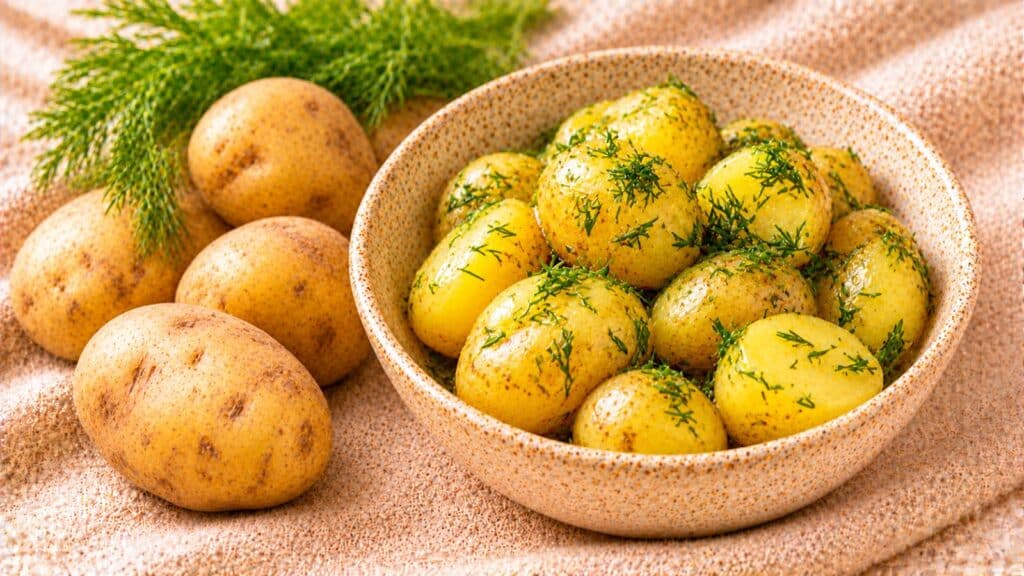
- Boiled or steamed: cook small or new potatoes whole in their skins until a knife slides in, then dress with Olivenöl, Dill and a little salt. Boiling and steaming do not form acrylamide.
- Baked: scrub, prick and bake at about 200 °C for 45-60 minutes. Top with Greek yogurt and herbs instead of butter and cheese.
- Roasted and fried, lightly: EFSA cites the advice some countries give: “don’t burn it, lightly brown it”. Aim for golden rather than dark brown, and vary cooking methods instead of frying or roasting every time.
- In soups and stews: mit Zwiebeln, Möhren, Lauch oder Grünkohl; potato also thickens a vegetable soup without cream.
- Storage: the BfR recommends a cool, dark, dry place. According to EFSA, storing potatoes below 8 °C can raise their sugar content, which may increase acrylamide when they are later fried or roasted.
Who should be careful
- Green and sprouted potatoes (glycoalkaloids). Potatoes naturally contain glycoalkaloids, mainly α-solanine and α-chaconine. In 2020 EFSA set a lowest observed adverse effect level of 1 mg per kg body weight per day, with acute symptoms such as nausea, vomiting and diarrhoea; it found a health concern for infants and toddlers and for high-consuming adults. Peeling reduces glycoalkaloids by 25-75%, boiling by 5-65% and frying by 20-90%. Germany’s BfR advises cutting away green parts and “eyes” generously, not eating potatoes or dishes that taste bitter, not reusing the cooking water, eating the skin only from fresh, undamaged potatoes, and giving small children peeled potatoes.
- Acrylamide. Acrylamide forms in starchy foods cooked above 120 °C with little moisture. EFSA names fried potato products among the largest sources for adults and up to half of children’s exposure, and concluded that acrylamide in food potentially increases cancer risk for consumers of all ages, based mainly on animal studies; human studies have been limited and inconsistent.
- Kidney disease. NIH notes that people with chronic kidney disease or who take drugs that reduce potassium excretion can develop high blood potassium even from food. On a potassium-restricted diet, follow your care team’s advice.
- Diabetes. Boiled and mashed potatoes have a high GI: keep portions moderate and pair them with protein and vegetables.
Related entries and articles
- Süßkartoffel – lower GI and much more beta-carotene
- Brown rice Und quinoa – other starchy sides
- Zwiebeln Und Lauch – for potato soups
- DASH-Diät
- What is the glycemic index? (with food table)
- DASH-Diät
FAQ
Are potatoes healthy or fattening?
Plain potatoes are not fattening in themselves: a medium baked potato has about 161 kcal, almost no fat and plenty of potassium. What changes the picture is the cooking method and toppings, such as frying oil, butter, cream and cheese. Boiled, baked or steamed potatoes in a sensible portion fit into a balanced diet.
Is it safe to eat green potatoes?
Glycoalkaloids concentrate in sprouts and buds, and the German BfR advises cutting green parts and eyes away generously and not eating a potato dish that tastes bitter. If a potato is very green or heavily sprouted, it is better thrown away.
Should you eat potato skin?
The skin of fresh, undamaged potatoes is edible and adds a little fibre. Glycoalkaloids are higher in unpeeled potatoes, though, so the BfR recommends eating skin only from fresh, undamaged potatoes, advises against potato peel snacks and suggests peeled potatoes for small children.
Sources
- USDA FoodData Central, SR Legacy: Potatoes, baked, flesh and skin, without salt (FDC 170093). fdc.nal.usda.gov
- USDA FoodData Central, SR Legacy: Potatoes, flesh and skin, raw (FDC 170026). fdc.nal.usda.gov
- Atkinson FS, Foster-Powell K, Brand-Miller JC. International Tables of Glycemic Index and Glycemic Load Values: 2008. Diabetes Care 2008;31(12):2281-2283. PMC
- NIH Office of Dietary Supplements: Potassium, Fact Sheet for Health Professionals. ods.od.nih.gov
- NIH Office of Dietary Supplements: Vitamin C, Fact Sheet for Health Professionals. ods.od.nih.gov
- EFSA (2020). Glycoalkaloids in potatoes: public health risks assessed. efsa.europa.eu
- Commission Recommendation (EU) 2022/561 on monitoring the presence of glycoalkaloids in potatoes and potato-derived products. EUR-Lex
- German Federal Institute for Risk Assessment (BfR): Frequently asked questions about solanine (glycoalkaloids) in potatoes. bfr.bund.de
- EFSA: Acrylamide (topic page). efsa.europa.eu
- US FDA: Acrylamide Questions and Answers. fda.gov
- EFSA NDA Panel (2010). Scientific Opinion on Dietary Reference Values for carbohydrates and dietary fibre. EFSA Journal 8(3):1462. efsa.europa.eu
- Lad U, Lad V. Food Guidelines for Basic Constitutional Types, from Ayurvedic Cooking for Self-Healing, 2nd ed. The Ayurvedic Institute. ayurveda.com
This page is for information only and is not medical or dietary advice.
 Deutsch
 English
 Español
 Français

