
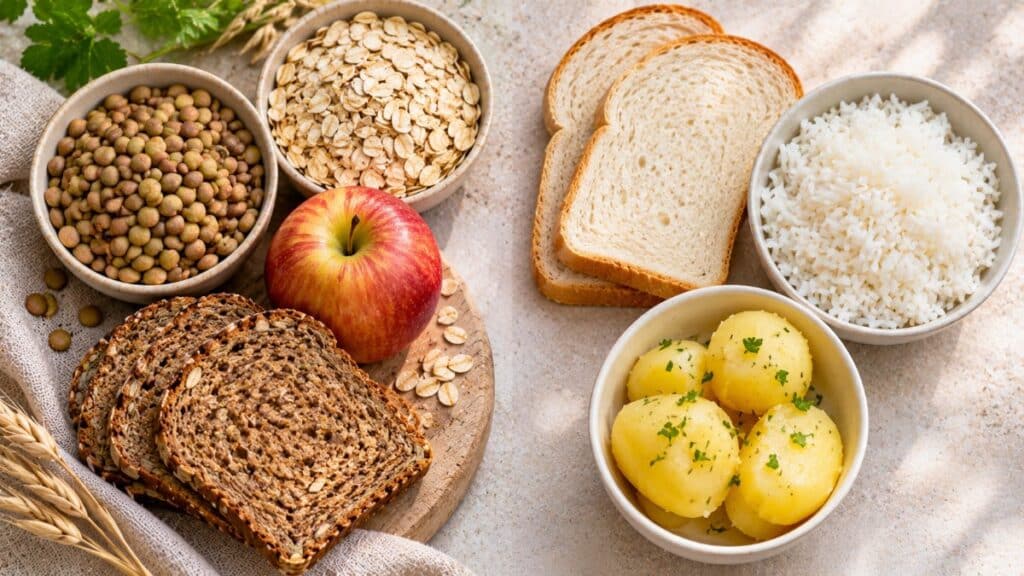
The glycemic index (GI) ranks carbohydrate foods by how much they raise blood sugar compared with pure glucose, which is set at 100. A GI of 55 or less is low, 56 to 69 is medium and 70 or more is high: lentils (about 32) and apples (about 36) are low GI foods, while boiled potatoes (about 78) and white bread (about 75) are high. GI describes carbohydrate quality, not quantity, so it works best alongside portion size and glycemic load.
Below: what the glycemic index means, a glycemic index chart of 34 everyday foods from the international GI tables, what changes GI in your kitchen, its honest limits, and swaps that work.
What is the glycemic index?
When you eat bread, rice or fruit, glucose enters your blood. Some foods release it fast, giving a sharp spike; others slowly, giving a flatter curve. The glycemic index puts a number on that difference.
How is GI measured?
According to the University of Sydney GI Group, which maintains the international GI database, a food is tested in at least 10 healthy people. Each person eats a portion containing 50 grams of digestible carbohydrate, and their blood glucose is followed for two hours. The area under that curve is compared with the response to 50 grams of pure glucose. If a food produces 40 percent of glucose’s response, its GI is 40.
Foods with little or no carbohydrate, such as meat, fish, eggs and oils, have no meaningful GI.
What counts as a low, medium or high glycemic index?
- Low GI: 55 or less
- Medium GI: 56 to 69
- High GI: 70 or more
These cutoffs, used by Harvard’s Nutrition Source and Harvard Health, are handy labels, not sharp borders: 56 is not meaningfully worse than 54.
Glycemic index chart: GI values of 34 common foods
All values below come from Table 1 of the international GI tables (Atkinson and colleagues, Diabetes Care, 2008), glucose = 100 scale. They average studies from different laboratories, so a single brand or variety can differ.
| Food | GI (glucose = 100) | Category |
|---|---|---|
| White wheat bread | 75 | High |
| Whole wheat bread | 74 | High |
| Specialty grain bread | 53 | Low |
| Chapatti | 52 | Low |
| White rice, boiled | 73 | High |
| Brown rice, boiled | 68 | Medium |
| Gerste | 28 | Low |
| Spaghetti, white | 49 | Low |
| Spaghetti, wholemeal | 48 | Low |
| Couscous | 65 | Medium |
| Sweet corn | 52 | Low |
| Cornflakes | 81 | High |
| Rolled oat porridge | 55 | Low |
| Instant oat porridge | 79 | High |
| Muesli | 57 | Medium |
| Apple, raw | 36 | Low |
| Orange, raw | 43 | Low |
| Banana, raw | 51 | Low |
| Mango | 51 | Low |
| Dates, raw | 42 | Low |
| Pineapple | 59 | Medium |
| Watermelon, raw | 76 | High |
| Potato, boiled | 78 | High |
| Potato, instant mash | 87 | High |
| Potato, french fries | 63 | Medium |
| Süßkartoffel, boiled | 63 | Medium |
| Möhren, boiled | 39 | Low |
| Linsen | 32 | Low |
| Kidney Bohnen | 24 | Low |
| Kichererbsen | 28 | Low |
| Full-fat milk | 39 | Low |
| Fruit yogurt | 41 | Low |
| Honey | 61 | Medium |
| Sucrose (table sugar) | 65 | Medium |
Source: Atkinson FS, Foster-Powell K, Brand-Miller JC. International Tables of Glycemic Index and Glycemic Load Values: 2008. Diabetes Care 2008;31(12):2281-2283, Table 1 (mean values, glucose scale).
A few things jump out. Whole wheat bread (74) is barely lower than white (75), because both are made from finely milled flour. Pasta made from the same wheat sits much lower (49). Legumes are the steadiest group of all. A ripe banana lands in the low range, and cooked carrots (39) are nowhere near the “high sugar” reputation they sometimes get. A 2021 update of the same tables lists more than 4,000 items, 61 percent more than the 2008 edition, and added foods such as whole Tomaten with a GI of just 22.
What is glycemic load, and why does it matter?
GI is always measured with the same 50 grams of carbohydrate, so it tells you nothing about how much carbohydrate is in the portion you actually eat. Glycemic load (GL) fixes that: GL = GI x grams of available carbohydrate in a portion, divided by 100. Harvard’s Nutrition Source classes a GL of 10 or less as low, 11 to 19 as medium and 20 or more as high.
Watermelon is the classic example. Its GI is high (76 in the international tables; Harvard Health uses 80 in its example), but a serving contains so little carbohydrate that Harvard Health puts its glycemic load at only 5. A big plate of white rice is the opposite: high GI and high GL.
Which foods have a low glycemic index?
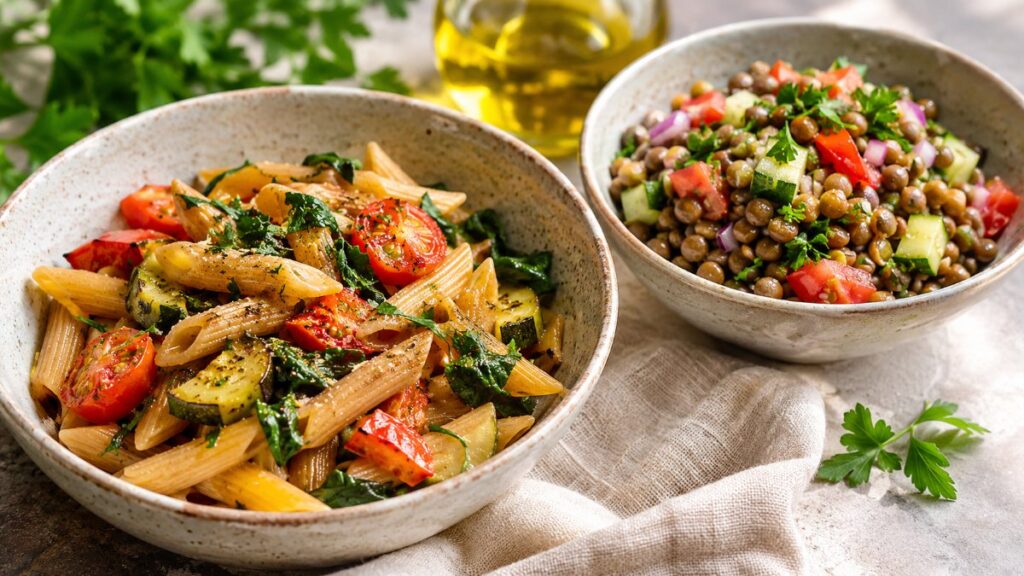
Based on the table above, these are the most reliable low glycemic foods to build meals around:
- Hülsenfrüchte: lentils, chickpeas, kidney beans and soya beans
- Intact or coarse grains: barley, rolled oats, pasta cooked al dente
- Low GI fruits: apples, oranges, dates, bananas and mango
- Dairy and alternatives: plain or fruit yogurt, milk, soy milk
Low GI rice and bread: the 2008 tables note that low-GI varieties were also identified for both white bread and white rice, so variety and processing matter. In practice, a dense specialty grain bread (53) or chapatti (52) is a lower-GI choice than a soft white loaf.
What changes the glycemic index of a food?
The same food can have a different GI depending on how it is grown, processed and cooked. The University of Sydney GI Group and Harvard’s Nutrition Source describe these factors:
- Processing and milling. Finely ground flour gives digestive enzymes easy access to starch. Whole and coarsely milled grains digest more slowly.
- Ripeness. Riper fruit tends to have a higher GI than less ripe fruit.
- Cooking time. Pasta has a low GI because its protein network traps starch granules. Cook it al dente; overcooking raises the GI.
- Cooling. Cold storage increased the resistant starch in cooked potatoes by more than a third in research cited by the GI Group.
- Fat, protein and acid. All three slow stomach emptying. A vinaigrette with lemon juice or vinegar, or protein on the plate, lowers the glycemic effect of the meal.
- Starch type and variety. Different rice, potato and oat varieties contain different ratios of amylose and amylopectin, which changes how easily the starch gelatinises.
What are the limits of the glycemic index?
GI is a tool, not a verdict on a food:
- Low GI is not the same as healthy. The categories were not designed around nutrient density. In the same tables, chocolate (40), ice cream (51) and potato crisps (56) score lower than boiled potatoes (78), mostly because of their fat.
- Portion size wins. A large serving of a low-GI food can still produce a big blood sugar rise. Harvard Health notes that total carbohydrate predicts blood sugar more strongly than GI.
- People vary. Glycemic responses differ between people and within the same person from day to day, and reported GI values for similar foods can differ between studies.
- The evidence for weight and disease is mixed. A 2018 review in Nutrients called the relationship between GI and disease outcomes equivocal, and Harvard describes the link with body weight as controversial.
What does Ayurveda say about blood sugar and sweet foods?
Ayurveda has no glycemic index, but in the traditional view the sweet taste (madhura rasa) is heavy, moist and grounding. In moderation it nourishes; in excess it is said to increase Kapha and dampen agni, the digestive fire. Classical texts describing prameha, a group of urinary and metabolic disorders, often recommend old grains, barley (yava), lentils and bitter vegetables, and advise against heavy, sweet, freshly harvested grains and daytime sleep.
Ayurveda also prefers the largest meal at midday, when agni is believed to be strongest, and pairs sweet foods with warming spices such as Ingwer, cinnamon or Kurkuma, as in our golden milk recipe. It is a curious overlap that barley and lentils also sit among the lowest GI values in the modern tables. That overlap is interesting, not proof: the Ayurvedic advice comes from tradition and observation, not from glucose testing.
How do you use the glycemic index in everyday meals?
You do not need to memorise numbers. Use GI for a few better default choices and let portion and the rest of the plate do the rest. One ordinary day:
- Frühstück: swap instant oats (79) or cornflakes (81) for rolled oat porridge (55), cooked in milk and topped with an apple.
- Mittagessen: instead of a big bowl of white rice, serve half the rice with a portion of lentils or chickpeas, a large salad and a lemon and olive oil dressing.
- Snack: an orange or a few dates with a small handful of nuts rather than rice crackers or a soft drink. For more ideas, see foods for energy without caffeine.
- Abendessen: boiled potatoes cooled and served as a potato salad with a vinegar dressing, or pasta cooked al dente with weiße Bohnen and vegetables. Our guide on how to cook white beans makes the beans easy.
- Dessert: keep sweet things small and eat them after a meal, not on an empty stomach. Our healthy desserts without sugar show how.
Are low GI foods good for diabetics, and who should be careful?
- People with diabetes. Low GI foods can be a helpful part of a diabetes eating plan, but the total amount of carbohydrate matters most. If you use insulin or medicines that lower blood sugar, changing your carbohydrate intake can change your doses; plan it with your diabetes team.
- People on very low carbohydrate diets. GI matters less when carbohydrate intake is already very low; see our article on low carb diets, risks and benefits before mixing the two approaches.
- Anyone tempted to cut out fruit. Most whole fruits in the table are low GI. Fruit juice, sweets and refined snacks are the better targets.
- Children and anyone with a history of disordered eating. Rigid number-based food rules rarely help; regular, balanced meals do.
FAQ
Is a banana a high glycemic food?
No. In the international tables a raw banana averages a GI of 51, which is low. Riper bananas tend to score higher than greener ones, and the portion still counts.
Is brown rice low GI?
Not quite. Boiled brown rice averages 68, which is medium, compared with 73 for boiled white rice. The variety of rice, and serving it with legumes and vegetables, makes a bigger difference.
Is honey better than sugar for blood sugar?
Only slightly in theory: honey averages a GI of 61 and table sugar 65 in the 2008 tables. Both are sugars, so the amount you use matters far more than which one you choose.
Does a low GI diet help with weight loss?
The evidence is mixed. Low GI eating patterns are usually rich in legumes, whole grains and fibre, which helps meals feel filling, but reviews have not shown that GI alone drives weight loss.
Sources
- Atkinson FS, Foster-Powell K, Brand-Miller JC. International Tables of Glycemic Index and Glycemic Load Values: 2008. Diabetes Care, 2008;31(12):2281-2283. PMC2584181
- Atkinson FS, Brand-Miller JC, Foster-Powell K, Buyken AE, Goletzke J. International tables of glycemic index and glycemic load values 2021: a systematic review. American Journal of Clinical Nutrition, 2021;114(5):1625-1632. American Society for Nutrition summary
- Harvard T.H. Chan School of Public Health, The Nutrition Source. Carbohydrates and Blood Sugar. Updated 2025. nutritionsource.hsph.harvard.edu
- Harvard Health Publishing. The lowdown on glycemic index and glycemic load. 2023. health.harvard.edu
- University of Sydney GI Group. About GI and GI FAQs. glycemicindex.com. About GI, GI FAQs
- Vega-López S, Venn BJ, Slavin JL. Relevance of the Glycemic Index and Glycemic Load for Body Weight, Diabetes, and Cardiovascular Disease. Nutrients, 2018;10(10):1361. mdpi.com
This article is for information only and is not medical advice. If you have a health condition, are pregnant or take medication, talk to your doctor or pharmacist before changing your diet or starting a supplement.


 Deutsch
 English
 Español
 Français

