
← EncyclopediaEnzyklopädie der Lebensmittel
By Nikola · Precision Nutrition L1 · Updated 4 November 2026
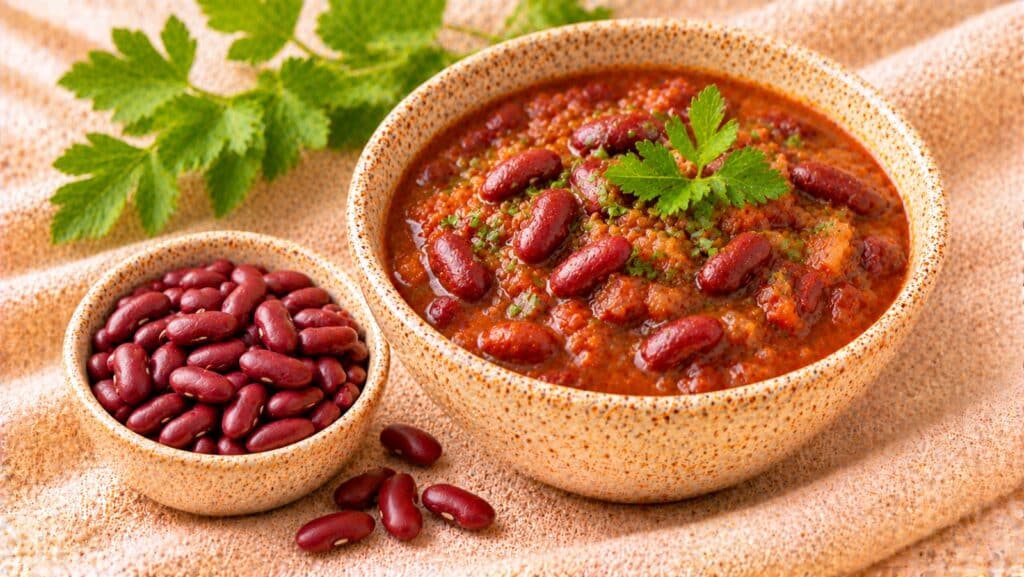
Red kidney beans are a variety of the common bean (Phaseolus vulgaris), named for their shape and known from chilli, bean salads and rice-and-beans dishes. Per 100 g cooked they give 127 kcal, 8.7 g of protein, 7.4 g of fibre and 130 µg of folate, with almost no fat, and their glycemic index of 24 is one of the lowest in the international tables. There is one rule you must not skip: dried kidney beans contain a natural toxin, phytohaemagglutinin, and must be soaked and boiled hard for at least 10 minutes. Undercooked beans can cause severe vomiting within hours, while tinned beans are already cooked.
Kidney bean nutrition per 100 g and per portion
| Nährstoff | Cooked, 100 g | Portion: 1 cup cooked (177 g) | Dry, 100 g |
|---|---|---|---|
| Energie | 127 kcal | 225 kcal | 337 kcal |
| Eiweiß | 8.7 g | 15.3 g | 22.5 g |
| Fat | 0.5 g | 0.9 g | 1.1 g |
| Carbohydrate | 22.8 g | 40.4 g | 61.3 g |
| of which fibre | 7.4 g | 13.1 g | 15.2 g |
| of which sugars | 0.3 g | 0.6 g | 2.1 g |
| Folat | 130 µg | 230 µg | 394 µg |
| Kalium | 403 mg | 713 mg | 1360 mg |
| Eisen | 2.9 mg | 5.2 mg | 6.7 mg |
| Magnesium | 45 mg | 80 mg | 138 mg |
| Phosphor | 142 mg | 251 mg | 406 mg |
| Zink | 1.07 mg | 1.9 mg | 2.8 mg |
Source: USDA FoodData Central, SR Legacy: “Beans, kidney, red, mature seeds, cooked, boiled, without salt” (FDC 175194) and “Beans, kidney, red, mature seeds, raw” (FDC 173744), checked 4 November 2026. The cup weight is from the USDA record; the portion column is calculated from the cooked values. Cooked values are without salt. Values rounded.
Going by energy, 100 g of dry kidney beans gives roughly 265 g cooked, so 60-80 g dry per person is a typical main-dish portion.
Glycemic index
Kidney beans have a glycemic index of 24 ± 4 in the international GI tables (glucose = 100), lower than lentils (32 ± 5) and chickpeas (28 ± 9) in the same tables, and far below boiled white rice (73 ± 4). Adding beans to a rice or bread meal, as in chilli with rice or a bean salad with bread, is a practical way to make the whole meal gentler on blood sugar. EFSA notes that the evidence for low-GI diets preventing disease is still inconclusive, so the fibre and protein in beans are the bigger story.
Health benefits: what the evidence says
- Fibre. One cup of cooked kidney beans gives about 13 g of fibre, more than half of the 25 g a day EFSA considers adequate for normal bowel function in adults.
- LDL cholesterol. In a meta-analysis of 26 randomised controlled trials (Ha et al., CMAJ 2014), diets including about one serving of pulses a day (median 130 g) lowered LDL cholesterol by an average of 0.17 mmol/L compared with control diets. The result applies to pulses as a group, not to kidney beans specifically.
- Folate. The NIH Office of Dietary Supplements names kidney beans among natural folate sources; a cup of cooked beans provides about 230 µg. Women who could become pregnant are still advised to take 400 µg of folic acid daily in addition to food folate.
- Iron and potassium. A cup gives 5.2 mg of iron and over 700 mg of potassium. NIH ODS also lists kidney beans as an iron source, noting that plant (non-heme) iron is absorbed less well than iron from meat and that vitamin C foods such as Pfeffer, Tomaten or citrus improve absorption.
- Plant protein. 15 g of protein per cup with less than 1 g of fat makes kidney beans a solid base for meat-free meals. Combined with grains over the day, they help cover your protein needs.
Ayurveda: kidney beans in the traditional system
In Usha and Vasant Lad’s food guidelines, kidney beans are favourable for Pitta and on the avoid list for Vata and Kapha. If you want legumes that the same guidelines rate well for all three types, mung beans are the usual choice. This is a traditional view, not a clinical finding.
How to prepare and use kidney beans
- Soak: cover dried beans with plenty of cold water and soak for at least 12 hours (the Hong Kong Centre for Food Safety guidance; an older FDA document cites at least 5 hours). Drain and rinse.
- Boil hard: cover with fresh water, bring to a full, rolling boil and keep it boiling for at least 10 minutes. Then lower the heat and simmer until completely soft, usually 45-60 minutes or more depending on the age of the beans.
- Slow cooker: only add kidney beans to a slow cooker after they have been boiled hard for 10 minutes. Low-temperature cooking alone does not reliably destroy the toxin.
- Tinned beans: already cooked and safe to eat without further cooking. Rinse them to remove some of the salty liquid.
- Ideas: vegetarian chilli with Tomaten, Zwiebeln Und Pfeffer; a bean salad with rote Zwiebel, Petersilie Und Olivenöl; rice and beans with brown rice; or a bean and vegetable soup.
Who should be careful
- Everyone, with raw or undercooked beans. According to the FDA’s Bad Bug Book chapter on phytohaemagglutinin, raw kidney beans contain 20,000-70,000 haemagglutinating units of the lectin, fully cooked beans 200-400. As few as four or five raw beans can cause symptoms. Nausea and severe vomiting start 1-3 hours after eating, followed by diarrhoea and sometimes abdominal pain; recovery is usually quick, within 3-4 hours of onset. The same document warns that heating beans to only about 80°C can increase toxicity up to five-fold, and that casseroles in slow cookers often stayed below 75°C. White kidney beans contain about a third as much toxin as red ones.
- Digestive comfort. If you are not used to legumes, start with smaller portions and increase slowly.
- Kidney disease. Beans are rich in potassium and phosphorus. If you have been told to limit these, ask your doctor or dietitian how beans fit your plan.
Related entries and articles
- weiße Bohnen
- Kichererbsen Und lentils
- Mung beans – a quicker-cooking legume
- Brown rice – for rice and beans
- Plant-based meals for weight loss
- DASH-Diät
FAQ
Are raw kidney beans poisonous?
Yes. Raw and undercooked red kidney beans contain phytohaemagglutinin, a lectin that can cause severe vomiting and diarrhoea within 1-3 hours; as few as four or five raw beans can be enough. Soaking and then boiling hard for at least 10 minutes makes them safe.
Can I cook dried kidney beans in a slow cooker?
Only after boiling them hard for at least 10 minutes on the stove. Slow cookers may not get the beans hot enough to destroy the toxin, and the FDA notes that heating to around 80°C can make beans more toxic than raw.
Are tinned kidney beans safe to eat without cooking?
They are already cooked, so they are safe straight from the tin and save you the soaking and boiling. Tinned beans often contain added salt, so check the label, drain and rinse them, or choose a no-added-salt version.
Sources
- USDA FoodData Central, SR Legacy: Beans, kidney, red, mature seeds, cooked, boiled, without salt (FDC 175194). fdc.nal.usda.gov
- USDA FoodData Central, SR Legacy: Beans, kidney, red, mature seeds, raw (FDC 173744). fdc.nal.usda.gov
- Atkinson FS, Foster-Powell K, Brand-Miller JC. International Tables of Glycemic Index and Glycemic Load Values: 2008. Diabetes Care 2008;31(12):2281-2283. PMC
- U.S. FDA, Bad Bug Book: Phytohaemagglutinin (kidney bean lectin), archived FDA/CFSAN page. FDA (archived)
- Centre for Food Safety, Hong Kong. Phytohaemagglutinin Poisoning. Food Safety Bulletin, issue 97, June 2024. cfs.gov.hk
- EFSA NDA Panel (2010). Scientific Opinion on Dietary Reference Values for carbohydrates and dietary fibre. EFSA Journal 8(3):1462. efsa.europa.eu
- Ha V et al. Effect of dietary pulse intake on established therapeutic lipid targets for cardiovascular risk reduction. CMAJ 2014;186(8):E252-262. PubMed
- NIH Office of Dietary Supplements: Folate – Fact Sheet for Consumers. ods.od.nih.gov
- NIH Office of Dietary Supplements: Iron – Fact Sheet for Consumers. ods.od.nih.gov
- Lad U, Lad V. Food Guidelines for Basic Constitutional Types, from Ayurvedic Cooking for Self-Healing, 2nd ed. The Ayurvedic Institute. ayurveda.com
This page is for information only and is not medical or dietary advice.
Enzyklopädie der Lebensmittel
Weiße Bohnen Kichererbsen Linsen Mung beans Brown rice Brown rice Mung beans
 Deutsch
 English
 Español
 Français

