
← EncyclopediaEnzyklopädie der Lebensmittel
By Nikola · Precision Nutrition L1 · Updated 5 November 2026
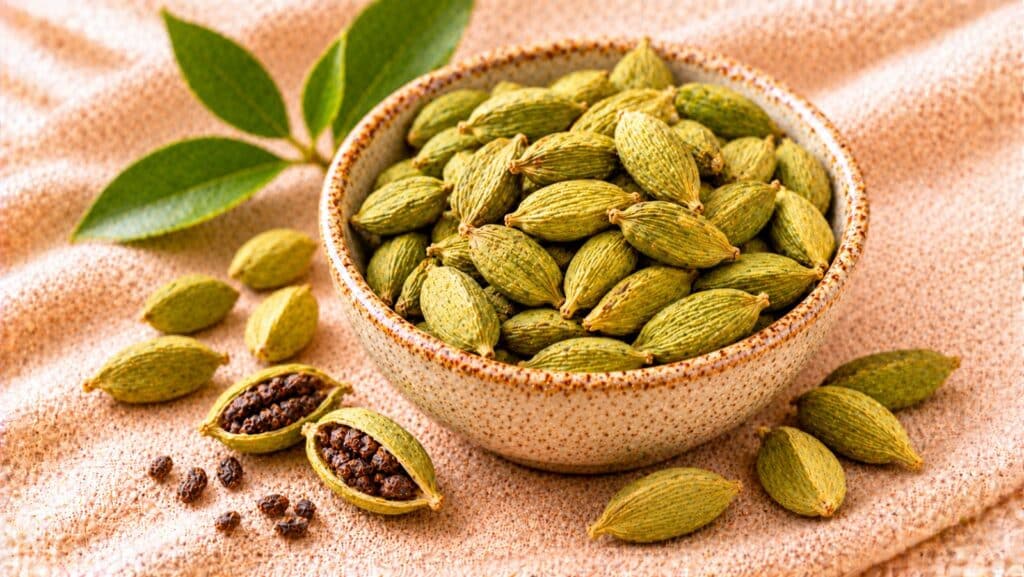
Cardamom is the aromatic seed pod of Elettaria cardamomum, a plant of the Ingwer family, with a sweet, floral and slightly citrusy flavour. Green cardamom is the one used in chai, Arabic coffee, rice dishes and Nordic sweet buns. A teaspoon of ground cardamom weighs about 2 g and gives about 0.56 mg of manganese, a real share of the daily need. Small trials suggest cardamom may lower blood pressure and some markers of inflammation, but the evidence is still limited.
Cardamom nutrition per 100 g and per teaspoon
| Nährstoff | Per 100 g (ground) | Per teaspoon, ground (2 g) |
|---|---|---|
| Energie | 311 kcal | 6 kcal |
| Eiweiß | 10.8 g | 0.2 g |
| Fat | 6.7 g | 0.1 g |
| Carbohydrate | 68.5 g | 1.4 g |
| of which fibre | 28.0 g | 0.6 g |
| Manganese | 28.0 mg | 0.56 mg |
| Eisen | 14.0 mg | 0.3 mg |
| Kalzium | 383 mg | 8 mg |
| Magnesium | 229 mg | 4.6 mg |
| Kalium | 1120 mg | 22 mg |
| Zink | 7.5 mg | 0.15 mg |
| Vitamin C | 21 mg | 0.4 mg |
Source: USDA FoodData Central, SR Legacy, “Spices, cardamom” (FDC 170919), checked 5 November 2026. Portions from the same record: 1 teaspoon ground = 2 g, 1 tablespoon = 5.8 g. The record gives no value for sugars. Values rounded.
Recipes rarely use more than a teaspoon of cardamom for a whole cake or a pot of rice, and a cup of chai gets one or two crushed pods. So calories, protein and fibre from cardamom are negligible. Manganese is the exception: a teaspoon has about 0.56 mg, compared with an adequate intake of 1.8 mg a day for women and 2.3 mg for men (NIH Office of Dietary Supplements). Per gram, cardamom has more manganese than cinnamon oder black pepper, but in a normal diet most manganese still comes from everyday foods such as whole grains, nuts and legumes.
Glycemic index
Cardamom is not listed in the international GI tables (Atkinson 2008). A teaspoon contains about 1.4 g of carbohydrate, almost half of it fibre, so cardamom itself has no meaningful effect on blood sugar. The sugar in a sweet bun or a sweetened chai is another matter.
Health benefits: what the evidence says
- Blood pressure and inflammation: promising but limited. A 2023 systematic review and meta-analysis of eight randomised clinical trials in adults found that cardamom was associated with lower systolic and diastolic blood pressure and with lower levels of several markers of inflammation. The authors stress that the number of studies is small and that the results should be interpreted with caution (Heydarian et al., 2023).
- Manganese. Regular use adds a useful amount of manganese, as shown above.
- Sweetness without extra sugar. The floral aroma of cardamom makes porridge, yogurt, fruit and coffee taste sweeter, which can help you cut back on added sugar. This is a kitchen effect, not a medical one.
- What is not proven. Claims that cardamom “detoxes”, cures bad breath for good or treats digestive disease are not supported by the sources reviewed for this entry.
How to eat it
- Buy pods, not powder. The seeds inside the pod lose aroma quickly once ground. Crush a pod with the flat of a knife, take out the small black seeds and grind them in a mortar right before use.
- In drinks. Add one or two crushed pods to black tea with milk, Ingwer Und cinnamon for a simple chai, or to the coffee pot for Arabic-style coffee. Also good in hot chocolate made with cocoa.
- Breakfast. A pinch of ground cardamom in oat porridge, rice pudding or Greek yogurt with pears or apples.
- Savoury. Whole pods go into pilaf, biryani, lentil dal and meat curries; take them out before serving, as the husk is fibrous.
- Baking. Cardamom is the key spice of Swedish and Finnish sweet buns and works in apple cakes, cookies and Christmas baking together with cinnamon and cloves.
- Green or black. Black cardamom comes from a related plant (Amomum species), has larger, dark pods and a smoky taste, and is used in savoury dishes only. Recipes that say “cardamom” mean green.
- Storage. Keep pods in a closed jar, away from light and heat. Whole pods keep their aroma far longer than ground cardamom.
Who should be careful
- Supplements and blood pressure medicines. Capsules and extracts can deliver far more than you would use in cooking. If you take medicine for high blood pressure or another chronic condition, talk to your doctor before using cardamom capsules or extracts.
- Whole pods in food. Remove whole pods from rice and stews before serving, especially for children; biting into one is unpleasant and the husk is hard to chew.
- Food safety. As with all dried spices, buy from reliable brands and keep containers closed and dry. FDA does not advise people to change how they use spices.
- Allergy. If you have ever reacted to cardamom or to a spice blend that contains it, avoid it and check labels on chai mixes and baked goods.
Traditional view (Ayurveda)
In Usha and Vasant Lad’s food guidelines cardamom is listed as good for Vata and Kapha and suitable in moderation for Pitta. This is a traditional view, not a clinical finding.
Related entries and articles
- Cinnamon and cloves – the classic warm spice blend for baking and chai
- Ingwer – a relative from the same plant family
- Black pepper Und cumin
- Hafer – a gentle base for cardamom at breakfast
- Ginger tea
- Foods for energy without caffeine
FAQ
What is the difference between green and black cardamom?
Green cardamom (Elettaria cardamomum) has small, pale green pods and a sweet, floral flavour used in drinks, baking and rice. Black cardamom comes from related Amomum plants, has large dark pods and a smoky, camphor-like taste suited to savoury stews. They cannot replace each other in most recipes.
Does cardamom lower blood pressure?
Possibly, but the evidence is thin. A meta-analysis of eight small trials found lower blood pressure with cardamom, and the authors advise caution in reading the results. Cardamom is not a substitute for blood pressure medication.
Can you eat cardamom pods whole?
You can, but most people do not enjoy it: the husk is fibrous and the flavour is very intense. It is better to crush the pods, use the seeds, and remove whole pods from food before serving.
Sources
- USDA FoodData Central, SR Legacy: Spices, cardamom (FDC 170919). fdc.nal.usda.gov
- Heydarian A, Tahvilian N, Shahinfar H, Abbas-Hashemi S, Daryabeygi-Khotbehsara R, Aryaeian N. Effect of cardamom consumption on inflammation and blood pressure in adults: a systematic review and meta-analysis of randomized clinical trials. Food Science & Nutrition. 2023;12(1):3-12. doaj.org
- NIH Office of Dietary Supplements: Manganese, Fact Sheet for Health Professionals. ods.od.nih.gov
- US Food and Drug Administration: Questions and Answers on Improving the Safety of Spices. fda.gov
- Atkinson FS, Foster-Powell K, Brand-Miller JC. International tables of glycemic index and glycemic load values: 2008. Diabetes Care. 2008;31(12):2281-2283. pmc.ncbi.nlm.nih.gov
- Lad U, Lad V. Food Guidelines for Basic Constitutional Types, from Ayurvedic Cooking for Self-Healing, 2nd ed. The Ayurvedic Institute. ayurveda.com
This page is for information only and is not medical or dietary advice.
 Deutsch
 English
 Español
 Français

