
← EncyclopediaEnzyklopädie der Lebensmittel
By Nikola · Precision Nutrition L1 · Updated 5 November 2026
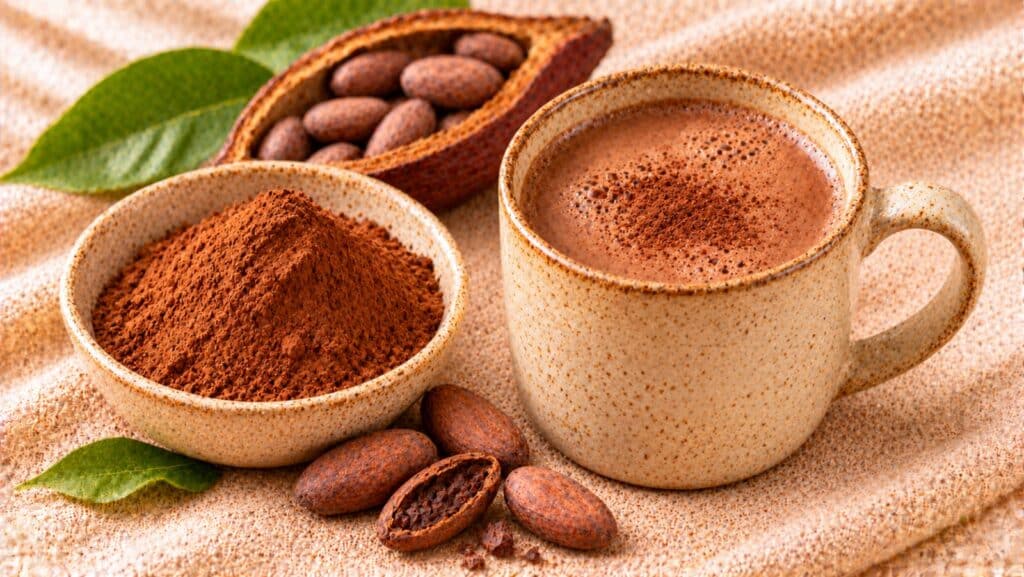
Cocoa powder is made from ground, partly defatted cocoa beans, the seeds of the Theobroma cacao tree. Unsweetened cocoa is surprisingly dense in nutrients: per 100 g it gives 37 g of fibre, 13.9 mg of iron, 499 mg of magnesium and a lot of copper and manganese, plus 230 mg of caffeine and 2,060 mg of theobromine. A real portion, though, is one or two tablespoons, about 5-11 g, and most “cocoa drinks” on the shelf are mainly sugar. The only health claim the EU permits for cocoa is for cocoa flavanols, at a set daily amount and for specific products.
Cocoa nutrition per 100 g and per tablespoon
| Nährstoff | Unsweetened cocoa powder, 100 g | 1 tablespoon (5.4 g) |
|---|---|---|
| Energie | 228 kcal | 12 kcal |
| Eiweiß | 19.6 g | 1.1 g |
| Fat | 13.7 g | 0.7 g |
| of which saturated | 8.1 g | 0.4 g |
| Carbohydrate (including fibre) | 57.9 g | 3.1 g |
| of which fibre | 37 g | 2.0 g |
| of which sugars | 1.8 g | 0.1 g |
| Eisen | 13.9 mg | 0.75 mg |
| Magnesium | 499 mg | 27 mg |
| Phosphor | 734 mg | 40 mg |
| Kalium | 1,520 mg | 82 mg |
| Zink | 6.8 mg | 0.37 mg |
| Copper | 3.8 mg | 0.20 mg |
| Manganese | 3.8 mg | 0.21 mg |
| Caffeine | 230 mg | 12 mg |
| Theobromine | 2,060 mg | 111 mg |
Source: USDA FoodData Central, “Cocoa, dry powder, unsweetened”, FDC ID 169593, checked 4 November 2026. The record gives 1 tablespoon as 5.4 g; the tablespoon column is calculated. In USDA data carbohydrate includes fibre. Values rounded.
The 100 g figures look impressive: on paper they cover more than the whole EU reference intake for magnesium (375 mg), copper (1 mg) and manganese (2 mg). One tablespoon, though, gives about 20% of the reference intake for copper, 10% for manganese, 7% for magnesium and 5% for iron (14 mg). A useful contribution, but cocoa is not a main source of minerals.
Glycemic index of cocoa
Cocoa powder is not listed in the international glycemic index tables (Atkinson 2008). The value of 40 ± 3 in those tables is for chocolate, not cocoa, and depends largely on the sugar in it. A tablespoon of unsweetened cocoa holds about 1 g of digestible carbohydrate; the sugar you add is what matters for blood sugar. More in What is the glycemic index? (with food table).
Health benefits: what the evidence says
- Cocoa flavanols and blood vessels. EFSA concluded that there is a cause-and-effect relationship between eating cocoa flavanols and the maintenance of normal endothelium-dependent vasodilation. The EU permits the claim that cocoa flavanols help maintain the elasticity of blood vessels, which contributes to normal blood flow, with a daily intake of 200 mg of cocoa flavanols. The claim was authorised on one company’s application (Barry Callebaut) and is tied to cocoa beverages, dark chocolate or extract capsules that provide those 200 mg (Regulation (EU) 2015/539). Ordinary cocoa tins usually do not state the flavanol content, so you cannot tell how much you are getting.
- The large COSMOS trial. In COSMOS, 21,442 older US adults (women over 65 and men over 60) took capsules of cocoa extract with 500 mg of flavanols a day or a placebo for a median of 3.6 years. Total cardiovascular events did not fall significantly (HR 0.90; 95% CI 0.78-1.02), but cardiovascular death was 27% lower (HR 0.73; 95% CI 0.54-0.98). The authors call for more research. Note that this was an extract in capsules, not sweetened cocoa powder.
- Fibre. 37 g per 100 g; two tablespoons for a mug of cocoa give about 4 g, close to 16% of the 25 g a day EFSA considers adequate for normal bowel function in adults.
- Iron, with a caveat. The iron in cocoa is non-haem, plant iron. According to the NIH it is absorbed less well than the haem iron in meat; vitamin C improves its absorption, while some polyphenols and calcium can reduce it. In practice, cocoa with milk is not a good way to cover your iron needs.
Ayurveda: cocoa in the traditional system
In Usha and Vasant Lad’s food guidelines chocolate is on the list to avoid for all three doshas, while carob is favourable for all three, as an alternative with a similar colour and taste. Cocoa powder is not listed separately, so we use the chocolate entry as the closest match. This is a traditional view, not a clinical finding. More in Ayurvedic diet for beginners.
How to choose and use cocoa
- Cocoa or cocoa drink mix. The ingredient list of plain cocoa says only “cocoa powder”. Instant cocoa drinks are often sweetened, so check that sugar is not the first ingredient. The WHO recommends keeping free sugars under 10% of daily energy.
- A mug of cocoa: stir 1-2 tablespoons of cocoa with a little warm water or milk into a smooth paste, then add the rest of the milk. Sweeten lightly, with a teaspoon of Honig once the drink has cooled a little, or with a mashed banana.
- Frühstück: a spoonful of cocoa in oat porridge mit banana Und walnuts, or in Greek yogurt with fruit.
- Baking: cocoa gives a homemade cake or muffins their chocolate flavour. A pinch of cinnamon lifts the aroma.
- Storage: in a closed container, somewhere cool and dry, away from moisture and strong smells.
Who should be careful
- Caffeine. One tablespoon of cocoa has about 12 mg of caffeine, and a mug made with two tablespoons about 25 mg. According to EFSA, single doses up to 200 mg and daily intakes up to 400 mg are safe for healthy adults, and in pregnancy and breastfeeding the limit is 200 mg a day from all sources. If you are sensitive to caffeine, skip cocoa in the evening.
- Children. EFSA suggests 3 mg of caffeine per kilogram of body weight per day as a safe level for children and adolescents. For a 20 kg child that is 60 mg a day; a mug with two tablespoons of cocoa gives about 25 mg. Watch the sugar in ready-made drinks too.
- MAO inhibitor medicines. People taking phenelzine are advised to avoid foods and drinks with caffeine (MedlinePlus). Ask your doctor about cocoa and chocolate.
- Sugar and calories. Cocoa itself is low in sugar, but sweetened drinks, cakes and chocolate are not.
Related entries and articles
- Hafer – cocoa oat porridge
- Bananen – natural sweetness for cocoa and smoothies
- Honey
- Walnuts
- Cinnamon
- Foods for energy without caffeine
- 7 gesunde Lebensmittel zum Frühstück
FAQ
How much caffeine is in cocoa?
Unsweetened cocoa powder contains 230 mg of caffeine per 100 g according to USDA, about 12 mg per tablespoon. A mug of cocoa made with two tablespoons has about 25 mg.
Is cocoa good for your heart?
The EU permits the claim that cocoa flavanols help maintain the elasticity of blood vessels, but only at 200 mg of flavanols a day and for specific products. In the large COSMOS trial, cocoa extract capsules did not significantly reduce total cardiovascular events, although cardiovascular deaths were lower. A mug of sweetened cocoa is not heart medicine.
What is the difference between cocoa and a cocoa drink?
Plain cocoa is only ground, defatted cocoa beans, with about 1.8 g of sugar per 100 g. Cocoa drink mixes are usually cocoa blended with sugar, and often with milk powder and flavourings. Check the ingredient list: cocoa should come first.
Sources
- USDA FoodData Central: Cocoa, dry powder, unsweetened (FDC ID 169593). fdc.nal.usda.gov
- Regulation (EU) No 1169/2011, Annex XIII – reference intakes for vitamins and minerals. EUR-Lex
- EFSA NDA Panel (2014). Scientific Opinion on the modification of the authorisation of a health claim related to cocoa flavanols and maintenance of normal endothelium-dependent vasodilation. EFSA Journal 12(5):3654. efsa.europa.eu
- Commission Implementing Regulation (EU) 2015/539 authorising a health claim for cocoa flavanols. legislation.gov.uk
- Sesso HD, Manson JE, Aragaki AK et al. Effect of cocoa flavanol supplementation for the prevention of cardiovascular disease events: the COSMOS randomized clinical trial. Am J Clin Nutr 2022;115(6):1490-1500. PubMed
- EFSA: Caffeine. efsa.europa.eu
- NIH Office of Dietary Supplements: Iron, Fact Sheet for Health Professionals. ods.od.nih.gov
- EFSA NDA Panel (2010). Scientific Opinion on Dietary Reference Values for carbohydrates and dietary fibre. EFSA Journal 8(3):1462. efsa.europa.eu
- MedlinePlus: Phenelzine. medlineplus.gov
- World Health Organization: Healthy diet, fact sheet. who.int
- Atkinson FS, Foster-Powell K, Brand-Miller JC. International tables of glycemic index and glycemic load values: 2008. Diabetes Care 2008;31(12):2281-2283. PMC
- Lad U, Lad V. Food Guidelines for Basic Constitutional Types, from Ayurvedic Cooking for Self-Healing, 2nd ed. The Ayurvedic Institute. ayurveda.com
This page is for information only and is not medical or dietary advice.
 Deutsch
 English
 Español
 Français

