
← EncyclopediaEnzyklopädie der Lebensmittel
By Nikola · Precision Nutrition L1 · Updated 5 November 2026
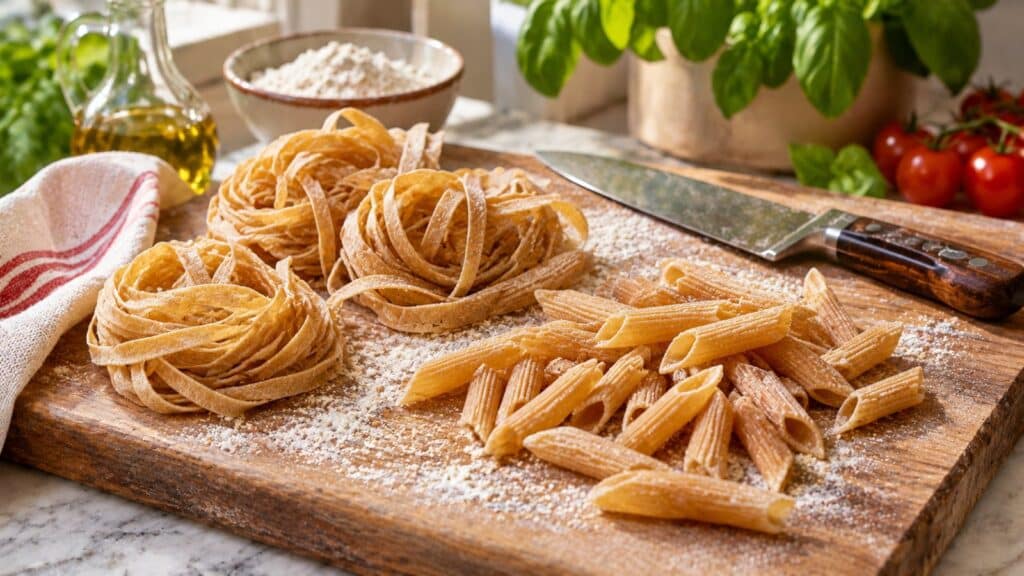
Whole wheat pasta is pasta made from whole grain wheat flour, which keeps the bran and germ of the grain instead of only the starchy centre. A 75 g dry portion gives about 264 kcal, 10 g of protein and 7 g of fibre, plus a good share of the day’s manganese and selenium. It tastes nuttier and a little firmer than white pasta and cooks in about the same time. Its glycemic index in the international tables (48) is practically the same as white spaghetti (49), so the real advantages are fibre, minerals and the whole grain itself, not a lower GI. It contains gluten.
Whole wheat pasta nutrition per 100 g and per portion
| Nährstoff | Dry, 100 g | Portion: 75 g dry | Cooked, 100 g |
|---|---|---|---|
| Energie | 352 kcal | 264 kcal | 149 kcal |
| Eiweiß | 13.9 g | 10.4 g | 6.0 g |
| Fat | 2.9 g | 2.2 g | 1.7 g |
| Carbohydrate | 73.4 g | 55.1 g | 30.1 g |
| of which sugars | 2.7 g | 2.1 g | 0.75 g |
| Fibre | 9.2 g | 6.9 g | 3.9 g |
| Magnesium | 128 mg | 96 mg | 54 mg |
| Phosphor | 343 mg | 257 mg | 127 mg |
| Eisen | 3.6 mg | 2.7 mg | 1.7 mg |
| Zink | 3.0 mg | 2.2 mg | 1.3 mg |
| Manganese | 3.0 mg | 2.2 mg | 1.3 mg |
| Selenium | 77.6 µg | 58.2 µg | 36.3 µg |
| Thiamin (B1) | 0.41 mg | 0.31 mg | 0.16 mg |
| Niacin (B3) | 8.7 mg | 6.5 mg | 3.1 mg |
Source: USDA FoodData Central, SR Legacy: “Pasta, whole-wheat, dry” (FDC 169738) and “Pasta, whole-wheat, cooked” (FDC 168910), checked 5 November 2026. The 75 g portion is our choice for a main-course serving; that column is calculated from the dry record. These are US records; European brands can differ, so check the label. Values rounded.
Comparing the carbohydrate values, cooked whole wheat pasta weighs about 2.4 times as much as dry, so 75 g dry ends up as roughly 180 g on the plate. Against the EU reference intakes (Regulation (EU) No 1169/2011, Annex XIII), the 75 g dry portion gives about 112% of the manganese (2 mg), 106% of the selenium (55 µg), 41% of the niacin (16 mg), 37% of the phosphorus (700 mg), 28% of the thiamin (1.1 mg), 26% of the magnesium (375 mg) and 22% of the zinc (10 mg).
Glycemic index
In the international GI tables (Atkinson 2008), whole meal spaghetti has a GI of 48 ± 5 and white spaghetti 49 ± 2, both measured against glucose. The difference between them is negligible. What changes the effect on blood sugar is mostly the amount: 75 g dry pasta carries about 55 g of carbohydrate. Cooking pasta al dente and serving it with vegetables, legumes, fish or other protein makes for a more balanced plate.
Health benefits: what the evidence says
- Fibre and whole grains. A large series of systematic reviews and meta-analyses in The Lancet found that people who ate the most dietary fibre had a 15-30% lower risk of all-cause and cardiovascular death than those who ate the least, with the largest reductions at 25-29 g of fibre a day; similar findings were seen for whole grain intake (Reynolds et al., 2019). These are mostly observational data. One portion of whole wheat pasta gives 6.9 g of fibre, about a quarter of that range.
- Manganese and selenium. Under EU rules, manganese contributes to the maintenance of normal bones and to the protection of cells from oxidative stress, and selenium contributes to the normal function of the immune system and to normal thyroid function (Regulation (EU) No 432/2012).
- B vitamins. Whole wheat pasta is a source of thiamin, which contributes to normal energy-yielding metabolism (Regulation 432/2012).
- Plant protein. 10 g of protein per dry portion is a solid base; add lentils, chickpeas, shrimp or cheese for a complete main course.
How to eat it
- Cook it al dente: use plenty of boiling, lightly salted water and start tasting a minute or two before the time on the pack. Whole wheat pasta turns mushy if overcooked.
- Use strong sauces: the nutty taste works with Tomate Und Knoblauch sauces, pesto, Pilze, roasted vegetables, Sardellen oder feta. A light cream sauce can feel heavy with it.
- Switch gradually: if the family is used to white pasta, mix half and half at first. Different shapes cook at different speeds, so mix only shapes with similar cooking times.
- Bulk it up with vegetables: add Spinat, Brokkoli, courgettes oder Tomaten to the sauce so a smaller pasta portion still fills the plate.
- Pasta salad: cold whole wheat pasta with olives, Pfeffer, Olivenöl and herbs keeps well for lunch boxes.
- Reading labels: look for “whole wheat” or “wholemeal” flour as the first ingredient.
Who should be careful
- Coeliac disease and wheat allergy. Whole wheat pasta is made from wheat, which Coeliac UK lists as not gluten free; wheat is also one of the most common food allergies according to MedlinePlus. Gluten-free pastas made from rice, Mais, buckwheat or legumes are the alternative.
- Diabetes and carbohydrate counting. Whole wheat pasta is still a starchy food. Weigh the dry portion until you know what 75 g looks like, and check your own glucose response if you measure it. On a ketogene Diät pasta does not fit.
- Sensitive digestion. If you eat little fibre, the jump to whole wheat pasta can cause bloating at first. Increase portions gradually and drink enough water.
Traditional view (Ayurveda)
In Usha and Vasant Lad’s food guidelines, pasta is favourable for Pitta and okay rarely for Vata and Kapha; wheat as a grain is favourable for Vata and Pitta and best avoided by Kapha. This is a traditional view, not a clinical finding.
Related entries and articles
- Whole wheat bread – the same grain in a loaf
- Bulgur Und quinoa – other grain sides
- Shrimp – a quick protein for pasta
- Tomaten
- Mediterranean diet
- What is the glycemic index? (with food table)
FAQ
Is whole wheat pasta healthier than white pasta?
It is a whole grain, with more fibre and minerals: 100 g dry has 9.2 g of fibre, and whole grain and fibre intakes are linked to lower risk of several chronic diseases in large reviews. Its glycemic index, however, is about the same as white spaghetti (48 vs 49 in the international tables), so the portion size still matters.
How many calories are in a portion of whole wheat pasta?
A 75 g dry portion has about 264 kcal according to USDA data, which comes to roughly 180 g cooked. Per 100 g cooked it has 149 kcal.
Is whole wheat pasta gluten-free?
No. It is made from wheat, which contains gluten. If you have coeliac disease, choose pasta labelled gluten free, made for example from rice, corn or buckwheat.
Sources
- USDA FoodData Central, SR Legacy: Pasta, whole-wheat, dry (FDC 169738). fdc.nal.usda.gov
- USDA FoodData Central, SR Legacy: Pasta, whole-wheat, cooked (FDC 168910). fdc.nal.usda.gov
- Atkinson FS, Foster-Powell K, Brand-Miller JC. International Tables of Glycemic Index and Glycemic Load Values: 2008. Diabetes Care 2008;31(12):2281-2283. PMC
- Reynolds A, Mann J, Cummings J et al. Carbohydrate quality and human health: a series of systematic reviews and meta-analyses. Lancet 2019;393(10170):434-445. Europe PMC
- Coeliac UK: Grains. coeliac.org.uk
- MedlinePlus Medical Encyclopedia: Food allergy. medlineplus.gov
- Regulation (EU) No 1169/2011, Annex XIII (reference intakes). legislation.gov.uk
- Regulation (EU) No 432/2012, authorised health claims (manganese, selenium, thiamin). legislation.gov.uk
- Lad U, Lad V. Food Guidelines for Basic Constitutional Types, from Ayurvedic Cooking for Self-Healing, 2nd ed. The Ayurvedic Institute. ayurveda.com
This page is for information only and is not medical or dietary advice.
 Deutsch
 English
 Español
 Français

