
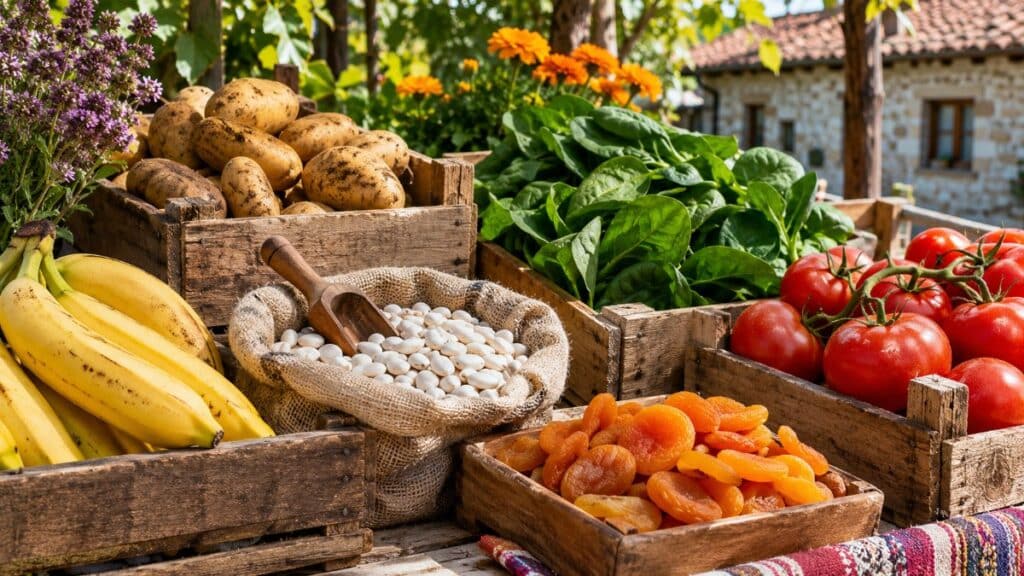
The foods highest in potassium are dried apricots, lentils, winter quetschen, prunes, raisins, potatoes, beans, bananas, Tomaten and leafy greens such as Spinat. A cup of cooked lentils gives about 731 mg and a medium baked potato about 610 mg, toward an adequate intake of 3,500 mg a day in the EU (2,600 mg for women and 3,400 mg for men in the US). For foods high in potassium and magnesium together, look at cashews, soy milk, bananas, beans, potatoes, spinach and seeds.
This guide is for you if you want real numbers rather than a vague “eat more bananas”: how much you need, milligrams per serving, foods that bring both minerals, the blood pressure evidence, the Ayurvedic view, a simple stew and the safety points for kidneys and medication.
Why does your body need potassium (and how is it linked to magnesium)?
Potassium is the main positively charged mineral inside your cells. It keeps their fluid balance steady and maintains the electrical gradients your nerves, muscles and kidneys rely on, according to the NIH Office of Dietary Supplements. You absorb about 85 to 90% of the potassium you eat, and your kidneys excrete most of what you do not need.
Magnesium is its quiet partner. The NIH lists magnesium depletion among the causes of low blood potassium, which is one reason the two minerals are often discussed together. Many of the same whole foods supply both, so a plate that is good for one is usually good for the other.
How much potassium do you need per day?
The European Food Safety Authority (EFSA) set an adequate intake of 3,500 mg a day for adult men and women in 2016, including during pregnancy, and 4,000 mg a day while breastfeeding. The World Health Organization suggests at least 3,510 mg (90 mmol) a day for adults. The US values are a little lower:
| Age | Men (mg/day) | Women (mg/day) | Pregnancy (mg/day) | Breastfeeding (mg/day) |
|---|---|---|---|---|
| 1 to 3 years | 2,000 | 2,000 | – | – |
| 4 to 8 years | 2,300 | 2,300 | – | – |
| 9 to 13 years | 2,500 | 2,300 | – | – |
| 14 to 18 years | 3,000 | 2,300 | 2,600 | 2,500 |
| 19 years and older | 3,400 | 2,600 | 2,900 | 2,800 |
Source: NIH Office of Dietary Supplements, Potassium Fact Sheet for Health Professionals (Adequate Intakes).
Most people fall short: in US survey data cited by the NIH, men averaged 3,016 mg a day and women 2,320 mg. These targets are for healthy people and do not apply if a condition or medication affects how your kidneys clear potassium.
Which foods are highest in potassium?
Ranked by milligrams per serving, dried fruit, legumes, squash and potatoes lead. A banana is good, but not the champion people think.
| Food | Serving | Potassium (mg) | % Tageswert |
|---|---|---|---|
| Apricots, dried | ½ cup | 755 | 16% |
| Lentils, cooked | 1 cup | 731 | 16% |
| Acorn squash, mashed | 1 cup | 644 | 14% |
| Prunes, dried | ½ cup | 635 | 14% |
| Raisins | ½ cup | 618 | 13% |
| Potato, baked, flesh only | 1 medium | 610 | 13% |
| Kidney beans, canned | 1 cup | 607 | 13% |
| Banane | 1 medium | 422 | 9% |
| Milk, 1% | 1 cup | 366 | 8% |
| Spinach, raw | 2 cups | 334 | 7% |
| Salmon, Atlantic, farmed, cooked | 3 oz (85 g) | 326 | 7% |
| Tomato, raw | 1 medium | 292 | 6% |
| Greek yogurt, plain, nonfat | 6 oz (170 g) | 240 | 5% |
| Rice, brown, cooked | 1 cup | 154 | 3% |
| Rice, white, cooked | 1 cup | 54 | 1% |
Source: NIH Office of Dietary Supplements, Potassium Fact Sheet for Health Professionals, Table 2 (Daily Value = 4,700 mg).
Plants close to how they grew carry the most. A pot of home-cooked beans, a baked potato and a ripe tomato make a solid start, and brown rice gives almost three times the potassium of white rice.

Which foods are high in both potassium and magnesium?
If you want foods rich in potassium and magnesium at the same time, the table below lines up the NIH figures for both minerals where the serving size is the same in each NIH table.
| Food | Serving | Potassium (mg) | Magnesium (mg) |
|---|---|---|---|
| Raisins | ½ cup | 618 | 23 |
| Banane | 1 medium | 422 | 32 |
| Milch | 1 cup | 366 | 27 |
| Salmon, Atlantic, farmed, cooked | 3 oz (85 g) | 326 | 26 |
| Soy milk | 1 cup | 287 | 61 |
| Brokkoli, cooked | ½ cup | 229 | 12 |
| Apple, with skin | 1 medium | 195 | 9 |
| Cashews | 1 oz (28 g) | 187 | 74 |
| Bread, whole wheat | 1 slice | 81 | 23 |
Source: NIH Office of Dietary Supplements, Potassium and Magnesium Fact Sheets for Health Professionals (Table 2 in each).
Cashews and soy milk are the stand-outs for both. For magnesium alone, seeds win by a wide margin: a 28 g handful of roasted Kürbis seeds gives 156 mg, and ½ cup of boiled Spinat gives 78 mg. Our full table of magnesium-rich foods ranks them all, and our guide to pumpkin seeds shows how many make sense in a day.
Does potassium lower blood pressure?
The evidence leans clearly yes for people with high blood pressure, with smaller or uncertain effects in people whose pressure is normal. The NIH summarises several meta-analyses: one of 25 trials in adults with hypertension found potassium lowered systolic pressure by about 4.5 mmHg and diastolic by about 3 mmHg. A Cochrane review of six high-quality trials found reductions that were not statistically significant, so the size of the benefit is still debated.
Potassium also works as a counterweight to salt. Harvard’s Nutrition Source describes pooled data from more than 10,000 adults: each extra 1,000 mg of daily potassium was linked to an 18% lower risk of cardiovascular disease, and each extra 1,000 mg of sodium to an 18% higher risk. The DASH-Diät lowered systolic pressure by an average of 5.5 mmHg, though its potassium effect cannot be separated from the rest of the pattern.
What are the signs of low or high potassium?
Low blood potassium (hypokalemia) rarely comes from diet alone. The usual causes are vomiting, diarrhea, some diuretics, laxative overuse, heavy sweating and low magnesium. Mild cases bring fatigue, weakness and constipation; severe ones can affect heart rhythm.
High blood potassium (hyperkalemia) is often silent until it is severe, when it can cause weakness, palpitations and dangerous arrhythmias. In healthy people the kidneys prevent this, which is why no upper limit for potassium from food has been set.
What does Ayurveda say about potassium-rich foods?
Ayurveda does not count minerals. It describes food by taste (rasa), heating or cooling effect (virya) and how easily your digestive fire (agni) handles it. In that traditional view, many potassium-rich foods are sweet in taste: bananas, dates, raisins, root vegetables and squash are considered grounding and calming for Vata, the dosha linked to dryness and restlessness.
Lentils and beans are described as astringent and drying, so the tradition cooks them soft with cumin, fresh ginger and a pinch of asafoetida. Tomatoes are seen as heating and sour, so people with a strong Pitta nature are told to enjoy them cooked and in moderation. These are traditional guidelines, not scientific findings.
How can you eat more potassium? A lentil, potato and spinach stew
This one-pot stew uses four foods from the table. By the NIH figures, the pot carries roughly 2,000 mg of potassium, about 1,000 mg in each of two bowls.
- 1 cup cooked brown or green lentils (or a drained can)
- 1 medium potato, peeled and cubed
- 1 medium tomato, chopped
- 2 cups fresh spinach
- 1 small onion, chopped
- 1 tablespoon Olivenöl
- 1 teaspoon ground cumin and a thumb of fresh ginger, grated
- About 500 ml water, a squeeze of lemon, a little salt
- Warm the olive oil in a pot and soften the onion for 5 minutes.
- Stir in the cumin and ginger for 30 seconds.
- Add the potato, tomato and water. Simmer for 12 to 15 minutes until the potato is tender.
- Add the cooked lentils and simmer for 5 more minutes.
- Stir in the spinach and let it wilt for 2 minutes.
- Season lightly, add lemon and serve.
Serve it with a slice of whole wheat bread or a spoon of plain yogurt on top for extra magnesium and calcium. More ideas live in our plant-based meals and our high-protein vegetarian breakfasts, many of which use beans, yogurt and seeds.
Who should be careful with potassium?
- Chronic kidney disease: damaged kidneys may not clear potassium, so blood levels can rise even at intakes below the adequate intake. Follow your kidney team’s advice on potassium foods.
- ACE inhibitors and ARBs (common blood pressure drugs such as lisinopril or losartan): they reduce potassium loss in urine and can raise blood potassium. The NIH recommends monitoring, especially with reduced kidney function.
- Potassium-sparing diuretics (spironolactone, amiloride): same effect, same need for monitoring.
- Loop and thiazide diuretics (such as furosemide or chlorothiazide): these do the opposite and can lower potassium.
- NSAID painkillers: Harvard lists them among the medicines that can raise blood potassium.
- Salt substitutes: many are potassium chloride, with about 440 to 2,800 mg of potassium per teaspoon. Check with your doctor first if you have kidney disease or take any of the drugs above.
- Supplements: most over-the-counter products contain 99 mg or less, because higher-dose potassium chloride tablets have been linked to small-bowel injury. Food is the better route.
Related reading: our sibling guide to zinc-rich foods and our entry on ripe bananas.
FAQ
Do bananas have the most potassium?
No. A medium banana gives 422 mg, which is good, but a cup of cooked lentils (731 mg), a medium baked potato (610 mg) and half a cup of dried apricots (755 mg) all give more.
Which fruits are highest in potassium?
Dried fruits lead the NIH table: dried apricots, prunes and raisins each give more than 600 mg per half cup. Among fresh fruit, bananas, orange juice and cantaloupe are good sources.
Can you get too much potassium from food?
Not if your kidneys work normally. They excrete the excess, and no upper limit has been set for potassium from food. With kidney disease or potassium-raising drugs, you need individual advice.
What foods are rich in potassium, magnesium and calcium?
Milk, plain yogurt and calcium-fortified soy milk cover all three, according to the NIH tables. Cooked spinach and beans add potassium and magnesium with some calcium.
Sources
- NIH Office of Dietary Supplements. Potassium: Fact Sheet for Health Professionals. National Institutes of Health. ods.od.nih.gov
- NIH Office of Dietary Supplements. Magnesium: Fact Sheet for Health Professionals. National Institutes of Health. ods.od.nih.gov
- NIH Office of Dietary Supplements. Calcium: Fact Sheet for Health Professionals. National Institutes of Health. ods.od.nih.gov
- EFSA Panel on Dietetic Products, Nutrition and Allergies. Dietary reference values for potassium. EFSA Journal, 2016. efsa.europa.eu
- World Health Organization. Increasing potassium intake to reduce blood pressure and risk of cardiovascular diseases in adults. eLENA, 2023. who.int
- Harvard T.H. Chan School of Public Health. Potassium. The Nutrition Source, 2023. nutritionsource.hsph.harvard.edu
This article is for information only and is not medical advice. If you have a health condition, are pregnant or take medication, talk to your doctor or pharmacist before changing your diet or starting a supplement.


 Deutsch
 English
 Español
 Français

