

Chia seeds are rich in fibre (about 34 g per 100 g) and in ALA, a plant omega-3 fat (about 18 g per 100 g), plus protein, calcium and magnesium, according to USDA data. Reviews of clinical trials find only small benefits for blood pressure, blood lipids and waist size. The best way to eat them is soaked or mixed into moist food, never by the dry spoonful, because they swell and have caused a blocked oesophagus.
If you have a bag of chia in the cupboard and are not sure what to do with it, this guide is for you. Below you will find the real numbers per serving, what the research does and does not show, how to soak them, a reliable pudding ratio, and who should be careful.
What nutrients are in chia seeds?
Chia (Salvia hispanica) is a tiny seed with a lot packed in. The per-28 g column is calculated from the USDA per-100 g values. Twenty-eight grams is one ounce, the standard US serving, and roughly what you would stir into a breakfast bowl.
| Nutritivo | Per 100 g | Per 28 g |
|---|---|---|
| Energía | 486 kcal | 136 kcal |
| Proteína | 16.5 g | 4.6 g |
| Fat, total | 30.7 g | 8.6 g |
| ALA omega-3 (18:3 n-3) | 17.8 g | 5.0 g |
| Carbohydrate | 42.1 g | 11.8 g |
| Fibre | 34.4 g | 9.6 g |
| Calcio | 631 mg | 177 mg |
| Magnesio | 335 mg | 94 mg |
| Fósforo | 860 mg | 241 mg |
| Hierro | 7.7 mg | 2.2 mg |
| Zinc | 4.6 mg | 1.3 mg |
Source: USDA FoodData Central, SR Legacy, “Seeds, chia seeds, dried” (FDC ID 170554). Per-28 g values calculated and rounded.
Notice that most of the carbohydrate is fibre. That is unusual and is the main reason chia behaves the way it does in your gut and in your kitchen.
What are the health benefits of chia seeds?
A serious fibre boost
Harvard’s Nutrition Source recommends at least 25 to 35 g of fibre a day and notes that most Americans get only about 15 g. A 28 g portion of chia gives close to 10 g. Part of chia’s fibre is soluble: it forms a gel with water, which you can see in your glass. Harvard links soluble fibre in general with lower blood glucose and cholesterol, and insoluble fibre with regular bowel movements.
Plant omega-3
The NIH sets the adequate intake for ALA at 1.6 g a day for men and 1.1 g for women. A single 28 g serving of chia covers that several times over. There is a catch: the body converts under 15% of ALA into EPA and DHA, the omega-3s found in oily fish. Chia is a useful plant source, especially on a dieta vegetariana, but it does not replace fish or an algae-based supplement for EPA and DHA. Our entry on grasas de alta calidad explains where ALA fits among the fats you need.
Minerals
Chia adds calcium, magnesium, phosphorus, iron and zinc. That makes it a handy topping, though it is still a small portion food, not your main source of any mineral.
Heart and metabolic markers: modest at best
A 2025 umbrella review in Plant Foods for Human Nutrition pooled earlier systematic reviews and meta-analyses of randomised trials on chia. It found small but statistically significant improvements in blood pressure, blood lipids, C-reactive protein (an inflammation marker) and waist circumference, plus a slight drop in HDL cholesterol. The authors rated the certainty of evidence as moderate to low for most outcomes and called the benefits modest. Fair summary: a helpful food, not a treatment.
Are chia seeds good for weight loss?
Chia seeds for weight loss work only as part of the whole plate, not on their own. The same review found only a small effect on waist circumference. Chia can make a breakfast more filling thanks to its fibre and gel, which may help you eat less later. But 28 g carries 136 kcal, so heaped spoonfuls on top of an already big meal add calories rather than remove them. Use chia to replace something less filling, such as a sugary cereal.
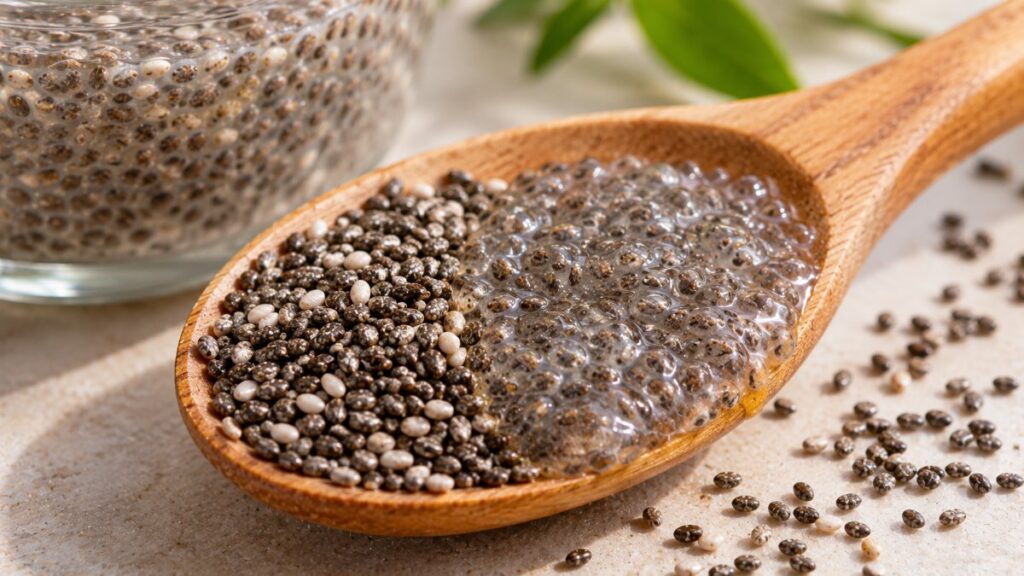
How do you eat chia seeds?
Chia has almost no taste, so it goes with sweet and savoury food. The key point is water: dry seeds pull in liquid and swell into a gel. Let that happen in the bowl, not in your throat.
- Soaked in milk or plant milk as a pudding (recipe below).
- Stirred into porridge or plain yogurt, then left for 5 to 10 minutes.
- Blended into a smoothie, which also breaks the seeds.
- As a quick jam: mash berries such as fresas, stir in chia and leave it to set in the fridge.
- As an egg replacer in baking: ground chia mixed with water turns into a gel that binds batter.
Milled chia seeds work too and mix more smoothly into batters and drinks. Whole seeds are fine as long as they are soaked.
How much chia should you eat per day?
Chia is classed as a novel food in the EU, and for years pre-packed chia sold there had to carry a label saying daily intake should not exceed 15 g. In 2019 EFSA reassessed chia for extended uses and concluded that its use in foods not heated at or above 120 °C is safe without specific restrictions on amounts. The EU then dropped the 15 g labelling requirement in Implementing Regulation (EU) 2020/24. Uses in foods heated at or above 120 °C were put on hold, because a study pointed to possible acrylamide formation.
In daily life, 1 to 2 tablespoons a day is a practical amount. It gives a good dose of fibre and omega-3 without upsetting a gut that is not used to it. If you eat little fibre now, start with 1 teaspoon and build up over a couple of weeks.
What does Ayurveda say about chia seeds?
Chia comes from Central America, so it is not described in classical Ayurvedic texts. Modern Ayurvedic practitioners usually reason from its qualities and compare it with sabja (albahaca seeds), which Indian households traditionally soak in water and drinks as a cooling food in summer.
In that traditional framework, soaked chia is moist, slippery and somewhat heavy. These qualities are said to calm Vata, the dry and mobile dosha, and to soothe Pitta in hot weather. For Kapha types, who already tend toward heaviness, practitioners suggest smaller amounts with warming spices such as jengibre o cinnamon. Eating the seeds soaked and at room temperature or warm, rather than ice-cold, is seen as kinder to agni, the digestive fire.
This is a traditional and interpretive view, not scientific evidence. It happens to agree with modern practice on one point: soak them first.
How do you make chia pudding?
The reliable ratio is about 1 part chia to 4 parts liquid by volume. That gives a spoonable pudding; use less liquid for a thicker set.
Basic chia pudding (1 serving)
- 3 tablespoons chia seeds
- 180 ml milk or unsweetened plant milk
- a pinch of cinnamon
- half a teaspoon vanilla extract (optional)
- a handful of blueberries or other fruit, to serve
- 1 tablespoon chopped walnuts, to serve
- Put the chia, milk, cinnamon and vanilla in a jar or bowl and stir well.
- Wait 5 minutes and stir again. This step stops the seeds from clumping at the bottom.
- Cover and refrigerate for at least 2 hours, or overnight.
- Stir, then top with fruit and walnuts. Ripe fruit brings enough sweetness for most people.
For more ways to sweeten without sugar, see our healthy desserts without sugar. To make the pudding a fuller meal, stir in thick yogurt or try one of our high-protein vegetarian breakfast ideas. Chia also earns a place on our superfoods list, and you will find more morning options in 7 alimentos saludables para desayunar.
Are chia seeds safe? Who should be careful?
- Never eat them dry by the spoonful. A published case report describes a 39-year-old man who swallowed a tablespoon of dry chia seeds followed by a glass of water. The seeds swelled into a gel that completely blocked his oesophagus, and doctors had to clear it with an endoscope. He had a history of swallowing difficulty, probably from eosinophilic oesophagitis. The authors advise that anyone with swallowing problems be cautious with chia, especially dry.
- Swallowing problems or a narrowed oesophagus. Prefer fully soaked chia, and ask your doctor first.
- Sensitive digestion. Harvard advises increasing fibre gradually and drinking enough fluid to avoid bloating and cramping.
- Allergy. EFSA found two reported cases of allergic reaction to chia. Rare, but real.
- Blood thinners. The NIH links bleeding risk to high doses of EPA and DHA supplements, not to ALA from seeds. Still, if you take warfarin or similar drugs, mention any big new daily habit, including large amounts of omega-3-rich seeds, to your doctor.
- Blood pressure medication. Trials suggest chia may lower blood pressure slightly. That is unlikely to matter at food amounts, but if you take antihypertensives and your readings drop, tell your doctor.
- Pregnancy. None of the sources used here give chia-specific advice for pregnancy. Stick to ordinary food amounts, and ask your doctor before using chia oil or concentrated supplements.
FAQ
Do you have to soak chia seeds?
Not always, but it is the safest habit. Sprinkling a few seeds on moist food like yogurt is fine; swallowing a spoonful of dry seeds and chasing it with water is not, because they swell in the oesophagus.
How many chia seeds per day is safe?
EFSA concluded in 2019 that chia in unheated foods is safe without specific limits on amounts. In practice, 1 to 2 tablespoons a day suits most people, and beginners should start smaller to let the gut adjust to the fibre.
Chia or flaxseed: which is better?
Both are rich in ALA and fibre. Flaxseed is usually eaten ground, while chia works well whole once soaked. Use whichever you like and will eat regularly.
Black or white chia seeds: is there a difference?
Both colours are the same plant, Salvia hispanica, and USDA FoodData Central lists chia as a single food without separating them. Buy whichever is cheaper and fresh.
Sources
- U.S. Department of Agriculture, Agricultural Research Service. FoodData Central, SR Legacy: Seeds, chia seeds, dried (FDC ID 170554), 2018. fdc.nal.usda.gov
- NIH Office of Dietary Supplements. Omega-3 Fatty Acids: Fact Sheet for Health Professionals. ods.od.nih.gov
- Harvard T.H. Chan School of Public Health. Fiber. The Nutrition Source. nutritionsource.hsph.harvard.edu/carbohydrates/fiber
- A Critical Review of the Health Benefits Associated with Chia Seeds (Salvia hispanica L.). Plant Foods for Human Nutrition, 2025;80(4):170. doi:10.1007/s11130-025-01401-z. PubMed 41076614
- Simmelink A, Rawl RE, Browne L, Scobey M. Watch it grow: Esophageal impaction with chia seeds. Case Reports in Internal Medicine, 2017;4(2):49. doi:10.5430/crim.v4n2p49. sciedupress.com
- European Commission. Commission Implementing Regulation (EU) 2020/24 authorising an extension of use of chia seeds (Salvia hispanica) as a novel food (recitals on the 2019 EFSA opinion). legislation.gov.uk/eur/2020/24
This article is for information only and is not medical advice. If you have a health condition, are pregnant or take medication, talk to your doctor or pharmacist before changing your diet or starting a supplement.


 Español
 English
 Deutsch
 Français

