
← Encyclopediaenciclopedia de comida
By Nikola · Precision Nutrition L1 · Updated 4 November 2026
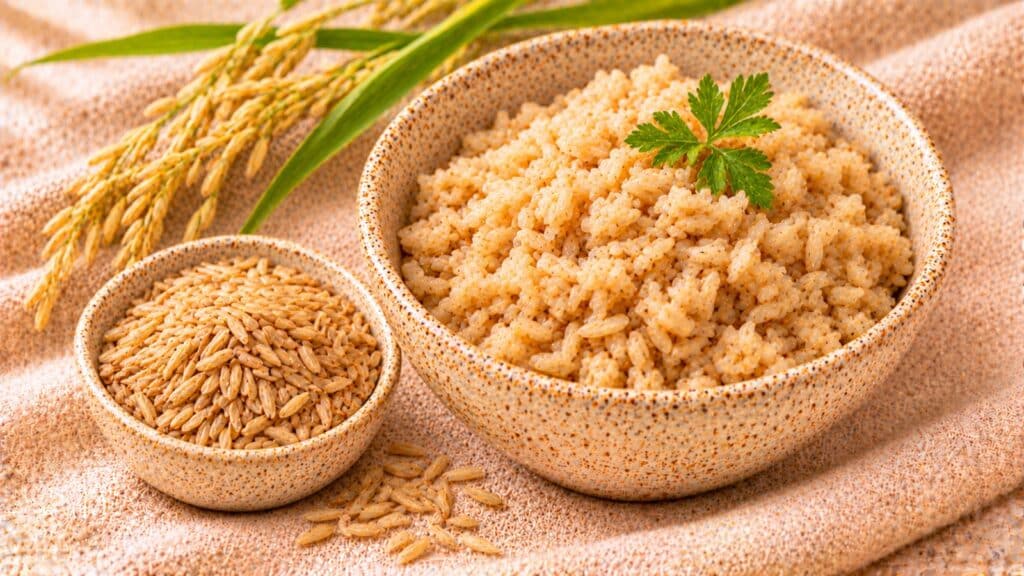
Brown rice is whole-grain rice: only the inedible outer husk is removed, so the bran and germ stay on the grain. Per 100 g cooked, long-grain brown rice gives 123 kcal, 2.7 g of protein and 1.6 g of fibre, plus useful amounts of manganese, magnesium, selenium, phosphorus, thiamin and niacina. Its glycemic index is 68, a little lower than boiled white rice at 73. The one real downside: rice takes up arsenic from flooded paddy soil, and brown rice tends to carry more of it than white rice, so variety and cooking method matter.
Brown rice nutrition per 100 g and per portion
| Nutritivo | Cooked, 100 g | Portion: 1 cup cooked (202 g) | Raw, 100 g |
|---|---|---|---|
| Energía | 123 kcal | 248 kcal | 367 kcal |
| Proteína | 2.7 g | 5.5 g | 7.5 g |
| Fat | 1.0 g | 2.0 g | 3.2 g |
| Carbohydrate | 25.6 g | 51.7 g | 76.2 g |
| of which fibre | 1.6 g | 3.2 g | 3.6 g |
| Magnesio | 39 mg | 79 mg | 116 mg |
| Fósforo | 103 mg | 208 mg | 311 mg |
| Manganese | 0.97 mg | 1.97 mg | 2.85 mg |
| Selenium | 5.8 µg | 11.7 µg | 17.1 µg |
| Thiamin (B1) | 0.18 mg | 0.36 mg | 0.54 mg |
| Niacina (B3) | 2.56 mg | 5.17 mg | 6.49 mg |
| Zinc | 0.71 mg | 1.43 mg | 2.13 mg |
Source: USDA FoodData Central, SR Legacy: “Rice, brown, long-grain, cooked” (FDC 169704) and “Rice, brown, long-grain, raw” (FDC 169703), checked 4 November 2026. The cup weight is from the USDA record; the portion column is calculated from the cooked values. Values rounded.
Cooked rice is about 70% water. Going by the energy values, 100 g of raw brown rice ends up as roughly 300 g cooked, so 70-80 g dry per person is a normal side portion.
Glycemic index
In the international GI tables, boiled brown rice has a glycemic index of 68 ± 4 and boiled white rice 73 ± 4 (glucose = 100). Brown rice is only a few points lower: it is still a starchy food, and one cup cooked carries about 52 g of carbohydrate. What you eat with it matters more. Pairing rice with lentils, kidney beans, vegetables, fish or eggs adds protein and fibre and balances the meal.
Health benefits: what the evidence says
- A whole grain. In a large dose-response meta-analysis of prospective studies (Aune et al., BMJ 2016), every extra 90 g of whole grains a day was associated with a 19% lower risk of coronary heart disease, 22% lower risk of cardiovascular disease, 15% lower risk of cancer death and 17% lower risk of death from all causes. These are associations for whole grains in general.
- Some fibre, not a lot. One cup of cooked brown rice gives 3.2 g of fibre. EFSA considers 25 g a day adequate for normal bowel function in adults, so brown rice helps but is not a high-fibre food on its own. Combine it with legumes and vegetables.
- Minerals and B vitamins. A cup provides about 2 mg of manganese, 79 mg of magnesium, 208 mg of phosphorus, 11.7 µg of selenium and meaningful amounts of thiamin and niacin. Much of this sits in the bran and germ, the parts white rice loses in milling.
- Gluten-free. Coeliac UK lists rice among the naturally gluten-free grains. Rice flours and mixes should still carry a “gluten free” label, because flour can be contaminated in mills that also handle wheat.
Ayurveda: brown rice in the traditional system
In Usha and Vasant Lad’s food guidelines, all kinds of rice are favourable for Vata. For Pitta, brown rice is “okay rarely”, while basmati and white rice are favoured. For Kapha, both brown and white rice are on the avoid list, with basmati or wild rice fine in moderation. This is a traditional view, not a clinical finding.
How to cook and use brown rice
- Absorption method: rinse, then use about 1 part rice to 2-2.5 parts water and a pinch of salt. Simmer covered on low heat for roughly 35-45 minutes and rest 10 minutes off the heat.
- Pasta method (less arsenic): the FDA describes cooking rice in 6 to 10 parts water to 1 part rice and draining the excess, which can cut inorganic arsenic by about 40-60% depending on the rice. The trade-off is that some nutrients go down the drain too.
- Bowls and salads: brown rice holds its shape when cold. Try it with roasted brócoli, palta y chickpeas, or with baked salmón y pepino.
- Stuffed vegetables and pilaf: use it in stuffed pimientos or a champiñón pilaf; allow extra cooking time.
- Quick fried rice: stir-fry cold leftover rice with vegetables and eggs.
Who should be careful
- Arsenic, especially for young children. A 2025 Michigan State University analysis (Scott, Wu et al., Risk Analysis) found that brown rice had higher total and inorganic arsenic than white rice; in US-grown rice, inorganic arsenic was 48% of total arsenic in brown rice and 33% in white. The researchers saw no major risk for the general adult population, but a potential concern for children under 5, who eat more for their body weight. In Europe, EFSA’s 2024 update concluded that dietary exposure to inorganic arsenic raises a health concern. The FDA advises pregnant women and parents of toddlers to choose a variety of grains. In practice: rotate rice with millet, buckwheat, quinoa y oats, and do not make rice cakes, rice drinks and rice cereal a small child’s daily staples.
- Diabetes. Keep the portion moderate, fill half the plate with vegetables and add protein; if you measure your glucose, check your own response.
- Coeliac disease. Plain rice is gluten-free, but seasoned mixes and ready meals may not be. Read the label.
Related entries and articles
- Millet – another gluten-free grain to rotate with rice
- Quinua y buckwheat
- Mung beans – the classic partner for rice in kitchari
- Kidney beans – rice and beans as a complete plant meal
- What is the glycemic index? (with food table)
- Plant-based meals for weight loss
FAQ
Is brown rice healthier than white rice?
Brown rice is a whole grain: it keeps the bran and germ that white rice loses, and its GI is slightly lower (68 vs 73). Whole-grain intake is associated with lower risk of heart disease in large studies. On the other hand, brown rice tends to contain more arsenic, so eat it as one of several grains rather than every day.
Should I worry about arsenic in brown rice?
For adults eating rice a few times a week in a varied diet, researchers do not see a major risk. Young children are the main concern. Rotate grains, cook rice in plenty of water and drain it now and then, and avoid relying on rice snacks and drinks for small children.
How long does brown rice take to cook?
Usually 35-45 minutes with about 2-2.5 parts water to 1 part rice, plus 10 minutes resting.
Sources
- USDA FoodData Central, SR Legacy: Rice, brown, long-grain, cooked (FDC 169704). fdc.nal.usda.gov
- USDA FoodData Central, SR Legacy: Rice, brown, long-grain, raw (FDC 169703). fdc.nal.usda.gov
- Atkinson FS, Foster-Powell K, Brand-Miller JC. International Tables of Glycemic Index and Glycemic Load Values: 2008. Diabetes Care 2008;31(12):2281-2283. PMC
- Aune D et al. Whole grain consumption and risk of cardiovascular disease, cancer, and all cause and cause specific mortality: systematic review and dose-response meta-analysis of prospective studies. BMJ 2016;353:i2716. PubMed
- EFSA NDA Panel (2010). Scientific Opinion on Dietary Reference Values for carbohydrates and dietary fibre. EFSA Journal 8(3):1462. efsa.europa.eu
- Coeliac UK: Grains (gluten-free and grains to check). coeliac.org.uk
- Michigan State University: Eating brown rice increases exposure to arsenic compared to white rice (on Scott C, Wu F et al., Risk Analysis 2025, doi:10.1111/risa.70008). newswise.com
- EFSA CONTAM Panel. Update of the risk assessment of inorganic arsenic in food. EFSA Journal 2024;22(1):e8488. efsa.europa.eu
- U.S. FDA Consumer Update: Seven things pregnant women and parents need to know about arsenic in rice and rice cereal (reproduced on drugs.com). drugs.com
- Lad U, Lad V. Food Guidelines for Basic Constitutional Types, from Ayurvedic Cooking for Self-Healing, 2nd ed. The Ayurvedic Institute. ayurveda.com
This page is for information only and is not medical or dietary advice.
enciclopedia de comida
Quinua Alforfón Millet Mung beans Kidney beans Alforfón Millet Mung beans Kidney beans Patatas
 Español
 English
 Deutsch
 Français

