
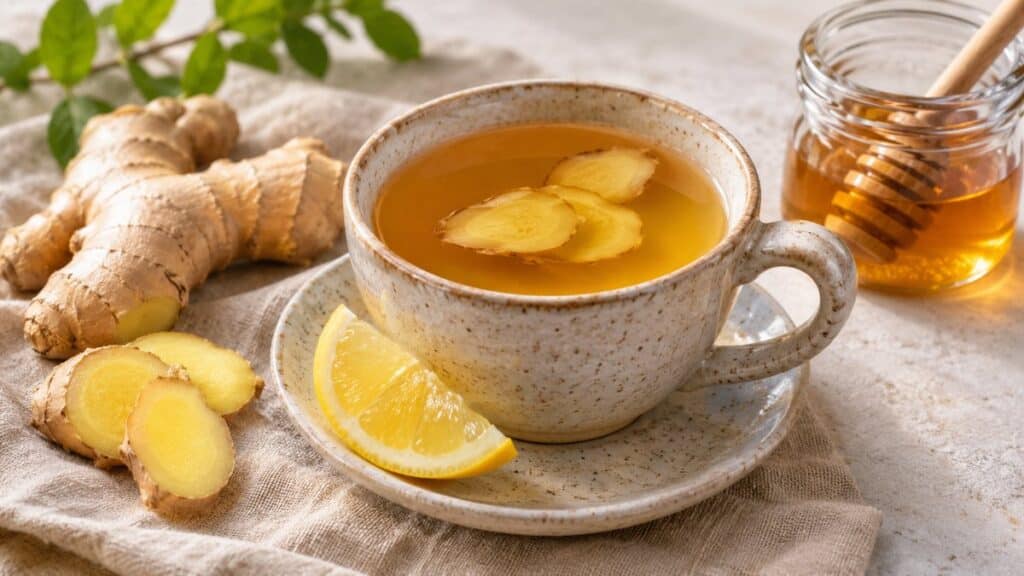
Gingembre tea, also called ginger root tea, is a warm, caffeine-free drink made by steeping fresh or dried ginger root in hot water. Its best-supported benefit is easing nausea, especially in pregnancy: a 2014 meta-analysis of 12 trials with 1,278 pregnant women found ginger relieved nausea better than placebo, while the evidence for chemotherapy nausea is weak and uncertain. To make it, simmer 2-3 cm of sliced fresh ginger in 300 ml of water for about 10 minutes.
This guide is for anyone who keeps a knob of ginger in the fridge and wonders what it can really do. You will find what the research shows (and how solid it is), a simple recipe with fresh and ground ginger, a few variations with lemon, honey and menthe, the traditional Ayurvedic view, and the people who should be careful with it.
What are the proven benefits of ginger tea?
The US National Center for Complementary and Integrative Health (NCCIH) says research shows ginger may help with nausea and vomiting in pregnancy. For most other uses, the picture is mixed or unclear. One detail matters for tea drinkers: most nausea studies tested ginger capsules or powder, not a mug of tea. A cup brewed at home contains an unknown and variable amount of ginger, so treat the studies as a guide to what ginger can do, not a promise of what your tea will do.
| Use | What the research found | How strong is the evidence? |
|---|---|---|
| Nausea in pregnancy | 12 randomised trials, 1,278 women: ginger reduced nausea compared with placebo; the drop in vomiting was not statistically significant. Results were similar to vitamin B6. | Low quality, but consistent; NCCIH says ginger may help |
| Chemotherapy nausea | Review of 23 trials (2022): no significant effect on nausea overall. In a subgroup, up to 1 g a day for more than 4 days reduced acute vomiting. | Very low certainty; NCCIH calls it uncertain |
| Nausea after surgery | It is unclear whether ginger helps. | Uncertain |
| Motion sickness | Most studies did not find a benefit. | Weak |
| Menstrual cramps | Ginger supplements may reduce how severe cramps feel. | Limited |
Source: NCCIH, Ginger (2025); Viljoen et al., Nutrition Journal (2014); Choi et al., Nutrients (2022).
Ginger tea for morning sickness
Pregnancy nausea is where ginger has the most data. In the 2014 meta-analysis, daily doses in the trials ranged from 600 to 2,500 mg, and most used about 1,000 mg of ginger powder a day, usually for four days. A subgroup analysis hinted that doses under 1,500 mg a day worked better for nausea. The authors called ginger a harmless and possibly effective option, but they also rated the evidence as low quality, because many trials were small and had a high or moderate risk of bias. The NHS also says there is some evidence that ginger may help, and suggests foods or drinks that contain it.
Ginger tea during chemotherapy
Here the honest answer is “maybe a little, maybe not at all”. The 2022 review pooled trials where ginger was added to standard anti-sickness medicines and found no clear effect on nausea or on delayed vomiting. The one positive signal was in acute vomiting, and the authors rated their confidence as very low. If you are in cancer treatment and like the taste, ask your oncology team first, for reasons explained in the precautions section below.
Does ginger tea help digestion and bloating?
Ginger has a long history as a digestive remedy, and many people find a warm cup after a heavy meal comforting. The research, though, focuses on nausea rather than general digestion, bloating or gas, so we cannot point you to strong trials for those. If digestion is your main concern, our guide to natural remedies for better digestion compares ginger with options that have better evidence, such as fibre, a short walk after meals and peppermint oil for IBS. You can also read more about the root itself in our ginger encyclopedia entry.

Is fresh or ground ginger better for tea?
Both work. They taste different and behave differently in the cup.
- Fresh root: bright, lemony, warming heat. Gives a clear, golden tea. Easy to make stronger by slicing thinner or simmering longer.
- Ground (dried) ginger: sharper and more peppery, with a dusty sediment at the bottom. Handy when you have no fresh root.
- Tea bags: convenient, usually milder. Check the label: some are blends where ginger is a minor ingredient.
Choose fresh root that is firm and heavy, with smooth, tight skin. You do not need to peel organic ginger; a good scrub is enough.
How do you make ginger root tea at home?
This is the base recipe we use. It makes one large mug and takes about 15 minutes.
Fresh ginger tea (1 large mug)
- 2-3 cm piece of fresh ginger root (about the size of the top of your thumb)
- 300 ml water
- Optional: 2-3 slices of lemon, 1 teaspoon of honey, a few fresh mint leaves
- Scrub the ginger and slice it into thin coins, or grate it for a stronger, cloudier tea.
- Put the ginger and water in a small pot, bring to a boil, then lower the heat.
- Simmer with a lid on for 10 minutes. For a fiery tea, go to 15-20 minutes.
- Strain into a mug. Add lemon and mint now, if using.
- Let it cool for a minute or two, then stir in the honey.
With ground ginger: stir half a teaspoon of ground ginger into a mug of just-boiled water, cover with a saucer, and let it steep for 5 minutes. Stir again before drinking.
Lemon ginger tea, honey ginger tea and other variations
- Lemon and ginger tea with honey: the classic winter mug. Lemon adds brightness; honey softens the heat.
- Ginger and mint: add a small handful of fresh menthe leaves for the last 2-3 minutes of steeping. Cooler, rounder flavour, nice after dinner.
- Curcuma and ginger tea: add a few slices of fresh turmeric root and a pinch of black pepper. If you prefer it creamy, our golden milk recipe is the milky cousin of this tea.
- Iced ginger tea: make a double-strength batch, cool it, and keep it in the fridge for up to two days. Pour over ice with a slice of lemon.
If you like to build small daily rituals, a mug of ginger tea in the afternoon fits well with the ideas in our post on healthy eating habits for a better lifestyle. Because it has no caffeine, it can also replace an evening coffee, which supports the routines we describe in pourquoi le sommeil est la pierre angulaire d'un mode de vie sain.
What does Ayurveda say about ginger?
In Ayurveda, the traditional medicine of India, ginger has such a central role that it is sometimes called “the universal medicine”. The following is the traditional view, not scientific evidence.
- Taste (rasa): pungent.
- Energy (virya): heating.
- Effect on agni: ginger is the classic herb for kindling agni, the “digestive fire” that Ayurveda sees at the centre of good health.
- Fresh vs dry: fresh ginger (ardraka) is considered moister and gentler; dry ginger (shunthi) is considered stronger and drier.
- Doshas: ginger is traditionally favoured for vata and kapha types, who tend to run cold. People with a strong pitta (heat) nature are advised to use it in smaller amounts, for example with mint, or to skip it on hot days.
A traditional habit you can try: about 15 minutes before lunch, chew a thin slice of fresh ginger with a pinch of salt and a few drops of lemon juice. If you are new to these ideas, start with our Ayurvedic diet for beginners.
Who should not drink ginger tea? Side effects and precautions
For most people, a mug or two of ginger tea is an ordinary food amount. Still, a few points are worth knowing.
- Heartburn and stomach upset: NCCIH lists abdominal discomfort, heartburn, diarrhoea and mouth or throat irritation as possible side effects of ginger taken by mouth. If you have reflux, try a weaker brew and avoid drinking it on an empty stomach.
- Blood thinners: Memorial Sloan Kettering Cancer Center advises that ginger supplements may increase the risk of bleeding in people taking warfarin or other blood thinners, although a systematic review found the evidence inconclusive. If you take an anticoagulant or antiplatelet medicine, talk to your doctor before using ginger in concentrated forms or large daily amounts.
- Surgery: the same source recommends stopping ginger supplements 2 weeks before surgery.
- Pregnancy: ginger supplements in pregnancy may be safe, but NCCIH and the NHS both advise checking with a health professional or pharmacist first. Seek help quickly if you cannot keep food or fluids down for 24 hours, have very dark urine or have not urinated for over 8 hours, feel faint, or vomit blood.
- Breastfeeding: little is known about the safety of ginger supplements while breastfeeding.
- Other medicines: herbs and medicines can interact, so ask your pharmacist if you take any regular medication.
Ginger is often mentioned in lists of foods that reduce inflammation. That article explains what the evidence does and does not show, so you can keep your expectations realistic.
FAQ
Can I drink ginger tea every day?
For most healthy adults, yes. No official body sets a daily limit for ginger tea. If you notice heartburn or a loose stomach, make it weaker or drink less, and check with your doctor if you take blood thinners.
How much ginger tea should I drink for nausea?
There is no tested dose for tea. Pregnancy trials mostly used about 1 g of ginger powder a day, often in divided doses. Small, slow sips of a mild tea are usually easier to keep down than one large mug.
Is ginger tea good for you before bed?
It contains no caffeine, so it will not keep you awake the way coffee or black tea can. Some people find its warmth relaxing. If it gives you heartburn, drink it earlier in the evening rather than right before lying down.
What is the best ginger tea: fresh, ground or tea bags?
For flavour, fresh root wins. Many of the pregnancy trials used dried ginger powder, though, so ground ginger is not a lesser choice, and tea bags are fine if ginger is the main ingredient. Use about half a teaspoon of ground ginger per mug and steep it covered for 5 minutes.
Sources
- National Center for Complementary and Integrative Health (NCCIH). Ginger. NIH, updated 2025. nccih.nih.gov/health/ginger
- Viljoen E, Visser J, Koen N, Musekiwa A. A systematic review and meta-analysis of the effect and safety of ginger in the treatment of pregnancy-associated nausea and vomiting. Nutrition Journal, 2014. PMC3995184
- Choi J, Lee J, Kim K, et al. Effects of Ginger Intake on Chemotherapy-Induced Nausea and Vomiting: A Systematic Review of Randomized Clinical Trials. Nutrients, 2022. PMC9739555
- Memorial Sloan Kettering Cancer Center. Ginger (About Herbs). 2022. mskcc.org/cancer-care/integrative-medicine/herbs/ginger
- NHS. Vomiting and morning sickness. nhs.uk/pregnancy/…/vomiting-and-morning-sickness
This article is for information only and is not medical advice. If you have a health condition, are pregnant or take medication, talk to your doctor or pharmacist before changing your diet or starting a supplement.


 Français
 English
 Deutsch
 Español

