
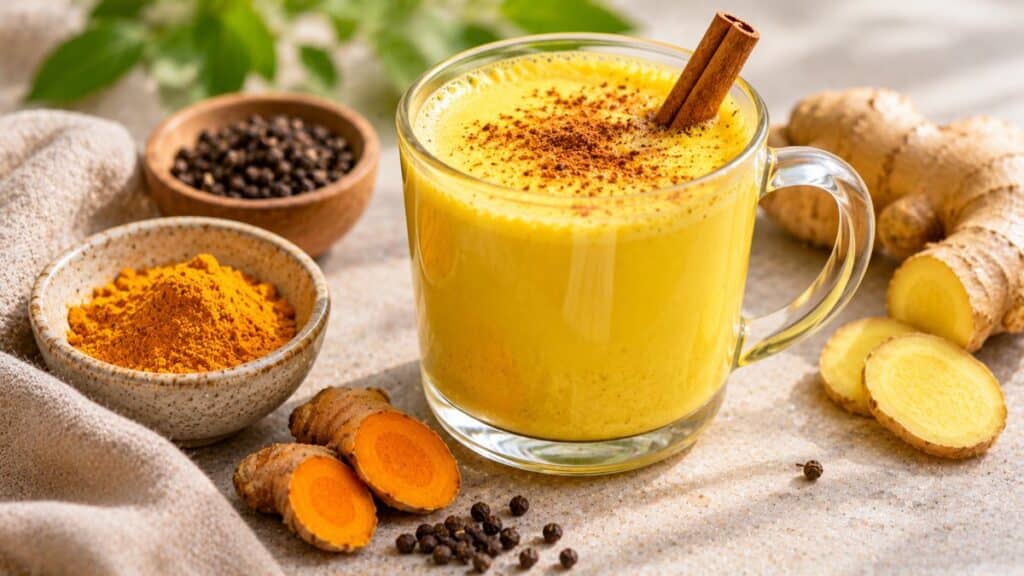
Golden milk, also called curcuma milk or a turmeric latte, is warm milk, dairy or plant-based, gently heated with ground turmeric, a pinch of black pepper, gingembre and cinnamon, plus a little fat and optional honey. It is a comforting traditional drink from India, but the research on curcumin, turmeric’s main active compound, comes from small trials of concentrated supplements, not from a daily cup, so treat golden milk as a good food habit rather than a remedy.
Below you will find a golden milk recipe with exact amounts, why the pepper and fat are there, what turmeric studies actually show, the Ayurvedic background, and who should skip it.
What is golden milk (turmeric latte), and where does it come from?
Golden milk is the English name for haldi doodh, which simply means “turmeric milk” in Hindi. In many Indian homes it is the mug a parent warms up on a cold evening: hot milk, a spoon of turmeric, sometimes a little ghee. Cafes later turned it into the “turmeric latte”, “golden latte” or “golden milk latte”, usually frothier and sweeter than the original.
The colour comes from turmeric root, a relative of ginger. Its best-known compound is curcumin, which, according to the NIH LiverTox database, makes up only about 1 to 6 percent of whole turmeric by dry weight. The rest is starch, fibre, fats, protein, water and other plant compounds. Keep that number in mind when you read headlines about curcumin: a teaspoon of the spice is not a curcumin supplement.
How do you make golden milk at home? (Easy turmeric milk recipe)
A one-mug recipe, mild enough for a first try. Once you like it, increase the turmeric slowly.
Ingredients (1 mug, about 250 ml)
- 250 ml milk: whole cow’s milk, or an unsweetened plant milk such as oat, soy or almond
- 1/2 teaspoon ground turmeric (or 2 cm fresh turmeric root, finely grated)
- 1 small pinch of freshly ground black pepper
- 1/4 teaspoon ground ginger (or 1 cm fresh ginger root, grated)
- 1/4 teaspoon ground cinnamon, or half a cinnamon stick
- 1 teaspoon ghee or coconut oil (optional if you use whole milk)
- Optional: 1 crushed cardamom pod, 1 teaspoon honey
Steps
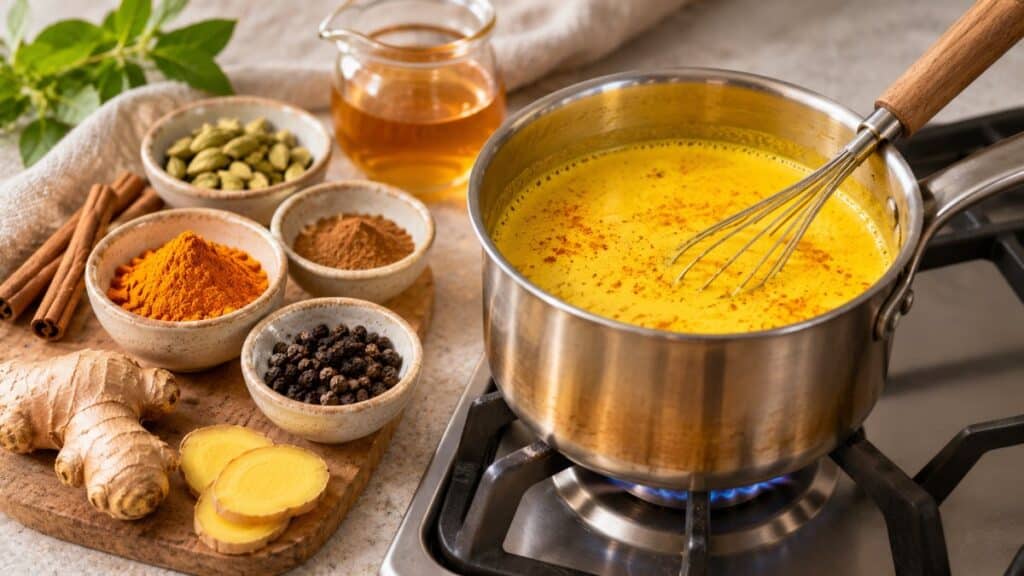
- Pour the milk into a small saucepan and add the turmeric, pepper, ginger, cinnamon and cardamom.
- Whisk well before you turn on the heat, so the turmeric does not form lumps.
- Warm over low to medium heat for 5 to 7 minutes, whisking now and then. Let it steam and barely tremble at the edges; do not let it boil hard, especially plant milks, which can split.
- Stir in the ghee or coconut oil for the last minute.
- If you used fresh roots or a cinnamon stick, strain through a fine sieve into your mug.
- Let it cool for a minute or two, then stir in the honey if you want sweetness.
Easy variations
For a make-ahead golden paste, cook 3 tablespoons turmeric with a pinch of pepper and about 100 ml water for a few minutes until thick, then keep it in a clean, closed jar in the fridge for a few days and stir a teaspoon into hot milk. For a lighter evening version, use half milk and half water, or make a golden milk tea by steeping the same spices in hot water and adding a splash of milk at the end. If you avoid added sugar, a few drops of vanilla or a chopped date cooked with the milk work well.
Why add black pepper and fat to turmeric milk?
Curcumin is poorly absorbed when you swallow it. In a frequently cited 1998 study in human volunteers, 2 grams of curcumin taken alone produced blood levels that were undetectable or very low. When the same dose was taken with 20 mg of piperine, the pungent compound in black pepper, bioavailability rose by about 2000 percent. It was a small study and it used isolated compounds, not a kitchen spice, but it explains why so many recipes add pepper.
Fat is the other traditional partner. Ghee, whole milk or a spoon of coconut oil carry fat-loving plant compounds better than water does, and supplement makers use a similar idea: LiverTox notes that higher-absorption curcumin products were developed with piperine or with lipid particles. If you want to go deeper into the pepper, fat and heat question, read our separate guide on how to take turmeric for best absorption, and our piece on ghee and how to use it.
Better absorption is not automatically better, though: LiverTox links high-absorption products, including piperine combinations, to rare cases of liver injury (see precautions below).
What are the real benefits of golden milk?
Here is what the research says about turmeric and curcumin, and how strong it is. Note that none of these studies tested golden milk itself.
| Question | What the research shows | Strength |
|---|---|---|
| Is curcumin absorbed on its own? | 2 g of curcumin alone gave undetectable or very low blood levels in volunteers | One small human study (1998) |
| Does black pepper help absorption? | 20 mg piperine with 2 g curcumin raised bioavailability by about 2000 percent | Same small study |
| Joint pain (arthritis) | A 2016 meta-analysis of 8 randomised trials found lower pain scores than placebo, at around 1,000 mg curcumin per day; versus pain medication there was no significant difference | Limited: few, small trials, authors call for larger studies |
| Knee osteoarthritis overall | NCCIH calls the initial evidence positive but says higher-quality studies are needed | Preliminary |
| Other uses (mood, allergies, cholesterol) | NCCIH: not enough evidence to conclude benefit | Insufficient |
| Digestive discomfort | EU herbal monograph accepts turmeric as a traditional remedy for fullness, slow digestion and wind, based on long use rather than trials | Traditional use |
Source: Shoba et al. 1998 (Planta Medica); Daily et al. 2016 (Journal of Medicinal Food); NCCIH Turmeric, 2025; European Medicines Agency herbal monograph on Curcuma longa, 2018.
So what does a mug give you? Warm milk or fortified plant milk, a little spice, and a calm ritual. The joint pain trials used concentrated extracts at doses half a teaspoon of spice will not reach. Your overall eating pattern matters far more than any single spice.
What does Ayurveda say about golden milk?
In the traditional Ayurvedic view, turmeric (haridra) has a bitter and pungent taste (tikta et katu rasa) and a heating quality (ushna virya). Milk is sweet, cooling and heavy. Cooking the two together is a classic balancing move: the spice is said to make milk easier to digest and kinder to agni, the digestive fire, while the milk softens the drying, heating side of turmeric.
Each addition in a traditional recipe has a job. Black pepper and ginger are seen as kindling for agni, cinnamon and cardamom as warming and aromatic, ghee as the carrier that takes the spices deeper. Ayurvedic teachers often suggest golden milk in the evening, especially in cold, windy seasons, and for people with a Vata or Kapha tendency. Someone with a strong Pitta constitution might use less pepper and ginger. Many traditional texts also advise against heating honey, which is why it goes in at the end.
This is tradition, not scientific evidence, but it is a practical guide to when the drink suits you.
When is the best time to drink golden milk?
There is no proven best time. Most people enjoy it as an evening wind-down drink, about an hour before bed. A routine that works:
- Make the turmeric paste on Sunday so the evening version takes two minutes.
- Drink one mug three to five evenings a week, not as a daily medicine.
- Pair it with the rest of a good evening: screens down, lights low, same bedtime. Our article on pourquoi le sommeil est la pierre angulaire d'un mode de vie sain explains why that matters more than any drink.
If you add honey, remember it is still a sugar that raises blood glucose. Our guide to the glycemic index with a food table shows how honey compares with table sugar, fruit and other everyday carbohydrates.
Golden milk side effects: who should be careful?
Turmeric in food amounts is widely used. The concerns grow with concentrated supplements and with daily, long-term use. Be careful if any of these apply to you:
- Blood thinners. Memorial Sloan Kettering’s herb database warns that turmeric may increase bleeding risk with warfarin and other anticoagulants, and that curcumin may affect how some other drugs are processed. Ask your doctor or pharmacist before drinking it regularly or taking turmeric supplements.
- Gallbladder and liver problems. Because turmeric may stimulate bile flow, the European Medicines Agency’s herbal monograph does not recommend it for people with blocked bile ducts, cholangitis, liver disease, gallstones or other biliary disease.
- Pregnancy and breastfeeding. NCCIH says turmeric supplements in pregnancy may be unsafe, and the EMA says safety in pregnancy and breastfeeding has not been established. Turmeric used as a spice in normal cooking is a different matter from supplement doses; check with your midwife or doctor before regular use.
- Liver injury. LiverTox estimates clinically apparent liver injury from turmeric at roughly 1 in 10,000 to 1 in 100,000 people exposed, mostly with supplements and especially high-absorption products. Stop and see a doctor if you notice unusual tiredness, nausea, poor appetite, dark urine or yellowing skin or eyes.
- Kidney stones and stomach upset. MSKCC advises people prone to kidney stones to talk to their provider first. NCCIH lists nausea, reflux, diarrhoea or constipation as possible side effects.
Related reading: plant milks and the vegan diet, high-quality fats in your diet.
FAQ
Is it OK to drink golden milk every day?
For most healthy adults, a mug made with half a teaspoon of turmeric is a food amount. Still, a few evenings a week is a sensible rhythm, and anyone on blood thinners, with gallbladder or liver disease, or who is pregnant should ask a doctor first.
Can I make golden milk with almond or oat milk?
Yes. Choose an unsweetened plant milk and add a teaspoon of coconut oil or ghee, because most plant milks are low in fat. Heat gently, as some plant milks separate when boiled.
Is golden milk good before bed?
Many people find a warm, caffeine-free drink relaxing in the evening, and that is reason enough. There is no good evidence that golden milk itself improves sleep, so treat it as part of a calming routine.
Can I make my own golden milk powder?
Yes. Mix 4 parts ground turmeric with 2 parts ground ginger, 2 parts cinnamon and a little ground black pepper, and store it in a dry, closed jar. Use about 1 teaspoon of the mix per mug and add the fat while heating; ready-made powders often contain added sugar, so check the label.
Sources
- National Center for Complementary and Integrative Health (NCCIH). Turmeric. nccih.nih.gov, updated April 2025. nccih.nih.gov/health/turmeric
- Shoba G, Joy D, Joseph T, et al. Influence of piperine on the pharmacokinetics of curcumin in animals and human volunteers. Planta Medica, 1998;64(4):353-356. PubMed 9619120
- Daily JW, Yang M, Park S. Efficacy of turmeric extracts and curcumin for alleviating the symptoms of joint arthritis: a systematic review and meta-analysis of randomized clinical trials. Journal of Medicinal Food, 2016. PubMed 27533649
- LiverTox: Clinical and Research Information on Drug-Induced Liver Injury. Turmeric. National Institute of Diabetes and Digestive and Kidney Diseases, updated 2025. ncbi.nlm.nih.gov/books/NBK548561
- Memorial Sloan Kettering Cancer Center. Turmeric (About Herbs). mskcc.org, 2026. mskcc.org: Turmeric
- European Medicines Agency, HMPC. European Union herbal monograph on Curcuma longa L., rhizoma (Revision 1). EMA, 2018. ema.europa.eu: Curcuma longa monograph
This article is for information only and is not medical advice. If you have a health condition, are pregnant or take medication, talk to your doctor or pharmacist before changing your diet or starting a supplement.


 Français
 English
 Deutsch
 Español

