
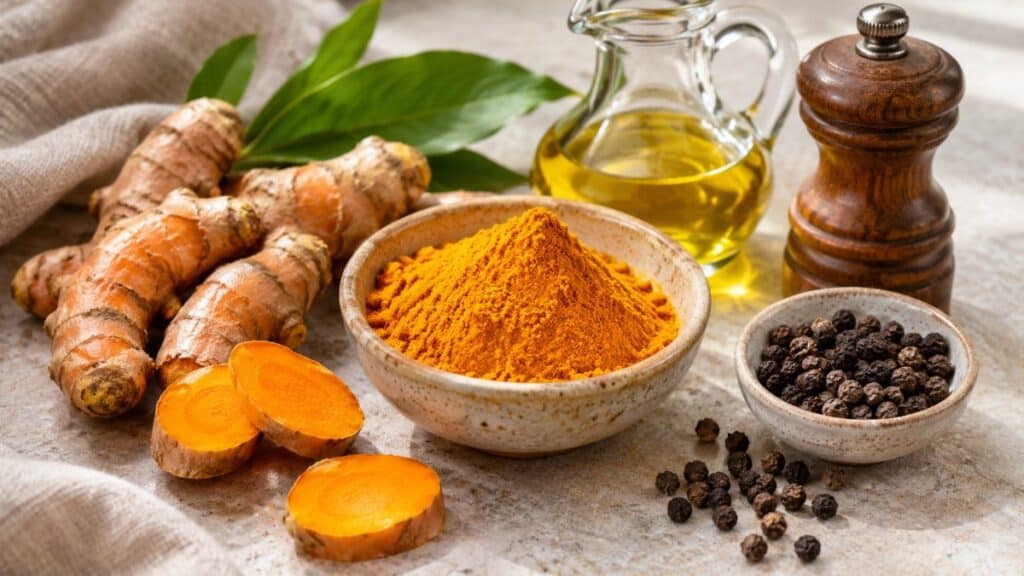
For better curcuma absorption, take it with black pepper and a little fat, ideally cooked into a meal. Curcumin, turmeric’s main active compound, dissolves poorly in water and is broken down quickly by the gut and liver; in a small 1998 study, adding 20 mg of piperine from black pepper to 2 g of curcumin raised blood levels by about 2,000%. Keep supplements at or below the EFSA acceptable daily intake of 3 mg of curcumin per kg of body weight a day, because highly absorbable products have been linked to rare liver injury.
Whether you cook with turmeric, drink turmeric milk or are eyeing a curcumin capsule, here is why absorption is the weak spot, what pepper and fat really do, the safe amounts, and a two-minute routine.
Why is turmeric absorption so poor?
Turmeric root is mostly not curcumin. Its yellow pigments, the curcuminoids, make up roughly 1 to 6% of turmeric by weight, and curcumin is about 60 to 70% of those. So one gram of ground turmeric holds somewhere around 10 to 60 mg of curcuminoids, depending on the batch.
Then the body makes it harder. Curcumin is practically insoluble in water, so little of it crosses the gut wall. What does get in is quickly attached to glucuronic acid in the gut and liver (a process called glucuronidation) and sent for excretion. Gut cells also pump some of it straight back out. In rats, oral bioavailability of curcumin was below 1%, and about 75% of a large dose left the body unchanged in the faeces.
For the plant itself, see our turmeric encyclopedia entry.
Does black pepper help turmeric absorption?
Yes, at least in the short term, and the reason is piperine, the compound that gives black pepper its bite. Piperine slows glucuronidation, so curcumin stays in circulation longer before it is cleared.
The famous number comes from Shoba and colleagues in 1998. Eight volunteers took 2 g of curcumin with or without 20 mg of piperine. With piperine, blood levels rose by about 2,000%. That headline needs context. Without piperine, curcumin in the blood was below what the lab could detect, so a large percentage rise started from almost nothing. The UK Committee on Toxicity (COT), reviewing the evidence in 2024, called the claim that piperine improves curcuminoid bioavailability “questionable”, with high uncertainty, and pointed to a 2021 study of 30 people where 15 mg of piperine with 1,500 mg of curcuminoids made no significant difference.
| Study | People | Dose | What happened |
|---|---|---|---|
| Shoba et al., 1998 | 8 | 2 g curcumin + 20 mg piperine, single dose | Blood curcumin up to about 2,000% higher; curcumin alone was below detection |
| Fança-Berthon et al., 2021 | 30 | 1,500 mg curcuminoids + 15 mg piperine | No significant difference from curcuminoids alone |
| Rat study, Shoba et al., 1998 | Animals | 2 g/kg curcumin + 20 mg/kg piperine | Bioavailability up to about 154% higher |
Source: Shoba G. et al., Planta Medica, 1998; UK Committee on Toxicity, Statement on turmeric and curcumin supplements, 2024 (toxicokinetics section).
A pinch of black pepper is cheap, traditional and plausibly helpful. Just don’t treat “2,000%” as a promise.
Should you take turmeric with fat?
Yes. Because curcumin dissolves in fat rather than water, eating it with fat gives it a better chance of being carried through the gut. A 2019 review in Nutrients notes that dietary lipids affect curcumin’s solubility and absorption, and suggests using turmeric with lecithin-rich ingredients such as eggs or vegetable oils. In one lab test of digestion it cites, adding curcuminoids to buttermilk raised the share available for absorption about 15-fold, although in yoghurt the share stayed low, around 6%.
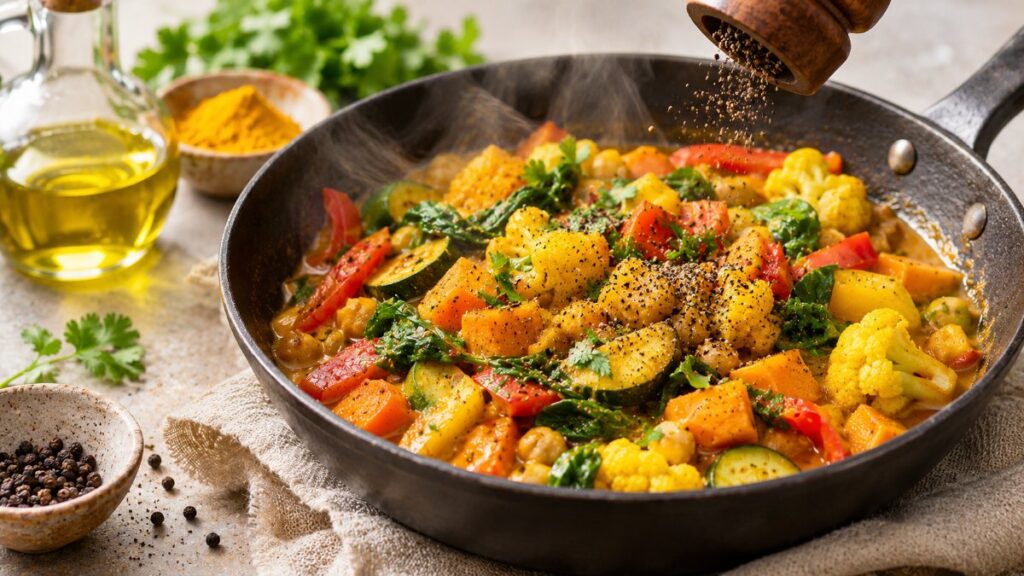
In the kitchen this means something very ordinary: warm turmeric in huile d'olive ou ghee before adding the vegetables, stir it into a curry made with coconut milk, or mix it into scrambled eggs. Our guide to graisses de haute qualité helps you pick the fat, and the post on why healthy fats matter explains the bigger picture.
Does heat or cooking help?
Cooking turmeric briefly in fat is how most traditional cuisines use it. We found no good human data showing that heat on its own improves absorption, so we won’t claim it. The fat is the part with a clear reason behind it.
Are high absorption curcumin supplements better?
Many supplements are designed to get around poor absorption, using piperine, liposomes, micelles, nanoparticles or phospholipid complexes. They are designed to raise blood levels. Whether that makes them work better for any health condition is still unclear: the US National Center for Complementary and Integrative Health (NCCIH) says the evidence is not strong enough to conclude that turmeric or curcumin helps any condition, though early research on knee osteoarthritis looks positive.
Higher absorption is also a safety question. NCCIH warns that highly bioavailable curcumin products may harm the liver, and the UK COT singled out micellar, nano and micro formulations as a particular concern needing more study. In a 2021 survey of 15 turmeric supplements reviewed by the COT, 10 contained piperine.
How much turmeric per day is safe?
The European Food Safety Authority (EFSA) set an acceptable daily intake (ADI) for curcumin of 3 mg per kg of body weight per day. EFSA estimated that curcumin from a normal diet stays below 7% of that figure, so turmeric in food is not the issue. Supplements are where you can go over.
| Body weight | EFSA ADI for curcumin (3 mg/kg/day) |
|---|---|
| 50 kg | 150 mg per day |
| 60 kg | 180 mg per day |
| 70 kg | 210 mg per day |
| 80 kg | 240 mg per day |
| 90 kg | 270 mg per day |
Source: EFSA Scientific Opinion on the re-evaluation of curcumin (E 100) as a food additive, 2010. Amounts per body weight calculated by Nutriveda from the ADI.
The UK COT found that 2 of the 15 supplements it surveyed would exceed the ADI if taken as the label directed. Check the curcumin content on your label, not the turmeric content, and do the sum for your weight.
What does Ayurveda say about taking turmeric?
In Ayurveda turmeric is called haridra, and it has been part of daily cooking and home remedies in India for centuries. What follows is the traditional view, not scientific evidence.
Ayurveda describes turmeric’s taste (rasa) as bitter and pungent and its energy (virya) as heating. It is traditionally used to balance kapha and vata, while people with a strong pitta nature are advised not to overdo it. Tradition rarely uses turmeric alone: it is cooked in ghee or oil, paired with black pepper, or simmered in milk as golden milk, framed as supporting agni, the digestive fire. Modern pharmacology, with its focus on fat and piperine, lands somewhere similar.
Turmeric often travels with fresh ginger, another warming spice.
How to take turmeric with food: an easy daily routine
You don’t need a capsule to use turmeric well. Make a small batch of spiced oil, often called a tadka, and spoon it over lentils, soups, roasted vegetables or eggs.
Turmeric and black pepper tadka (4 servings)
- 2 tablespoons ghee or extra virgin olive oil
- 1 teaspoon cumin seeds
- 1 teaspoon ground turmeric
- 1/4 teaspoon freshly ground black pepper
- 1 ail clove, thinly sliced
- A pinch of salt
- Warm the ghee or oil in a small pan over medium-low heat.
- Add the cumin seeds and let them sizzle for about 30 seconds.
- Add the garlic and cook for 30 seconds more, without letting it brown.
- Take the pan off the heat, stir in the turmeric, black pepper and salt, and let the warm oil bloom the spices for a few seconds.
- Pour over a bowl of cooked lentils, soup or vegetables right away.
Prefer a drink? Our golden milk recipe gives you a turmeric latte with milk, black pepper and a little fat in one warm cup. For the wider picture of how turmeric fits into an everyday eating pattern, see which foods reduce inflammation naturally.
Who should avoid turmeric supplements?
Turmeric as a spice in food is considered safe for most people. Concentrated supplements are different.
- Liver. LiverTox, the US National Institutes of Health database on drug-induced liver injury, rates turmeric as a well-documented cause of liver injury. It is rare but serious: onset is usually 1 to 4 months after starting, and most people recover within 1 to 3 months of stopping. Over 70% of cases carried a gene variant called HLA-B*35:01, which you cannot know you have without testing. Stop and see a doctor if you notice fatigue, nausea, loss of appetite, dark urine or yellowing of the skin or eyes.
- Blood thinners. Memorial Sloan Kettering Cancer Center advises against turmeric supplements if you take warfarin or other blood thinners because of a possible increase in bleeding risk.
- Gallbladder and bile ducts. The UK COT lists impaired bile flow as a condition that may raise risk even at lower doses. If you have gallstones or bile duct problems, ask your doctor first.
- Pregnancy and breastfeeding. NCCIH says turmeric supplements may be unsafe in pregnancy, and little is known about amounts above food levels while breastfeeding.
- Kidney stones. Memorial Sloan Kettering advises people prone to kidney stones to talk to a doctor before using turmeric supplements.
- Other medicines. Curcumin may interact with several drugs, including some chemotherapy agents. Tell your doctor or pharmacist what you take.
NCCIH notes that common oral forms are likely safe for up to 2 or 3 months at recommended amounts, with possible side effects such as nausea, acid reflux and diarrhoea.
FAQ
Does turmeric need black pepper to work?
Not strictly, but piperine slows the breakdown of curcumin, and one small study showed a large rise in blood levels. Later work is less clear-cut, so think of pepper as a helpful habit rather than a switch.
What is the best time to take turmeric?
There is no good evidence for a particular time of day. What matters more is taking it with a meal that contains some fat, which is also gentler on the stomach.
Is turmeric milk a good way to absorb turmeric?
It’s a reasonable one. Milk with some fat, plus a pinch of black pepper, gives curcumin both of the helpers discussed above. Lab digestion tests suggest dairy can carry curcuminoids, though how much varies with the product.
Can you take turmeric every day?
As a spice in food, yes. For supplements, stay at or below the EFSA ADI of 3 mg of curcumin per kg of body weight and talk to a doctor if you use them for more than a couple of months or take other medicines.
Sources
- Shoba G, Joy D, Joseph T, Majeed M, Rajendran R, Srinivas PS. Influence of piperine on the pharmacokinetics of curcumin in animals and human volunteers. Planta Medica, 1998. PubMed 9619120
- UK Committee on Toxicity of Chemicals in Food, Consumer Products and the Environment. Statement on the potential risk to human health of turmeric and curcumin supplements (COT/2024/07). Food Standards Agency, 2024. cot.food.gov.uk
- EFSA Panel on Food Additives and Nutrient Sources added to Food. Scientific Opinion on the re-evaluation of curcumin (E 100) as a food additive. EFSA Journal, 2010. efsa.europa.eu
- National Center for Complementary and Integrative Health. Turmeric. NIH, updated 2025. nccih.nih.gov
- LiverTox: Clinical and Research Information on Drug-Induced Liver Injury. Turmeric. National Institute of Diabetes and Digestive and Kidney Diseases, updated 2025. ncbi.nlm.nih.gov/books
- Dei Cas M, Ghidoni R. Dietary Curcumin: Correlation between Bioavailability and Health Potential. Nutrients, 2019. mdpi.com
- Memorial Sloan Kettering Cancer Center. Turmeric. About Herbs, Botanicals and Other Products, updated 2026. mskcc.org
This article is for information only and is not medical advice. If you have a health condition, are pregnant or take medication, talk to your doctor or pharmacist before changing your diet or starting a supplement.


 Français
 English
 Deutsch
 Español

