
By Nikola · Precision Nutrition L1 · Updated 4 November 2026
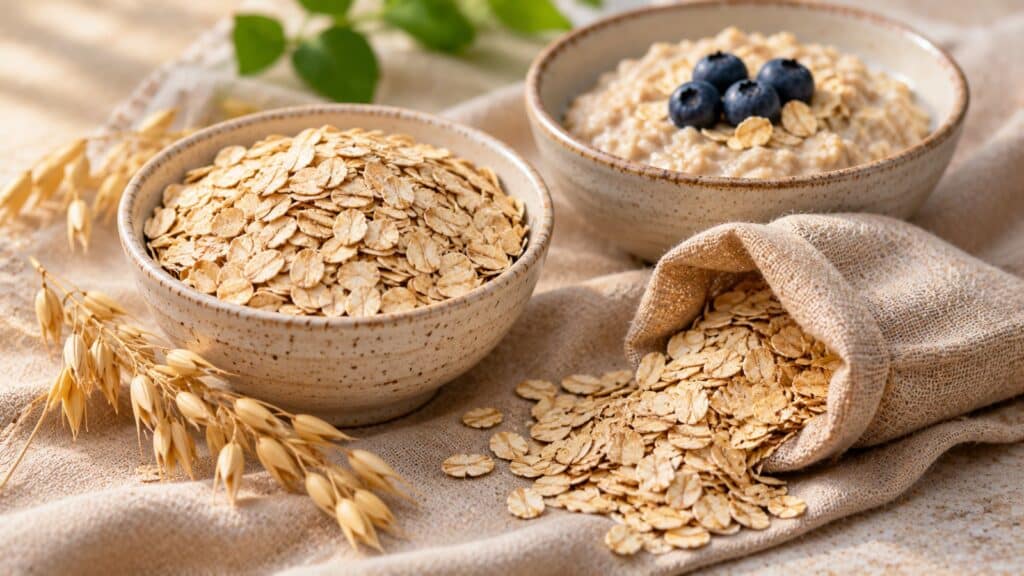
Oats (Avena sativa) are a whole grain eaten as rolled flakes, porridge, muesli and oat bran. They give slow-release carbohydrate, more protein than most grains and a special soluble fibre, beta-glucan, which the EU accepts can lower blood cholesterol. Rolled-oat porridge has a medium glycemic index of about 55; instant oats are much higher at about 79, so the kind you buy matters as much as the grain itself.
Oats nutrition per 100 g and per portion
| Nutritif | Rolled oats, dry, 100 g | Portion: 40 g dry | Porridge cooked in water, 100 g |
|---|---|---|---|
| Énergie | 379 kcal | 152 kcal | 71 kcal |
| Protéine | 13.2 g | 5.3 g | 2.5 g |
| Fat | 6.5 g | 2.6 g | 1.5 g |
| Carbohydrate | 67.7 g | 27.1 g | 12.0 g |
| of which fibre | 10.1 g | 4.0 g | 1.7 g |
| of which sugars | 1.0 g | 0.4 g | 0.3 g |
| Magnésium | 138 mg | 55 mg | 27 mg |
| Phosphore | 410 mg | 164 mg | 77 mg |
| Fer | 4.3 mg | 1.7 mg | 0.9 mg |
| Zinc | 3.6 mg | 1.5 mg | 1.0 mg |
| Manganese | 3.6 mg | 1.5 mg | 0.6 mg |
| Thiamin (vitamin B1) | 0.46 mg | 0.18 mg | 0.08 mg |
Source: USDA FoodData Central, SR Legacy: “Cereals, oats, regular and quick, not fortified, dry” (FDC 173904) and “Cereals, oats, regular and quick, unenriched, cooked with water, without salt” (FDC 173905), checked 4 November 2026. The 40 g portion is calculated from the dry record; one cup of dry oats weighs 81 g. Values rounded.
Water is the reason the porridge column looks so modest: 40 g of oats cooked into about 230 g of porridge gives the same nutrients as the 40 g column, spread over a bigger bowl.
Glycemic index of oats
| Oat food | Glycemic index (glucose = 100) | Category |
|---|---|---|
| Porridge from rolled oats | 55 ± 2 | low to medium |
| Muesli | 57 ± 2 | medium |
| Instant oat porridge | 79 ± 3 | high |
Source: Atkinson, Foster-Powell and Brand-Miller, International Tables of Glycemic Index and Glycemic Load Values 2008, Diabetes Care (summary table, means ± SEM).
The more an oat is cut, rolled thin and pre-cooked, the faster its starch is digested. Thick rolled oats or steel-cut oats, cooked and eaten with yogurt, nuts or seeds, raise blood sugar more gently than instant sachets. Adding protein and fat to the bowl also slows things down.
Health benefits: what the evidence says
- Cholesterol. The EU allows the claim that oat beta-glucan lowers blood cholesterol, and that high cholesterol is a risk factor for heart disease, for foods that provide at least 3 g of oat beta-glucan a day (Regulation (EU) No 1160/2011). Oat bran is richer in beta-glucan than flakes.
- Blood sugar after meals. The EU also accepts that beta-glucans from oats or barley eaten as part of a meal reduce the rise in blood sugar after that meal (Regulation (EU) No 432/2012, with conditions on the amount).
- Fibre. A 40 g portion gives 4 g of fibre, about a sixth of the 25 g a day EFSA considers adequate for normal bowel function in adults.
- Fullness. Beta-glucan forms a thick gel in the gut, which is one reason a bowl of porridge keeps many people full until lunch. How full you feel varies from person to person.
- Minerals. Oats are a good everyday source of magnesium, phosphorus, zinc and manganese.
Ayurveda: oats in the traditional system
Oats are not among the grains described in the classical Ayurvedic texts, which build their grain advice around rice, barley and wheat. Modern Ayurvedic teachers do: in Usha and Vasant Lad’s food guidelines, cooked oats are favourable for Vata and Pitta, while dry oats (granola, raw muesli) are better for Kapha, and cooked oats are on Kapha’s list to avoid. In plain words: warm, soft porridge suits people who run cold, dry or anxious; light, dry forms suit people who feel heavy and sluggish. This is a traditional view, not a clinical finding.
How to buy, cook and use oats
- Choose the cut: steel-cut (chewy, 20-30 minutes), thick rolled (5-10 minutes), quick or instant (1-3 minutes, higher glycemic index). Avoid flavoured instant sachets with added sugar.
- Basic porridge: 40 g oats with about 200-250 ml water or milk, a pinch of salt, simmer and stir. Top with fruit, nuts, seeds or a spoon of yogurt.
- Overnight oats: mix oats with milk or yogurt and leave them in the fridge overnight; eat cold with berries.
- Savoury oats: cook in stock, finish with a little olive oil, black pepper, épinard and an egg.
- Baking: blend oats into flour for pancakes, or add them to bread, meatballs and veggie burgers.
- Storage: keep oats in a closed container in a cool, dry place. Oats contain more fat than most grains, so they can turn stale over time.
Who should be careful
- Coeliac disease and gluten. Oats do not contain gluten themselves, but they are often grown and milled together with wheat, barley and rye. In the EU, oats can be labelled “gluten-free” only if they contain no more than 20 mg of gluten per kg (Regulation (EU) No 828/2014). A small number of people with coeliac disease also react to avenin, the oat protein; ask your doctor or dietitian before adding oats.
- Digestive comfort. If you are not used to fibre, start with smaller portions and drink enough water to avoid bloating.
- Diabetes. Prefer rolled or steel-cut oats over instant, watch the portion, and pair oats with protein; check your own glucose response if you measure it.
Related entries and articles
- Myrtilles – a classic porridge topping
- Bananes – natural sweetness for oats
- Sarrasin – another whole-grain breakfast option
- Lentilles – a different route to soluble fibre
- Mediterranean diet
- 7 aliments sains à manger au petit-déjeuner
- Foods for energy without caffeine
- Natural remedies for better digestion
FAQ
What is the glycemic index of oats?
Porridge made from rolled oats has a glycemic index of about 55, muesli about 57 and instant oat porridge about 79 (international GI tables, 2008). Less processed oats raise blood sugar more slowly.
Are oats gluten-free?
Oats are naturally free of gluten but are often contaminated with wheat, barley or rye. If you need to avoid gluten, buy oats labelled gluten-free and check with your doctor, because a few people with coeliac disease also react to oat protein.
How much oats should I eat per day?
A usual portion is 40-50 g dry (about half a cup). To reach the 3 g of oat beta-glucan behind the EU cholesterol claim, most people need oat bran or several oat portions across the day.
Sources
- USDA FoodData Central, SR Legacy: Cereals, oats, regular and quick, not fortified, dry (FDC 173904). fdc.nal.usda.gov
- USDA FoodData Central, SR Legacy: Cereals, oats, regular and quick, unenriched, cooked with water, without salt (FDC 173905). fdc.nal.usda.gov
- Atkinson FS, Foster-Powell K, Brand-Miller JC. International Tables of Glycemic Index and Glycemic Load Values: 2008. Diabetes Care 2008;31(12):2281-2283. PMC
- Commission Regulation (EU) No 1160/2011 on the authorisation of health claims, including oat beta-glucan and blood cholesterol. EUR-Lex
- Commission Regulation (EU) No 432/2012, list of permitted health claims (beta-glucans from oats and barley). EUR-Lex
- EFSA NDA Panel (2010). Scientific Opinion on Dietary Reference Values for carbohydrates and dietary fibre. EFSA Journal 8(3):1462. efsa.europa.eu
- Commission Implementing Regulation (EU) No 828/2014 on information to consumers on the absence or reduced presence of gluten in food. EUR-Lex
- Lad U, Lad V. Food Guidelines for Basic Constitutional Types, from Ayurvedic Cooking for Self-Healing, 2nd ed. The Ayurvedic Institute. ayurveda.com
This page is for information only and is not medical or dietary advice.
Encyclopédie de la nourriture
Lentilles Bleuets, crus Bananes, mûres et légèrement mûres, crues Sarrasin, grains entiers Lentilles
Encyclopédie des régimes
Статии по темата
- Golden Milk: Recipe and Benefits
- Healthy Desserts Without Sugar
- Plant-Based Meals for Weight Loss
- Ghee: Benefits and How to Use It
- Chia Seeds: Benefits and How to Eat Them
- Gut Health Foods: What to Eat for a Healthy Gut
- Superfoods List with Benefits (and What the Word Really Means)
- What Is the Glycemic Index? (With Food Table)
 Français
 English
 Deutsch
 Español

