
← EncyclopediaEncyclopédie de la nourriture
By Nikola · Precision Nutrition L1 · Updated 4 November 2026
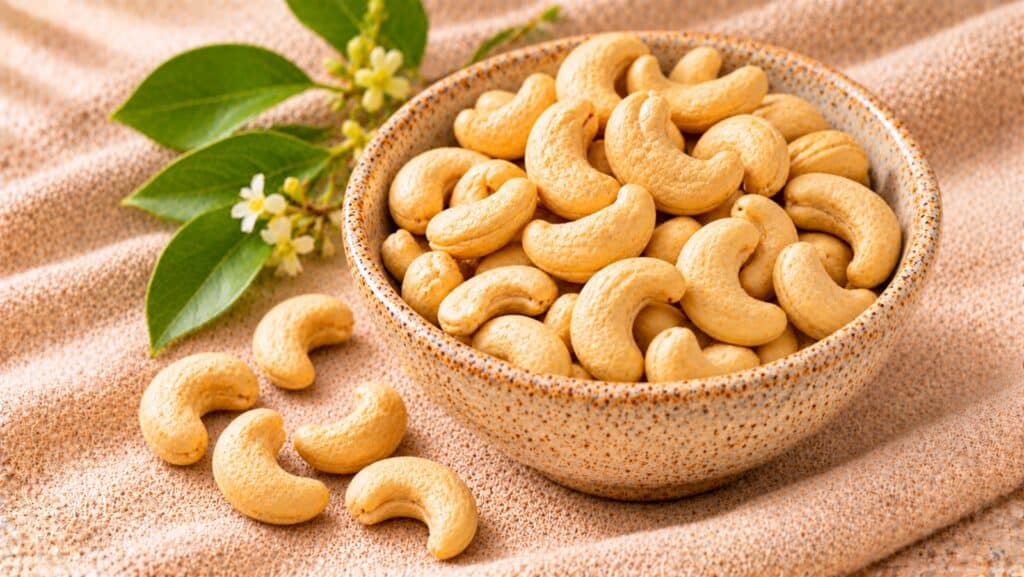
Cashews are the kidney-shaped seeds of the cashew tree (Anacardium occidentale), sold and eaten as a nut. 100 g of raw cashews gives 553 kcal, 18.2 g of protein and 43.8 g of fat, most of it unsaturated. They stand out for copper, magnesium, zinc and iron, and they are softer and starchier than most nuts, with 30.2 g of carbohydrate per 100 g. A 28 g handful gives about 155 kcal and more than half of the EU reference intake for copper.
Cashew nutrition per 100 g and per handful
| Nutritif | Raw cashews, 100 g | Handful: 28 g |
|---|---|---|
| Énergie | 553 kcal | 155 kcal |
| Protéine | 18.2 g | 5.1 g |
| Fat | 43.8 g | 12.3 g |
| of which monounsaturated | 23.8 g | 6.7 g |
| of which polyunsaturated | 7.8 g | 2.2 g |
| of which saturated | 7.8 g | 2.2 g |
| Carbohydrate (including fibre) | 30.2 g | 8.5 g |
| of which sugars | 5.9 g | 1.7 g |
| Fibre | 3.3 g | 0.9 g |
| Copper | 2.2 mg | 0.62 mg |
| Magnésium | 292 mg | 82 mg |
| Phosphore | 593 mg | 166 mg |
| Zinc | 5.8 mg | 1.6 mg |
| Fer | 6.7 mg | 1.9 mg |
| Manganese | 1.7 mg | 0.46 mg |
| Selenium | 19.9 µg | 5.6 µg |
| Vitamine K | 34.1 µg | 9.5 µg |
Source: USDA FoodData Central, SR Legacy, “Nuts, cashew nuts, raw” (FDC 170162), checked 4 November 2026. The record’s household measure is 1 oz = 28.35 g; the 28 g column is calculated from the 100 g values. USDA gives carbohydrate including fibre. Values rounded.
Measured against the EU nutrient reference values (Regulation (EU) No 1169/2011, Annex XIII), 100 g of cashews provides about 220% of the reference intake for copper (1 mg), 78% for magnesium (375 mg), 85% for phosphorus (700 mg), 58% for zinc (10 mg) and 48% for iron (14 mg). A 28 g handful covers about 62% of copper and 22% of magnesium.
Glycemic index of cashews
Cashews are not listed in the international GI tables (Atkinson 2008), so there is no tested value to quote. They contain more carbohydrate than walnuts ou almonds, but a handful still adds only about 8.5 g, alongside fat and protein that slow a meal down. Honey-roasted or sugar-coated cashews are a different product.
Health benefits: what the evidence says
- Nuts and heart health. A 2016 meta-analysis of 20 prospective studies found that each extra 28 g of nuts a day was associated with a 29% lower risk of coronary heart disease, 21% lower risk of cardiovascular disease and 22% lower all-cause mortality. Results were similar for tree nuts and peanuts (Aune and colleagues, 2016). These are observational findings: people who eat nuts may differ in other ways, so the numbers show an association, not proof that nuts caused the difference.
- Unsaturated fat. About 72% of the fat in cashews is unsaturated. The EU recognises that replacing saturated fats in the diet with unsaturated fats contributes to the maintenance of normal blood cholesterol levels (Regulation (EU) No 432/2012). The benefit comes from the swap, for example cashews instead of biscuits or processed meat, not from adding cashews on top.
- Copper. Cashews are one of the richest everyday food sources of copper. Under EU rules, copper contributes to normal energy-yielding metabolism, to the maintenance of normal connective tissues and to normal iron transport in the body.
- Magnesium and zinc. Magnesium contributes to normal muscle function, normal functioning of the nervous system and a reduction of tiredness and fatigue; zinc contributes to the normal function of the immune system (Regulation 432/2012). A handful gives 82 mg of magnesium and 1.6 mg of zinc.
- Iron. 100 g holds 6.7 mg of iron, but it is non-heme iron, which the body absorbs less well than iron from meat. Eating cashews with vegetables or fruit rich in vitamin C, such as poivrons, is a sensible pairing.
Ayurveda: cashews in the traditional system
In Usha and Vasant Lad’s food guidelines, all nuts, cashews included, are favourable for Vata in moderation. For Pitta and Kapha, cashews are on the list to avoid. This is a traditional view, not a clinical finding.
How to buy, prepare and use cashews
- As a snack: a measured 28 g handful of plain or dry-roasted cashews. Salted versions add sodium; WHO advises adults to keep salt below 5 g a day.
- Cashew cream: soak raw cashews in water for a few hours, drain, and blend with fresh water until smooth. It thickens soups and curries and can stand in for cream in plant-based cooking.
- Stir-fries and curries: toast cashews in a dry pan and add them at the end, for example to a vegetable curry with curcuma et chickpeas.
- Grain bowls: scatter chopped cashews over quinoa ou buckwheat with roasted vegetables.
- Cashew butter: choose jars where cashews are the main or only ingredient and check the label for added sugar, salt and oils.
- Storage: keep cashews in a closed jar in a cool, dark place, or in the fridge for longer storage. Throw away nuts that smell rancid or look mouldy. Mould on nuts can produce aflatoxins, which EFSA considers genotoxic and carcinogenic.
Who should be careful
- Tree nut allergy. Cashews are one of the tree nuts that must be emphasised in ingredient lists in the EU (Regulation (EU) No 1169/2011, Annex II). Tree nut allergies tend to last a lifetime and can cause anaphylaxis, a severe reaction that needs epinephrine and emergency care (MedlinePlus). If you are allergic to any tree nut, ask an allergist which nuts, if any, are safe for you.
- Poison ivy sensitivity and shell fragments. The oil inside the cashew shell contains irritant compounds related to those in poison ivy. In 1982, 54 people in Pennsylvania developed a poison ivy-like rash after eating imported cashew pieces that contained shell fragments (CDC, MMWR 1983). Cashews sold in shops have had the shell and its oil removed; do not try to crack fresh cashews in the shell yourself.
- If you watch your energy intake. At 553 kcal per 100 g, cashews are easy to overeat straight from the bag.
Related entries and articles
- Amandes – more fibre and vitamin E, fewer carbohydrates
- Pistachios – a close botanical relative of cashews
- Walnuts – the nut richest in plant omega-3
- Cacahuètes – the legume most people treat as a nut
- Graisses de haute qualité
- All about high-quality fats
- Plant-based meals for weight loss
FAQ
Are “raw” cashews really raw?
Not in the strict sense. The cashew shell contains an irritating oil related to poison ivy, so cashews are processed to remove the shell and oil before they are sold. “Raw” on the pack means they have not been roasted afterwards, and USDA’s nutrition data for raw cashews refers to these shelled nuts.
How many cashews should I eat a day?
There is no official amount for cashews. The large studies on nuts and heart health usually describe intake in steps of 28 g a day, which is a small handful of about 155 kcal. That portion also gives about 62% of the EU reference intake for copper.
Do cashews have more carbs than other nuts?
Yes. Per 100 g, raw cashews contain 30.2 g of carbohydrate and 3.3 g of fibre, compared with 21.6 g and 12.5 g in almonds and 13.7 g and 6.7 g in walnuts (USDA). On a low-carb diet they count for more than most nuts.
Sources
- USDA FoodData Central, SR Legacy: Nuts, cashew nuts, raw (FDC 170162). fdc.nal.usda.gov
- USDA FoodData Central, SR Legacy: Nuts, almonds (FDC 170567) and Nuts, walnuts, english (FDC 170187), for the comparison. fdc.nal.usda.gov
- Aune D, Keum N, Giovannucci E, et al. Nut consumption and risk of cardiovascular disease, total cancer, all-cause and cause-specific mortality: a systematic review and dose-response meta-analysis of prospective studies. BMC Medicine 2016;14:207. PMC
- Commission Regulation (EU) No 432/2012, list of permitted health claims (unsaturated fats, copper, magnesium, zinc). EUR-Lex
- Regulation (EU) No 1169/2011, Annex II (allergens) and Annex XIII (reference intakes). EUR-Lex
- MedlinePlus: Food allergy. medlineplus.gov
- CDC. Dermatitis associated with cashew nut consumption – Pennsylvania. MMWR 1983;32(9):129-130. cdc.gov
- EFSA: Aflatoxins in food. efsa.europa.eu
- WHO: Salt reduction, fact sheet. who.int
- Lad U, Lad V. Food Guidelines for Basic Constitutional Types, from Ayurvedic Cooking for Self-Healing, 2nd ed. The Ayurvedic Institute. ayurveda.com
This page is for information only and is not medical or dietary advice.
Encyclopédie de la nourriture
Amandes Graisses de haute qualité Pistachios Cacahuètes Pistachios Walnuts Cacahuètes
 Français
 English
 Deutsch
 Español

