
← EncyclopediaEncyclopédie de la nourriture
By Nikola · Precision Nutrition L1 · Updated 4 November 2026
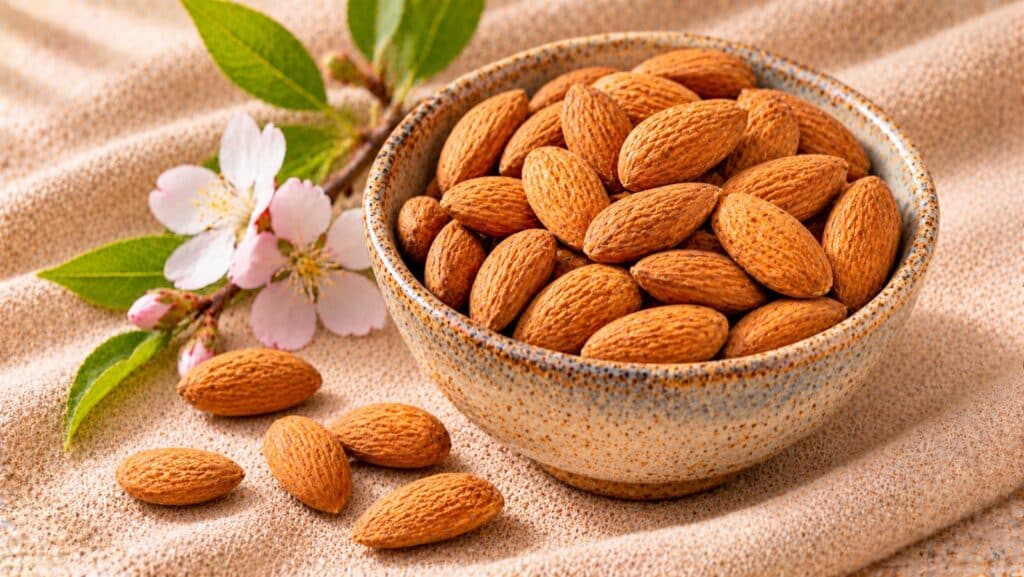
Almonds are the seeds of the almond tree (Prunus dulcis), eaten and sold as a nut. 100 g of almonds gives 579 kcal, 21.2 g of protein, 12.5 g of fibre and 25.6 mg of vitamin E. A 28 g handful, about 23 almonds, provides 162 kcal and 7.2 mg of vitamin E, which is 60% of the EU reference intake. Most of their fat is monounsaturated, and in controlled trials diets with almonds lowered LDL cholesterol by a modest amount.
Almond nutrition per 100 g and per handful
| Nutritif | Almonds, 100 g | Handful: 28 g (about 23 almonds) |
|---|---|---|
| Énergie | 579 kcal | 162 kcal |
| Protéine | 21.2 g | 5.9 g |
| Fat | 49.9 g | 14.0 g |
| of which monounsaturated | 31.6 g | 8.9 g |
| of which polyunsaturated | 12.3 g | 3.4 g |
| of which saturated | 3.8 g | 1.1 g |
| Carbohydrate (including fibre) | 21.6 g | 6.0 g |
| of which sugars | 4.35 g | 1.2 g |
| Fibre | 12.5 g | 3.5 g |
| Vitamine E | 25.6 mg | 7.2 mg |
| Riboflavine (B2) | 1.14 mg | 0.32 mg |
| Magnésium | 270 mg | 76 mg |
| Calcium | 269 mg | 75 mg |
| Phosphore | 481 mg | 135 mg |
| Potassium | 733 mg | 205 mg |
| Fer | 3.71 mg | 1.0 mg |
| Copper | 1.03 mg | 0.29 mg |
| Manganese | 2.18 mg | 0.61 mg |
Source: USDA FoodData Central, Nuts, almonds, FDC ID 170567 (fdc.nal.usda.gov), checked 4 November 2026. USDA household measure: 1 oz (23 whole kernels) = 28.35 g; one almond weighs about 1.2 g. The 28 g column is calculated from the 100 g values. USDA carbohydrate includes fibre. Values rounded.
Against the EU nutrient reference values (Regulation (EU) No 1169/2011, Annex XIII), 100 g of almonds covers about twice the reference intake for vitamin E (12 mg) and for manganese (2 mg), all of the copper reference (1 mg), 81% of riboflavin (1.4 mg) and 72% of magnesium (375 mg). A 28 g handful gives about 20% of the magnesium reference and 23% of riboflavin.
Glycemic index of almonds
Almonds are not listed in the international GI tables (Atkinson 2008). More than half of their carbohydrate is fibre, and a handful contains only about 2.5 g of other carbohydrate, so a portion adds very little digestible carbohydrate to a meal.
Health benefits: what the evidence says
- Blood lipids. A meta-analysis of randomised controlled trials (18 publications, 27 almond-control comparisons, 20 to 113 g of almonds a day) found that almond diets lowered total cholesterol by 0.153 mmol/l, LDL cholesterol by 0.124 mmol/l and triglycerides by 0.067 mmol/l compared with control diets. HDL cholesterol did not change (Musa-Veloso and colleagues, 2016). The effect is small but consistent.
- Unsaturated fat. Of the 49.9 g of fat in 100 g of almonds, only 3.8 g is saturated. The EU permits the claim that replacing saturated fats with unsaturated fats in the diet contributes to the maintenance of normal blood cholesterol levels, for foods high in unsaturated fat (Regulation (EU) No 432/2012). Almonds work best instead of biscuits or pastries, not on top of them.
- Vitamin E. NIH describes vitamin E as a fat-soluble antioxidant, and alpha-tocopherol as the only form recognised to meet human needs. Almonds are one of the richest everyday food sources: NIH lists 6.8 mg per ounce of dry-roasted almonds, against an adult RDA of 15 mg. Under EU rules, foods that are a source of vitamin E may state that it contributes to the protection of cells from oxidative stress.
- Magnesium. NIH notes that many people in the United States eat less magnesium than recommended, and lists almonds among good sources (80 mg per ounce dry-roasted). EU-permitted claims for magnesium include normal muscle function and the reduction of tiredness and fatigue.
- Fibre. A handful gives 3.5 g of fibre, about 14% of the 25 g a day EFSA considers adequate for normal bowel function in adults.
Ayurveda: almonds in the traditional system
In Usha and Vasant Lad’s food guidelines, nuts in general are favourable for Vata in moderation. For Pitta, almonds with their skin are on the list to avoid, while almonds soaked and peeled are favoured. For Kapha, soaked and peeled almonds are okay only rarely. It is a traditional view, not a clinical finding.
How to buy, prepare and eat almonds
- Petit-déjeuner: a small handful of chopped almonds on porridge or on Greek yogurt avec grated apple et cinnamon.
- Soaked and peeled: cover raw almonds with water, leave them overnight in the fridge, drain and press each one between your fingers; the skin slides off. They turn softer and milder.
- Salads and vegetables: toasted flaked almonds go well with haricots verts, brocoli or a épinard salad. Toast them in a dry pan for two or three minutes.
- Almond butter: choose jars that list almonds as the only ingredient, or almonds and salt.
- Ground almonds: replace part of the flour in cakes, biscuits or pancakes, or use them to thicken sauces.
- Storage: keep almonds in a closed container in a cool, dark place, or in the fridge for longer storage. A bitter, paint-like smell means the fat has gone rancid.
Who should be careful
- Nut allergy. Almonds are named among the tree nuts in the list of 14 allergens that must be highlighted on food labels in the EU (Regulation (EU) No 1169/2011, Annex II). If you have a nut allergy, avoid almonds and almond products and check labels for “may contain” warnings, with advice from an allergist.
- Energy density. At 579 kcal per 100 g, almonds are easy to overeat straight from the bag. Portion out a handful rather than eating from a large pack, especially if you are trying to lose weight.
- Salted and coated almonds. Salted, smoked, honey-roasted or chocolate almonds add salt or sugar. Plain raw or dry-roasted almonds are the default.
Related entries and articles
- Walnuts – the nut with the most plant omega-3
- Hazelnuts – another nut rich in vitamin E and monounsaturated fat
- Pumpkin seeds – for more magnesium and zinc
- Avoine – porridge with almonds
- Graisses de haute qualité
- All about high-quality fats
- 7 aliments sains à manger au petit-déjeuner
FAQ
How many almonds should I eat a day?
There is no official amount. A usual portion is a handful of about 28 g, roughly 23 almonds, which gives 162 kcal, 7.2 mg of vitamin E and 3.5 g of fibre. Trials have used 20 to 113 g a day.
Do almonds need to be soaked?
No, plain almonds are fine to eat as they are. Soaking makes them softer and easier to peel, and it is the traditional way in Ayurveda. NIH notes that soaking seeds may reduce the binding of zinc by phytates, but there is little direct evidence that soaked almonds are meaningfully more nutritious.
Do almonds lower cholesterol?
They can help a little. In a meta-analysis of controlled trials, almond diets lowered LDL cholesterol by about 0.12 mmol/l and total cholesterol by about 0.15 mmol/l compared with control diets. The benefit is greatest when almonds replace foods high in saturated fat rather than being added on top.
Sources
- USDA FoodData Central: Nuts, almonds (FDC ID 170567). fdc.nal.usda.gov
- Musa-Veloso K, Paulionis L, Poon T, Lee HY. The effects of almond consumption on fasting blood lipid levels: a systematic review and meta-analysis of randomised controlled trials. Journal of Nutritional Science 2016;5:e34. PMC
- NIH Office of Dietary Supplements: Vitamin E, Fact Sheet for Health Professionals. ods.od.nih.gov
- NIH Office of Dietary Supplements: Magnesium, Fact Sheet for Health Professionals. ods.od.nih.gov
- NIH Office of Dietary Supplements: Zinc, Fact Sheet for Health Professionals. ods.od.nih.gov
- Commission Regulation (EU) No 432/2012, list of permitted health claims. EUR-Lex
- Regulation (EU) No 1169/2011 on food information to consumers, Annex II (allergens) and Annex XIII (reference intakes). EUR-Lex
- EFSA NDA Panel (2010). Scientific Opinion on Dietary Reference Values for carbohydrates and dietary fibre. EFSA Journal 8(3):1462. efsa.europa.eu
- Atkinson FS, Foster-Powell K, Brand-Miller JC. International tables of glycemic index and glycemic load values: 2008. Diabetes Care 2008;31(12):2281-2283. PMC
- Lad U, Lad V. Food Guidelines for Basic Constitutional Types, from Ayurvedic Cooking for Self-Healing, 2nd ed. The Ayurvedic Institute. ayurveda.com
This page is for information only and is not medical or dietary advice.
Encyclopédie de la nourriture
Avoine Graisses de haute qualité Pumpkin seeds Hazelnuts Cashews Pistachios Cacahuètes Walnuts Walnuts Hazelnuts Pumpkin seeds
 Français
 English
 Deutsch
 Español

