
By Nikola · Precision Nutrition L1 · Updated 4 November 2026
Cinnamon is the dried inner bark of Cinnamomum trees, sold as rolled sticks or ground spice. Two kinds matter in the kitchen: Ceylon cinnamon (Cinnamomum verum), mild and delicate, and cassia (Cinnamomum cassia and related species), stronger, cheaper and far more common in supermarkets. Cassia contains much more coumarin, a natural compound that can harm the liver in sensitive people when eaten in large amounts, so the type and the amount matter more than any claimed health effect. Research does not clearly support cinnamon for blood sugar or any other condition yet (NIH).
Cinnamon nutrition per 100 g and per teaspoon
| Nutritif | Per 100 g (ground) | Per teaspoon (2.6 g) |
|---|---|---|
| Énergie | 247 kcal | 6 kcal |
| Protéine | 4.0 g | 0.1 g |
| Fat | 1.2 g | 0.03 g |
| Carbohydrate | 80.6 g | 2.1 g |
| of which fibre | 53.1 g | 1.4 g |
| of which sugars | 2.2 g | 0.1 g |
| Calcium | 1000 mg | 26 mg |
| Manganese | 17.5 mg | 0.46 mg |
| Fer | 8.3 mg | 0.2 mg |
| Vitamine K | 31.2 µg | 0.8 µg |
Source: USDA FoodData Central, SR Legacy, “Spices, cinnamon, ground” (FDC 171320), checked 4 November 2026; one teaspoon = 2.6 g, one tablespoon = 7.8 g (same record). The record does not say whether the cinnamon was Ceylon or cassia. Values rounded.
More than half of ground cinnamon by weight is fibre, but a teaspoon gives only 1.4 g of it. The manganese is the one nutrient that adds up noticeably even in a teaspoon.
Ceylon or cassia: why it matters
| Ceylon cinnamon | Cassia cinnamon | |
|---|---|---|
| Look | thin, papery layers rolled like a cigar; soft and crumbly | one thick, hard layer of bark |
| Flavour | mild, sweet, citrusy | strong, spicy, slightly bitter |
| Coumarin (measured by AGES) | up to about 185 mg per kg | about 1,880-3,260 mg per kg |
| Where you find it | labelled “Ceylon”, more expensive | most ground “cinnamon” and pastries |
Cassia has roughly a hundred times more coumarin than Ceylon cinnamon. The tolerable daily intake for coumarin is 0.1 mg per kg of body weight, about 6 mg a day for a 60 kg adult. With the coumarin levels AGES measured, that equals roughly 2-3 g of cassia cinnamon, or about one teaspoon, before counting any other sources. Austria’s food agency advises no more than half a teaspoon (0.5 g) a day for children. Ceylon cinnamon leaves far more room.
Glycemic index
Cinnamon has no glycemic index: a teaspoon carries about 2 g of carbohydrate, most of it fibre, and does not raise blood sugar.
Health benefits: what the evidence says
- Blood sugar and diabetes. Many studies have tested cinnamon, but they are hard to compare because the species and plant part are often unclear. NCCIH concludes it is unclear whether cinnamon supplements help diabetes or weight loss.
- Other conditions. Research does not clearly support cinnamon for any health condition. A nasal spray with Ceylon cinnamon extract showed early promise for hay fever, but more reliable evidence is needed (NCCIH).
- Flavour without sugar. The most useful everyday benefit is practical: cinnamon makes porridge, yogurt, fruit and coffee taste sweeter, which can help you use less sugar.
Ayurveda: cinnamon in the traditional system
In Ayurveda cinnamon (tvak) is a warming, sweet-pungent spice used in chai, golden milk and rice dishes. In Usha and Vasant Lad’s food guidelines cinnamon is listed as favourable for all three doshas, Vata, Pitta and Kapha, which makes it one of the easiest spices to use daily in moderate amounts. This is a traditional view, not a clinical finding.
How to use cinnamon
- Petit-déjeuner: a pinch on oat porridge, yogurt or stewed apples.
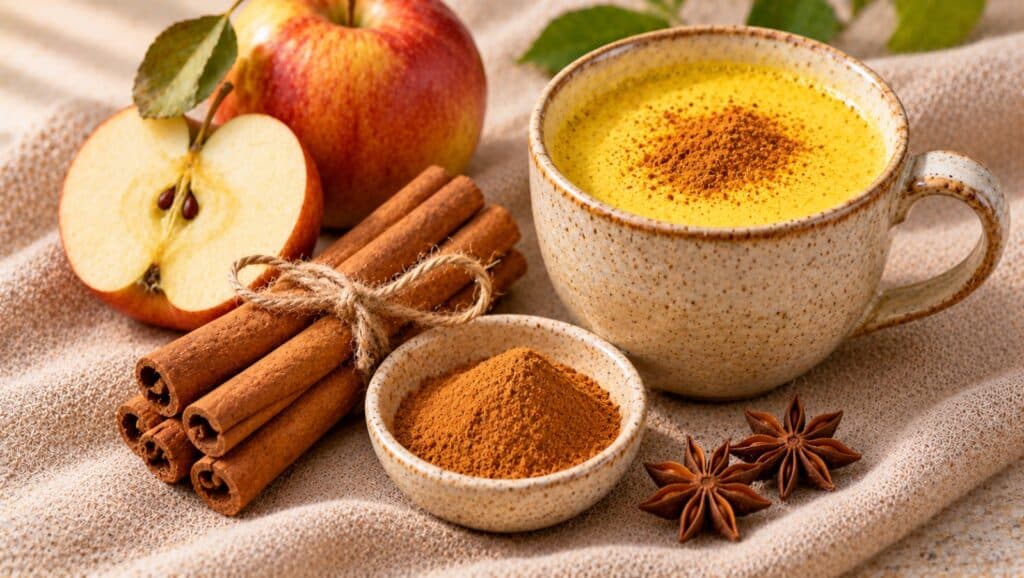
- Drinks: a stick in tea, coffee, warm milk or golden milk with curcuma et gingembre.
- Savoury: dans lentil et chickpea stews, rice pilaf, Moroccan-style tagines and tomate sauces.
- Baking: for cakes and biscuits made often, choose Ceylon cinnamon.
- Storage: sticks keep their aroma longer than ground cinnamon; store both closed, dark and dry.
Who should be careful
- Liver disease. Prolonged use of cassia cinnamon could be an issue for sensitive people, such as those with liver disease (NCCIH). Prefer Ceylon and keep to small amounts.
- Children. Keep amounts small; AGES advises at most half a teaspoon a day.
- Pregnancy. Cinnamon in food amounts appears safe; larger amounts are not recommended (NCCIH).
- Supplements and medicines. Capsules can contain much more than a kitchen pinch. If you take medicines, especially for diabetes, talk to your doctor first.
- Never inhale or swallow spoonfuls of dry powder (the “cinnamon challenge”): it can cause serious harm to the lungs (NCCIH).
Related entries and articles
- Gingembre et curcuma – the warming trio of golden milk
- Avoine – the classic base for cinnamon
- Pommes
- What is the glycemic index? (with food table)
- Ayurvedic diet for beginners
FAQ
How much cinnamon per day is safe?
For cassia, the common supermarket type, about one teaspoon a day is the upper range for a 60 kg adult because of its coumarin; children should have much less. Ceylon cinnamon contains only traces of coumarin, so normal kitchen amounts are not a concern.
Does cinnamon lower blood sugar?
The evidence is unclear. Studies vary in the type and amount of cinnamon, and NCCIH concludes it is not clear whether cinnamon supplements help diabetes. Do not replace diabetes medication with cinnamon.
How can I tell Ceylon from cassia?
Ceylon sticks are made of many thin, papery layers and crumble easily; cassia sticks are one thick, hard layer. For ground cinnamon, check the label for “Ceylon” or Cinnamomum verum.
Sources
- USDA FoodData Central, SR Legacy: Spices, cinnamon, ground (FDC 171320). fdc.nal.usda.gov
- National Center for Complementary and Integrative Health (NIH): Cinnamon, updated November 2024. nccih.nih.gov
- AGES (Austrian Agency for Health and Food Safety): Coumarin. ages.at
- BfR (German Federal Institute for Risk Assessment): FAQ on coumarin in cinnamon and other foods. bfr.bund.de
- Lad U, Lad V. Food Guidelines for Basic Constitutional Types, from Ayurvedic Cooking for Self-Healing, 2nd ed. The Ayurvedic Institute. ayurveda.com
This page is for information only and is not medical or dietary advice.
Encyclopédie de la nourriture
Статии по темата
- Flaxseed: Benefits and How to Eat It
- Kapha Diet: Foods That Balance Kapha Dosha
- Low Glycemic Fruits List (With GI Values)
- Zinc-Rich Foods: Best Sources and How Much You Need
- No-Bake Energy Balls with Oats and Dates
- Vata Diet: What to Eat to Balance Vata Dosha
- Anti-Inflammatory Breakfast Ideas
- Anti-Inflammatory Diet Meal Plan for 7 Days
 Français
 English
 Deutsch
 Español

