
← EncyclopediaEncyclopédie de la nourriture
By Nikola · Precision Nutrition L1 · Updated 5 November 2026
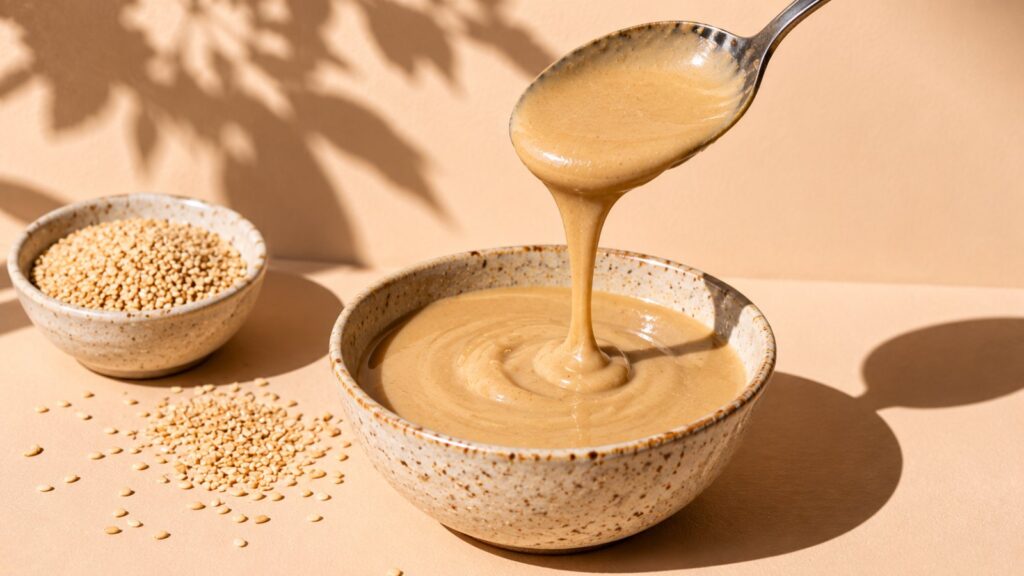
Tahini is a paste of ground sesame seeds, the base of hummus, baba ganoush and many Middle Eastern and Balkan sauces. 100 g gives 592 kcal, 17 g of protein and 53 g of fat, most of it unsaturated. One tablespoon (15 g) has 89 kcal and is a good source of copper, phosphorus and thiamin (vitamin B1). Sesame is one of the 14 allergens that must be declared on EU labels, so tahini is off the menu for anyone with a sesame allergy.
Tahini nutrition per 100 g and per tablespoon
| Nutritif | Tahini, 100 g | 1 tablespoon (15 g) |
|---|---|---|
| Énergie | 592 kcal | 89 kcal |
| Protéine | 17.4 g | 2.6 g |
| Fat | 53.0 g | 8.0 g |
| of which saturated | 7.4 g | 1.1 g |
| of which monounsaturated | 20.0 g | 3.0 g |
| of which polyunsaturated | 23.2 g | 3.5 g |
| of which linoleic acid (omega-6) | 22.8 g | 3.4 g |
| Carbohydrate | 21.5 g | 3.2 g |
| Fibre | 4.7 g | 0.7 g |
| Copper | 1.61 mg (161% NRV) | 0.24 mg (24% NRV) |
| Phosphore | 790 mg (113% NRV) | 119 mg (17% NRV) |
| Thiamin (B1) | 1.59 mg (145% NRV) | 0.24 mg (22% NRV) |
| Selenium | 34.4 µg (63% NRV) | 5.2 µg (9% NRV) |
| Folate | 98 µg (49% NRV) | 15 µg (7% NRV) |
| Zinc | 4.6 mg (46% NRV) | 0.7 mg (7% NRV) |
| Fer | 4.4 mg (32% NRV) | 0.7 mg (5% NRV) |
| Calcium | 141 mg (18% NRV) | 21 mg (3% NRV) |
| Sodium | 35 mg | 5 mg |
Source: USDA FoodData Central, SR Legacy, “Seeds, sesame butter, tahini, type of kernels unspecified” (FDC 168604), checked 5 November 2026. The tablespoon weight is the USDA portion; per-spoon values are calculated. NRV: EU nutrient reference value, Regulation (EU) No 1169/2011, Annex XIII. The record does not say whether the seeds were hulled or unhulled, and it gives no values for sugars, vitamin E or manganese.
Two things stand out. First, the fat: 43 of the 53 g are unsaturated, and almost all of the polyunsaturated fat is omega-6 linoleic acid, with very little omega-3. Second, the micronutrients: per 100 g tahini is rich in copper, phosphorus and thiamin, but because a realistic portion is one or two tablespoons, each spoon contributes a useful share rather than a whole day’s worth.
Glycemic index
Tahini is not listed in the international GI tables (Atkinson 2008). A tablespoon contains about 3 g of carbohydrate, so it has very little effect on blood sugar by itself.
Health benefits: what the evidence says
- Mostly unsaturated fat. WHO recommends that fat intake should be mainly unsaturated and that saturated fat be replaced with polyunsaturated or monounsaturated fat from plant sources. In the EU, the authorised health claim reads: “Replacing saturated fats with unsaturated fats in the diet contributes to the maintenance of normal blood cholesterol levels” (Regulation (EU) No 432/2012). Tahini spread on bread instead of butter is an example of that swap: per 15 g it has 1.1 g of saturated fat, against about 7.7 g in 15 g of salted butter (USDA).
- Plant protein and minerals. With 2.6 g of protein per spoon and meaningful copper, phosphorus, zinc and iron, tahini adds nutrients to plant-based meals, especially combined with chickpeas in hummus.
- Calcium: less than often claimed. Tahini is sometimes promoted as a calcium source. This USDA record gives 141 mg per 100 g, or 21 mg per tablespoon, about 3% of the EU reference value. NIH ODS also notes that compounds in plants, such as phytic acid, can reduce calcium absorption.
- Energy-dense. At 89 kcal per spoon, tahini is nourishing but easy to overdo in dressings and sauces.
How to eat it
- Stir before use: the oil separates and rises to the top in the jar; mix it back in until smooth.
- Hummus: blend cooked chickpeas with tahini, lemon juice, ail and a little huile d'olive.
- Tahini sauce: whisk 2 tablespoons of tahini with lemon juice, a pinch of salt and cold water until it turns pale and pourable. It is very good on roasted vegetables, falafel and grain bowls.
- Baba ganoush: mix roasted, mashed aubergine with tahini, lemon and ail.
- Petit-déjeuner: a thin layer on wholegrain toast, or a spoon stirred into porridge with a little Miel.
- Storage: keep it closed in a cool, dark place, or in the fridge if you use it slowly; check the label, because storage advice differs between brands. If it smells or tastes off, throw it away.
Who should be careful
- Sesame allergy. Sesame seeds and products made from them are one of the 14 allergens that must be declared on food labels in the EU (Regulation (EU) No 1169/2011, Annex II), and since 1 January 2023 sesame has also been the 9th major food allergen in the United States (FDA). MedlinePlus lists sesame among the foods that cause most food allergies. Check labels of hummus, halva, bread and sauces, and avoid tahini completely if you are allergic.
- Weight management. At 89 kcal per tablespoon, measure tahini rather than pouring it.
- Omega-6 balance. Tahini adds mainly omega-6 fat. If you want more omega-3, add sources such as oily fish, walnuts ou flaxseed alongside it.
Traditional view (Ayurveda)
In Usha and Vasant Lad’s food guidelines, tahini is favourable for Vata and best avoided by Pitta and Kapha. This is a traditional system, not evidence from clinical studies.
Related entries and articles
- Sesame seeds – the seed tahini is made from
- Pois chiches – the other half of hummus
- Lemons – for tahini sauce
- Aubergine – for baba ganoush
- Extra virgin olive oil
- Plant-based meals for weight loss
- All about high-quality fats
FAQ
Is tahini healthy?
Yes, in normal amounts. Tahini is mostly unsaturated fat and adds plant protein, copper, phosphorus and thiamin to meals. It is also energy-dense, at 89 kcal per tablespoon, so one or two spoons is a sensible portion.
Is tahini high in calcium?
Less than its reputation suggests. The USDA record gives 141 mg per 100 g, or about 21 mg in a tablespoon, while the EU reference value is 800 mg a day. Tahini contributes some calcium, but it cannot replace dairy or other calcium-rich foods on its own.
Does tahini need to be refrigerated?
Follow the label. Most jars state their own storage advice: usually a cool, dark place, with the fridge as an option if you use tahini slowly. In the fridge it gets thicker, so stir it well before use.
Sources
- USDA FoodData Central, SR Legacy: Seeds, sesame butter, tahini, type of kernels unspecified (FDC 168604). fdc.nal.usda.gov
- USDA FoodData Central, SR Legacy: Beurre, salé (FDC 173410), for comparison. fdc.nal.usda.gov
- Regulation (EU) No 1169/2011, Annex II (allergens) and Annex XIII (reference values). legislation.gov.uk
- Regulation (EU) No 432/2012, Annex: list of permitted health claims (replacing saturated fats). legislation.gov.uk
- World Health Organization: WHO updates guidelines on fats and carbohydrates (2023). who.int
- NIH Office of Dietary Supplements: Calcium, fact sheet for health professionals. ods.od.nih.gov
- U.S. Food and Drug Administration: Food allergies. fda.gov
- MedlinePlus: Food allergy. medlineplus.gov
- Atkinson FS, Foster-Powell K, Brand-Miller JC. International tables of glycemic index and glycemic load values: 2008. Diabetes Care 31(12):2281-2283. PMC2584181
- Lad U, Lad V. Food Guidelines for Basic Constitutional Types, from Ayurvedic Cooking for Self-Healing, 2nd ed. The Ayurvedic Institute. ayurveda.com
This page is for information only and is not medical or dietary advice.
Encyclopédie de la nourriture
Sesame seeds Pois chiches Lemons Aubergine Extra Virgin Olive Oil
 Français
 English
 Deutsch
 Español

