
← Encyclopediaenciclopedia de comida
By Nikola · Precision Nutrition L1 · Updated 4 November 2026
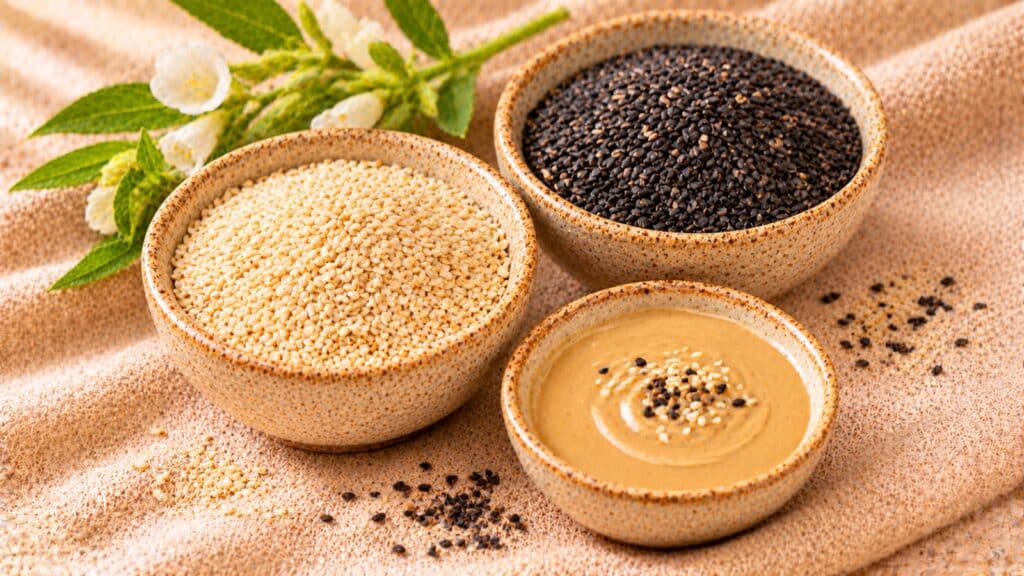
Sesame seeds are the small oil-rich seeds of the sesame plant (Sesamum indicum), sold white, golden or black and ground into tahini. Whole dried sesame is exceptionally dense in minerals: 100 g gives 975 mg of calcium, 14.6 mg of iron and 4.08 mg of copper, four times the EU reference intake for copper. The catch is portion size. A tablespoon weighs 9 g, so it brings 52 kcal, 88 mg of calcium and 0.37 mg of copper: useful, but not a dairy replacement.
Sesame seed nutrition per 100 g and per tablespoon
| Nutritivo | Sesame seeds, whole, dried, 100 g | 1 tablespoon (9 g) |
|---|---|---|
| Energía | 573 kcal | 52 kcal |
| Proteína | 17.7 g | 1.6 g |
| Fat | 49.7 g | 4.5 g |
| of which polyunsaturated | 21.8 g | 2.0 g |
| of which monounsaturated | 18.8 g | 1.7 g |
| of which saturated | 6.96 g | 0.6 g |
| Carbohydrate (including fibre) | 23.4 g | 2.1 g |
| of which sugars | 0.3 g | 0.03 g |
| Fibre | 11.8 g | 1.1 g |
| Calcio | 975 mg | 88 mg |
| Hierro | 14.6 mg | 1.3 mg |
| Magnesio | 351 mg | 32 mg |
| Fósforo | 629 mg | 57 mg |
| Zinc | 7.75 mg | 0.7 mg |
| Copper | 4.08 mg | 0.37 mg |
| Manganese | 2.46 mg | 0.22 mg |
| Thiamin (B1) | 0.791 mg | 0.07 mg |
| Vitamina B6 | 0.79 mg | 0.07 mg |
| Selenium | 34.4 µg | 3.1 µg |
Source: USDA FoodData Central, Seeds, sesame seeds, whole, dried, FDC ID 170150 (fdc.nal.usda.gov), checked 4 November 2026. USDA household measure: 1 tablespoon = 9 g, 1 cup = 144 g; the tablespoon column is calculated. USDA carbohydrate includes fibre. Values rounded. The record is for whole (unhulled) seeds; hulled seeds and tahini have their own USDA records with different values.
Against the EU nutrient reference values (Regulation (EU) No 1169/2011, Annex XIII), 100 g of whole sesame covers about 4 times the reference intake for copper (1 mg), 122% of calcium (800 mg), 104% of iron (14 mg), 94% of magnesium (375 mg) and 72% of thiamin (1.1 mg). One tablespoon gives about 37% of copper, 11% of calcium and 9% of iron. Most of the polyunsaturated fat is omega-6 linoleic acid (21.4 g per 100 g).
Glycemic index of sesame seeds
Sesame seeds are not listed in the international GI tables (Atkinson 2008). A tablespoon contains about 1 g of carbohydrate that is not fibre, so plain sesame has almost no effect on blood sugar. Halva and sesame snaps are mostly sugar and behave very differently.
Health benefits: what the evidence says
- Copper. At 4.08 mg per 100 g, sesame is very rich in copper. Foods that are a source of copper may state under EU rules that copper contributes to the maintenance of normal connective tissues, to normal iron transport in the body and to the normal function of the immune system (Regulation (EU) No 432/2012).
- Calcium and iron, with a reality check. Per 100 g, whole sesame is very high in calcium, but nobody eats 100 g of sesame. Two tablespoons of whole seeds (18 g) give about 175 mg of calcium, a meaningful extra rather than a main source. The iron is non-heme iron; NIH notes that vitamin C improves its absorption, while phytate reduces it. That makes tahini with lemon juice, or sesame on pimientos y Tomates, a sensible pairing.
- Zinc for plant-based eaters. At 7.75 mg per 100 g, sesame adds zinc, but NIH points out that zinc from seeds, nuts and legumes is absorbed less well than zinc from animal foods because phytates bind it. Vegetarians and vegans benefit from several zinc sources over the day.
- Mostly unsaturated fat. Of 49.7 g of fat, 40.6 g is unsaturated. The EU permits the claim that replacing saturated fats with unsaturated fats contributes to the maintenance of normal blood cholesterol levels, for foods high in unsaturated fat. Tahini instead of butter or mayonnaise is a practical example.
Ayurveda: sesame in the traditional system
In Usha and Vasant Lad’s food guidelines, sesame seeds and tahini are favourable for Vata. For Pitta and Kapha both are on the list to avoid. This is a traditional view, not a clinical finding.
How to buy, prepare and eat sesame seeds
- Toast before using: 2-3 minutes in a dry pan, shaking often, brings out a nutty flavour. Stop as soon as they turn golden.
- Tahini dressing: whisk 2 tablespoons of tahini with lemon juice, a crushed ajo clove and water until smooth. Pour it over roasted coliflor, berenjena or a grain bowl.
- Hummus: blend cooked chickpeas with tahini, lemon, garlic and aceite de oliva.
- On greens: scatter toasted seeds over steamed brócoli, espinaca o col rizada with a little soy sauce.
- Baking: press seeds onto bread rolls or crackers before baking, or mix black and white seeds for crusting fish or tofu.
- Storage: keep seeds in a closed jar away from heat and light; store opened tahini according to the label. The oil in tahini separates naturally, so stir it back in.
Who should be careful
- Sesame allergy. Sesame seeds and products made from them are one of the 14 allergens that must be highlighted on food labels in the EU (Regulation (EU) No 1169/2011, Annex II). Sesame hides in hummus, halva, bread, crackers, dressings and Asian sauces, so people with a sesame allergy need to read every label and follow an allergist’s advice.
- Sweet sesame products. Halva and sesame snaps contain sesame but are mostly sugar. Treat them as sweets.
- Energy density. Sesame is about half fat. A spoonful in a dressing is plenty; three tablespoons of seeds (27 g) already add about 155 kcal.
Related entries and articles
- garbanzos – hummus with tahini
- Pumpkin seeds – another mineral-rich seed
- Flaxseed – for plant omega-3, which sesame lacks
- Lemons – vitamin C to pair with sesame’s iron
- Extra virgin olive oil
- Mediterranean diet
- Plant-based meals for weight loss
FAQ
Is sesame a good source of calcium?
Per 100 g, yes: whole seeds have 975 mg. In real portions it is more modest, about 88 mg per tablespoon. Sesame and tahini can add useful calcium to a plant-based diet, but they do not replace other calcium sources on their own.
Is tahini as healthy as sesame seeds?
Tahini is ground sesame, so it has the same kind of fat and protein. Tahini is often made from hulled seeds, which changes the mineral content compared with the whole seeds in the table above, so check the label. Choose tahini with sesame as the only ingredient.
How much sesame can I eat per day?
There is no official amount. One to two tablespoons of seeds or tahini a day (9-18 g of seeds) is a common culinary portion that fits easily into most diets, unless you are allergic to sesame.
Sources
- USDA FoodData Central: Seeds, sesame seeds, whole, dried (FDC ID 170150). fdc.nal.usda.gov
- Commission Regulation (EU) No 432/2012, list of permitted health claims. EUR-Lex
- Regulation (EU) No 1169/2011 on food information to consumers, Annex II (allergens) and Annex XIII (reference intakes). EUR-Lex
- NIH Office of Dietary Supplements: Iron, Fact Sheet for Health Professionals. ods.od.nih.gov
- NIH Office of Dietary Supplements: Zinc, Fact Sheet for Health Professionals. ods.od.nih.gov
- Atkinson FS, Foster-Powell K, Brand-Miller JC. International tables of glycemic index and glycemic load values: 2008. Diabetes Care 2008;31(12):2281-2283. PMC
- Lad U, Lad V. Food Guidelines for Basic Constitutional Types, from Ayurvedic Cooking for Self-Healing, 2nd ed. The Ayurvedic Institute. ayurveda.com
This page is for information only and is not medical or dietary advice.
enciclopedia de comida
garbanzos Pumpkin seeds Flaxseed Extra Virgin Olive Oil Pumpkin seeds Lemons
 Español
 English
 Deutsch
 Français

