
← Encyclopediaenciclopedia de comida
By Nikola · Precision Nutrition L1 · Updated 4 November 2026
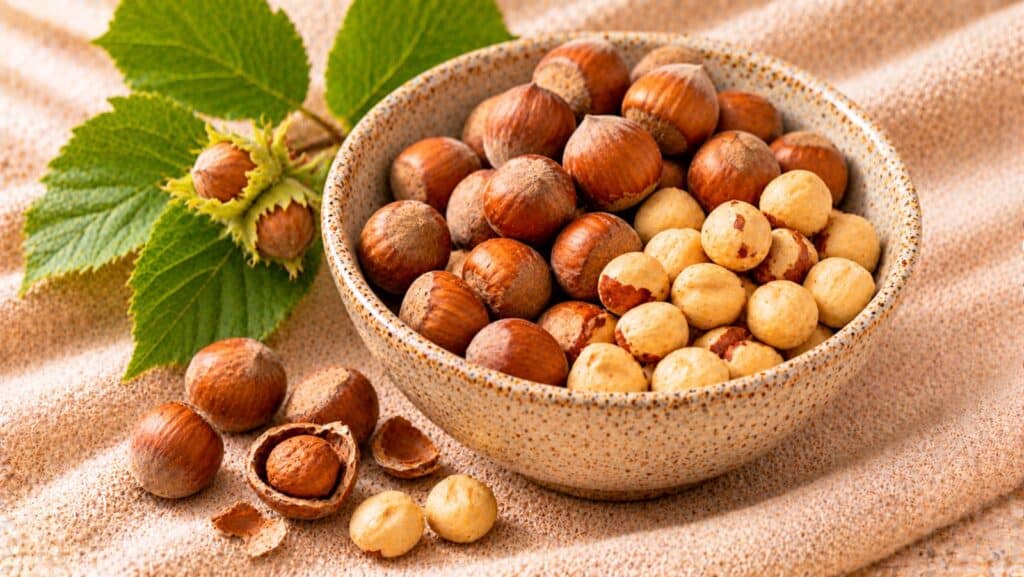
Hazelnuts, also called filberts, are the nuts of the hazel tree (Corylus avellana), a shrub native to Europe. They are rich in monounsaturated fat and stand out for manganese and vitamin E: 100 g gives 628 kcal, 6.18 mg of manganese and 15 mg of vitamin E. A 28 g handful, about 21 hazelnuts, provides 176 kcal, 87% of the EU reference intake for manganese and 35% for vitamin E. In controlled trials, hazelnut-enriched diets lowered LDL cholesterol slightly.
Hazelnut nutrition per 100 g and per handful
| Nutritivo | Hazelnuts, 100 g | Handful: 28 g (about 21 hazelnuts) |
|---|---|---|
| Energía | 628 kcal | 176 kcal |
| Proteína | 15.0 g | 4.2 g |
| Fat | 60.8 g | 17.0 g |
| of which monounsaturated | 45.7 g | 12.8 g |
| of which polyunsaturated | 7.92 g | 2.2 g |
| of which saturated | 4.46 g | 1.2 g |
| Carbohydrate (including fibre) | 16.7 g | 4.7 g |
| of which sugars | 4.34 g | 1.2 g |
| Fibre | 9.7 g | 2.7 g |
| vitamina e | 15.0 mg | 4.2 mg |
| Manganese | 6.18 mg | 1.73 mg |
| Copper | 1.72 mg | 0.48 mg |
| folato | 113 µg | 32 µg |
| Thiamin (B1) | 0.643 mg | 0.18 mg |
| Vitamina B6 | 0.563 mg | 0.16 mg |
| Magnesio | 163 mg | 46 mg |
| Potasio | 680 mg | 190 mg |
| Hierro | 4.7 mg | 1.3 mg |
| Vitamina K | 14.2 µg | 4.0 µg |
Source: USDA FoodData Central, Nuts, hazelnuts or filberts, FDC ID 170581 (fdc.nal.usda.gov), checked 4 November 2026. USDA household measure: 1 oz (21 whole kernels) = 28.35 g; the 28 g column is calculated. USDA carbohydrate includes fibre. Values rounded.
Against the EU nutrient reference values (Regulation (EU) No 1169/2011, Annex XIII), 100 g of hazelnuts covers about 3 times the reference intake for manganese (2 mg), 172% of copper (1 mg), 125% of vitamin E (12 mg), 58% of thiamin (1.1 mg) and 57% of folate (200 µg). A handful gives about 87% of manganese, 48% of copper, 35% of vitamin E and 16% of folate.
Glycemic index of hazelnuts
Hazelnuts are not listed in the international GI tables (Atkinson 2008). A handful contains about 2 g of carbohydrate that is not fibre, so plain hazelnuts have very little effect on blood sugar. Hazelnut chocolate, wafers and sweet spreads are another story because of their sugar.
Health benefits: what the evidence says
- Blood lipids. A systematic review and meta-analysis of nine studies with 425 participants found that hazelnut-enriched diets lowered LDL cholesterol by about 0.15 mmol/l. Total cholesterol showed a downward trend of about 0.13 mmol/l that was not statistically clear, and HDL cholesterol, triglycerides and body mass index did not change (Perna and colleagues, 2016). In other words, eating hazelnuts did not lead to weight gain in these studies, and the effect on cholesterol was modest.
- Monounsaturated fat. Three quarters of the fat in hazelnuts is monounsaturated (45.7 of 60.8 g), and only 4.46 g is saturated. The EU permits the claim that replacing saturated fats with unsaturated fats contributes to the maintenance of normal blood cholesterol levels, for foods high in unsaturated fat (Regulation (EU) No 432/2012).
- Vitamin E. NIH lists 4.3 mg of vitamin E per ounce of dry-roasted hazelnuts, against an adult RDA of 15 mg, and describes vitamin E as a fat-soluble antioxidant. Under EU rules, vitamin E contributes to the protection of cells from oxidative stress.
- Manganese and copper. A handful covers most of the manganese reference intake. EU-permitted claims say that manganese contributes to the maintenance of normal bones and the normal formation of connective tissue, and that copper contributes to normal iron transport and normal function of the immune system.
Ayurveda: hazelnuts in the traditional system
In Usha and Vasant Lad’s food guidelines, nuts in general are favourable for Vata in moderation. Hazelnuts are on the list to avoid for both Pitta and Kapha. This is a traditional view, not a clinical finding.
How to buy, prepare and eat hazelnuts
- Toast and skin: roast shelled hazelnuts at about 175 °C for 10-12 minutes, then rub them in a clean kitchen towel; most of the papery skin comes off and the flavour deepens.
- Desayuno: chopped hazelnuts on porridge con apple y cinnamon, or on Greek yogurt with sliced banana.
- Salads: toasted hazelnuts pair well with roasted beets, goat’s cheese and leafy greens, or with roasted coles de Bruselas.
- Homemade spread: blend toasted hazelnuts until creamy, then add unsweetened cocoa and a little honey to taste. You control the sugar, unlike in most shop spreads.
- Baking: ground hazelnuts can replace part of the flour in cakes and biscuits and add moisture.
- Storage: hazelnuts in the shell keep longest. Store shelled nuts in a closed container in a cool, dark place or in the fridge; a bitter, stale taste means they are rancid.
Who should be careful
- Nut allergy. Hazelnuts are named among the tree nuts in the list of 14 allergens that must be highlighted on food labels in the EU (Regulation (EU) No 1169/2011, Annex II). They appear in chocolate, pralines, wafers, spreads and baked goods, so read labels and follow an allergist’s advice.
- Sweet hazelnut spreads. EU labels list ingredients in descending order of weight. If sugar comes before hazelnuts on a chocolate-hazelnut spread, it contains more sugar than nuts. Treat such spreads as a sweet, or choose ones made mostly from hazelnuts.
- Energy density. At 628 kcal per 100 g, hazelnuts are one of the most energy-dense nuts. Portion out a handful rather than eating from the bag.
Related entries and articles
- Almendras – the other nut rich in vitamin E
- Walnuts – for plant omega-3
- Pistachios
- Avena – porridge with hazelnuts
- Grasas de alta calidad
- All about high-quality fats
- Which foods reduce inflammation naturally?
FAQ
How many hazelnuts should I eat a day?
There is no official amount. A handful of 28 g, about 21 hazelnuts, is a practical portion: 176 kcal, 4.2 mg of vitamin E and most of the day’s manganese reference intake. That fits easily into most diets as a snack or topping.
Are hazelnuts or almonds healthier?
Both are good choices with different strengths. Per 100 g, almonds have more protein (21.2 vs 15 g), fibre and vitamin E, while hazelnuts have about three times more manganese and more folate. Mixing nuts gives you the best of each.
Is chocolate-hazelnut spread healthy?
Check the label: ingredients are listed by weight, and if sugar comes before hazelnuts, the spread is closer to a sweet than to a nut product. A homemade spread of ground hazelnuts with unsweetened cocoa, or 100% hazelnut butter, keeps the nut’s benefits with far less sugar.
Sources
- USDA FoodData Central: Nuts, hazelnuts or filberts (FDC ID 170581). fdc.nal.usda.gov
- Perna S, Giacosa A, Bonitta G, et al. Effects of hazelnut consumption on blood lipids and body weight: a systematic review and Bayesian meta-analysis. Nutrients 2016;8(12):747. PMC
- NIH Office of Dietary Supplements: Vitamin E, Fact Sheet for Health Professionals. ods.od.nih.gov
- Commission Regulation (EU) No 432/2012, list of permitted health claims. EUR-Lex
- Regulation (EU) No 1169/2011 on food information to consumers, Annex II (allergens) and Annex XIII (reference intakes). EUR-Lex
- Atkinson FS, Foster-Powell K, Brand-Miller JC. International tables of glycemic index and glycemic load values: 2008. Diabetes Care 2008;31(12):2281-2283. PMC
- Lad U, Lad V. Food Guidelines for Basic Constitutional Types, from Ayurvedic Cooking for Self-Healing, 2nd ed. The Ayurvedic Institute. ayurveda.com
This page is for information only and is not medical or dietary advice.
enciclopedia de comida
Almendras Avena Grasas de alta calidad Almendras Walnuts Pistachios
 Español
 English
 Deutsch
 Français

