
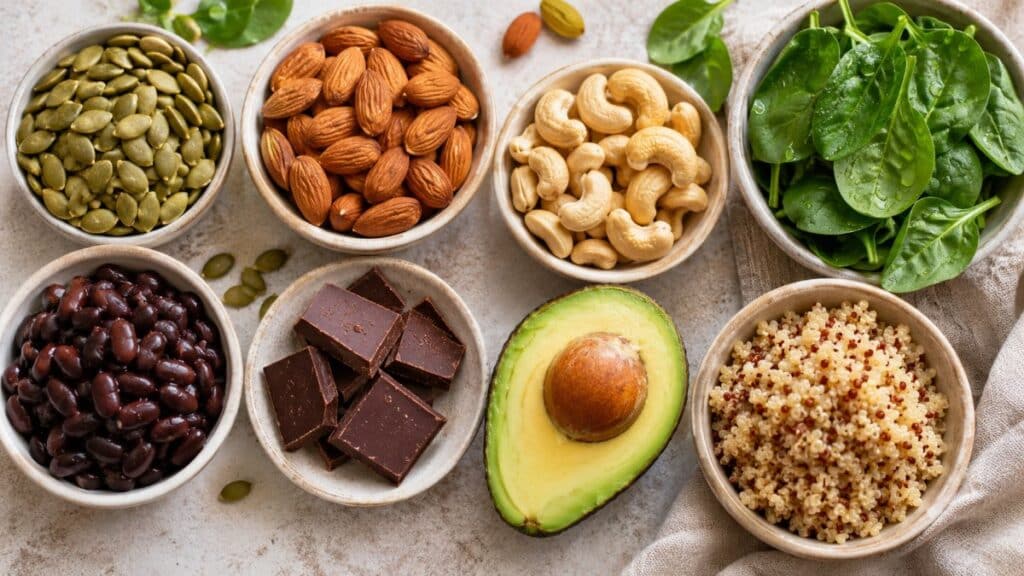
The best magnesium rich foods are citrouille seeds, chia seeds, almonds, cashews, cooked épinard, haricots, and whole grains such as brown rice and oats. A 28 g handful of roasted pumpkin seeds gives about 156 mg, which is more than a third of what most adults need in a day (310 to 420 mg in the US, or 300 mg for women and 350 mg for men in the EU). Most healthy people can cover their needs with food alone, and supplements should stay at or under 350 mg a day unless a doctor advises otherwise.
This guide is for you if you want to know which foods are high in magnesium, how much you need, and whether supplements are worth it. You will find real numbers, a bowl that covers most of a day’s needs, the Ayurvedic view and the safety points that matter.
Why does your body need magnesium?
Magnesium is a quiet worker. It helps more than 300 enzyme systems and is needed for energy production, muscle and nerve function, blood sugar control and blood pressure regulation, according to the NIH Office of Dietary Supplements. An adult body holds about 25 grams, and 50 to 60% of it sits in your bones, which is why a normal blood test does not always reflect your total stores.
How much magnesium do you need per day?
It depends on your age, sex and whether you are pregnant. The US recommendations (RDAs) run slightly higher than the European ones.
| Âge | Men (mg/day) | Women (mg/day) | Pregnancy (mg/day) | Breastfeeding (mg/day) |
|---|---|---|---|---|
| 9 to 13 years | 240 | 240 | – | – |
| 14 to 18 years | 410 | 360 | 400 | 360 |
| 19 to 30 years | 400 | 310 | 350 | 310 |
| 31 to 50 years | 420 | 320 | 360 | 320 |
| 51 years and older | 420 | 320 | – | – |
Source: NIH Office of Dietary Supplements, Magnesium Fact Sheet for Health Professionals (Recommended Dietary Allowances).
The European Food Safety Authority (EFSA) set adequate intakes of 350 mg a day for men and 300 mg for women. Either way, you are aiming for roughly 300 to 420 mg a day. Many people miss it: a US analysis cited by the NIH found 48% of Americans eat less than their estimated average requirement.
Which foods are high in magnesium?
Ranked by milligrams per serving, the top magnesium foods are seeds and nuts, followed by cooked leafy greens, legumes and whole grains.
| Food | Serving | Magnesium (mg) | Valeur quotidienne % |
|---|---|---|---|
| Pumpkin seeds, roasted | 1 oz (28 g) | 156 | 37% |
| Chia seeds | 1 oz (28 g) | 111 | 26% |
| Almonds, dry roasted | 1 oz (28 g) | 80 | 19% |
| Spinach, boiled | ½ cup | 78 | 19% |
| Cashews, dry roasted | 1 oz (28 g) | 74 | 18% |
| Soy milk, plain | 1 cup (240 ml) | 61 | 15% |
| Black beans, cooked | ½ cup | 60 | 14% |
| Edamame, shelled, cooked | ½ cup | 50 | 12% |
| Potato, baked with skin | 3.5 oz (100 g) | 43 | 10% |
| Brown rice, cooked | ½ cup | 42 | 10% |
| Plain low-fat yogurt | 8 oz (about 225 g) | 42 | 10% |
| Banane | 1 medium | 32 | 8% |
| Avocat, cubed | ½ cup | 22 | 5% |
| White rice, cooked | ½ cup | 10 | 2% |
Source: NIH Office of Dietary Supplements, Magnesium Fact Sheet for Health Professionals, Table 2 (Daily Value = 420 mg).
A small handful of seeds beats a portion of chicken (3 oz of roasted breast gives 22 mg). Cooked épinard scores well because cooking shrinks a pile of leaves into a few spoonfuls. And brown rice gives four times the magnesium of white rice.
Why do whole foods give you more magnesium than refined ones?
Refining removes the germ and bran of a grain, and with them much of its magnesium. The NIH sums it up: in general, foods that contain fiber also provide magnesium.
So swap white rice for brown, choose oats or whole grain buckwheat for breakfast, eat beans a few times a week and keep a jar of seeds on the counter. Greens such as bette à carde and legumes such as Edamame fill the gaps.
Water counts too: tap and mineral waters contain from 1 mg to more than 120 mg per litre, so check your label. And remember that your body absorbs only about 30 to 40% of the magnesium you eat.
What are the signs of magnesium deficiency?
True deficiency from diet alone is uncommon in healthy people, because your kidneys hold on to magnesium when intake is low. Mild shortfalls often cause no clear symptoms. When deficiency does develop, the NIH lists:
- Early: loss of appetite, nausea, vomiting, fatigue and weakness.
- Later: numbness, tingling, muscle cramps, personality changes and abnormal heart rhythms.
- Severe: seizures, and low blood calcium or potassium.
Those most likely to run low are people with Crohn’s or celiac disease, type 2 diabetes or alcohol dependence, and older adults. If you recognise these symptoms, see a doctor rather than guessing with supplements.
Do magnesium-rich foods help you sleep?
The honest answer: we do not know yet. The US National Center for Complementary and Integrative Health (NCCIH) says there is very little research on magnesium for insomnia. A 2021 review of three small studies with 151 older adults suggested it might help them fall asleep a little faster, but the studies were low quality, and a larger review of nine studies found mixed results.
Magnesium-rich foods at dinner will not hurt your sleep. For habits with stronger evidence, read pourquoi le sommeil est la pierre angulaire d'un mode de vie sain.
Should you take a magnesium supplement, and which form is best?
If you eat seeds, nuts, beans and whole grains most days, you probably do not need one. If your doctor suggests one, these facts help you choose:
- Small studies suggest magnesium citrate, aspartate, lactate and chloride are absorbed better than magnesium oxide and sulfate.
- The label lists elemental magnesium, the amount of actual magnesium, not the weight of the whole compound.
- Carbonate, chloride, gluconate and oxide are the forms most often linked to diarrhea.
The adult upper limit is 350 mg a day from supplements and medicines. It does not apply to food, because healthy kidneys clear the excess.
What does Ayurveda say about magnesium-rich foods?
Ayurveda does not talk about minerals the way modern nutrition does. It describes foods by their taste (rasa), their heating or cooling effect (virya) and how they affect the three doshas. Read the following as the traditional view, not as scientific evidence.
In that tradition, nuts and seeds are heavy, oily and nourishing, which makes them grounding for Vata, the dosha linked to dryness and restlessness. Almonds are traditionally soaked overnight and peeled, to be easier on your digestive fire (agni). Seeds are eaten in small, lightly toasted amounts, since their richness can feel heavy for Kapha.
Leafy greens carry the bitter and astringent tastes, considered cooling and good for Pitta and Kapha. To keep them from aggravating Vata, they are cooked with a spoon of ghee and warming spices such as cumin or gingembre. Mung beans are the legume Ayurveda calls easiest to digest, a gentle start if beans bloat you.
How can you eat more magnesium? A 350 mg bowl
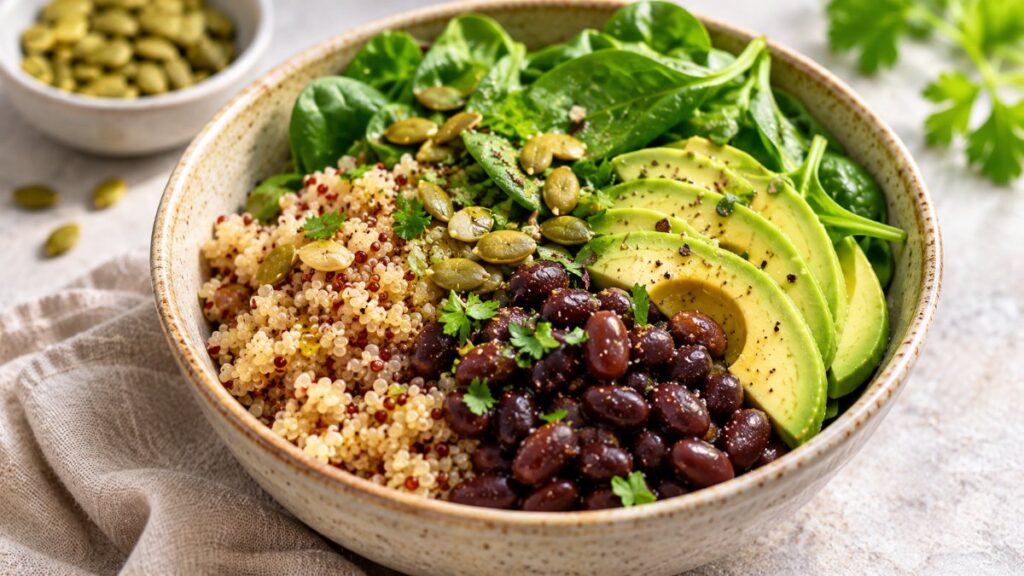
This plant-based bowl takes 15 minutes with cooked rice and beans on hand. Using the NIH values, it adds up to roughly 358 mg of magnesium (brown rice 42, black beans 60, spinach 78, pumpkin seeds 156, avocado 22), more than a woman’s daily RDA.
Ingredients (1 bowl)
- ½ cup cooked brown rice
- ½ cup cooked black beans, rinsed
- 2 large handfuls of fresh spinach (cooks down to about ½ cup)
- 1 oz (28 g) pumpkin seeds
- ½ cup cubed avocado
- 1 teaspoon olive oil or ghee
- ½ teaspoon ground cumin, a pinch of salt, a squeeze of lemon
Method
- Toast the pumpkin seeds in a dry pan over medium heat for 2 to 3 minutes, until they start to pop. Tip them onto a plate.
- Warm the oil or ghee in the same pan, add the cumin and let it sizzle for 20 seconds.
- Add the beans and rice and stir for 2 minutes until hot.
- Add the spinach and stir until it wilts, about 1 minute. Season with salt.
- Spoon into a bowl, top with the avocado and seeds, and finish with lemon.
For mornings, a spoon of seeds on porridge does a similar job: see our guide to chia seeds and how to eat them. Eating fully plant-based? Our overview of the benefits and risks of a vegan diet covers the nutrients that are harder to get.
Who should be careful with magnesium?
- Kidney disease: magnesium can build up. Do not take magnesium supplements, laxatives or antacids without your doctor’s approval.
- Too much from supplements: high doses cause diarrhea, nausea and cramps. Laxative or antacid doses above about 5,000 mg a day have caused serious toxicity.
- Bisphosphonates for osteoporosis (such as alendronate): take magnesium at least 2 hours apart.
- Some antibiotics (tetracyclines and quinolones): take the antibiotic at least 2 hours before or 4 to 6 hours after magnesium.
- Diuretics: loop and thiazide diuretics increase magnesium loss, while potassium-sparing diuretics reduce it.
- Proton pump inhibitors (stomach acid tablets) taken for more than a year can lower magnesium levels.
- Pregnancy: needs rise slightly (350 to 400 mg a day), and the 350 mg supplement limit still applies.
- Migraine: trials have used doses up to 600 mg a day, above the upper limit, so this should only be done under medical supervision.
Related reading: foods for energy without caffeine and our honest look at so-called superfoods.
FAQ
Which nuts have the most magnesium?
In the NIH table, dry-roasted almonds lead with 80 mg per 28 g, followed by cashews with 74 mg. Pumpkin seeds beat both at 156 mg.
Does dark chocolate have magnesium?
Yes. The Harvard T.H. Chan School of Public Health lists dark chocolate with at least 70% cocoa among food sources of magnesium. It also brings sugar and calories, so treat it as a bonus square, not your main source.
What are the best vegan sources of magnesium?
Pumpkin seeds, chia seeds, almonds, cashews, cooked spinach, black beans, edamame, soy milk and brown rice all sit near the top of the NIH table. A whole-food plant-based diet usually supplies plenty.
Can you get too much magnesium from food?
Not if your kidneys are healthy. They remove the excess, which is why the 350 mg upper limit applies only to supplements and medicines. People with kidney disease are the exception and should follow their doctor’s advice.
Sources
- NIH Office of Dietary Supplements. Magnesium: Fact Sheet for Health Professionals. National Institutes of Health. ods.od.nih.gov
- European Food Safety Authority. Dietary reference values: magnesium and phosphorus. EFSA, 2015. efsa.europa.eu
- Harvard T.H. Chan School of Public Health. Magnesium. The Nutrition Source, 2024. nutritionsource.hsph.harvard.edu
- National Center for Complementary and Integrative Health. In the News: Magnesium Supplements for Sleep Disorders. NCCIH, 2024. nccih.nih.gov
This article is for information only and is not medical advice. If you have a health condition, are pregnant or take medication, talk to your doctor or pharmacist before changing your diet or starting a supplement.


 Français
 English
 Deutsch
 Español

