
Spirulina is a dried blue-green alga (a cyanobacterium) that gives about 4 g of protein, 2 mg of iron and useful amounts of copper and B vitamins per tablespoon (7 g), according to USDA data. The best-supported benefit is a modest drop in blood pressure: a 2021 meta-analysis of five trials found systolic pressure fell by about 4.6 mmHg on 1 to 8 g a day. It is not a reliable source of vitamin B12, and you should buy only tested products, because spirulina can be contaminated with toxins from other algae.
This guide is for you if you have a tub of green powder in the cupboard and wonder whether it is worth the money. Below: real nutrition numbers, what trials show, trial doses, a smoothie and who should skip it.
What is spirulina?
Spirulina is the dried biomass of Arthrospira platensis and related species. Most people call it an alga, but biologically it is a cyanobacterium, a group often sold as “blue-green algae”. That detail matters later, when we talk about vitamin B12 and contamination.
You will see it as a fine dark green powder, as pressed tablets or in capsules. The taste is strong: think pond, algue and a slightly bitter finish.
What nutrients are in a tablespoon of spirulina powder?
The table uses USDA values for dried spirulina. The per-tablespoon column is calculated from the per-100 g data, using the USDA portion weight of 7 g for one tablespoon. A level teaspoon is about a third of that, roughly 2 to 2.5 g.
| Nutritif | Per 100 g | Per tablespoon (7 g) |
|---|---|---|
| Énergie | 290 kcal | 20 kcal |
| Protéine | 57.5 g | 4.0 g |
| Fat | 7.7 g | 0.5 g |
| Carbohydrate | 23.9 g | 1.7 g |
| Fibre | 3.6 g | 0.3 g |
| Fer | 28.5 mg | 2.0 mg |
| Copper | 6.1 mg | 0.43 mg |
| Magnésium | 195 mg | 14 mg |
| Potassium | 1,360 mg | 95 mg |
| Sodium | 1,050 mg | 74 mg |
| Thiamin (B1) | 2.38 mg | 0.17 mg |
| Riboflavine (B2) | 3.67 mg | 0.26 mg |
| Vitamine K | 25.5 µg | 1.8 µg |
| Phénylalanine | 2.78 g | 0.19 g |
| Vitamine B12 | 0 µg (USDA assumes zero) | 0 µg |
Source: USDA FoodData Central, SR Legacy, “Seaweed, spirulina, dried” (FDC ID 170495). Per-tablespoon values calculated and rounded.
Two things stand out. First, the protein percentage looks huge, but a tablespoon still gives only about 4 g. Spirulina is a condiment, not a protein source you can build meals on. If you need more protein, our page on high-protein diets covers foods that do the heavy lifting.
Second, the iron and copper per spoon are real and add up over a week.
What are the proven benefits of spirulina?
Blood pressure: the strongest signal
A 2021 systematic review in Nutrients pooled randomised controlled trials of spirulina. Across five trials with 230 people, systolic blood pressure fell by an average of 4.59 mmHg compared with control. Diastolic pressure fell by 4.29 mmHg across four trials, though the results varied a lot between studies. The effect looked larger in people who already had high blood pressure (about 9 mmHg systolic) than in people with normal readings (about 2 mmHg). Doses ran from 1 to 8 g a day, for 2 to 12 weeks.
That is a modest effect from a few short trials. It does not replace blood pressure medication, and the authors call for more research.
Cholesterol and blood sugar: less settled
You will read that spirulina lowers cholesterol. Some pooled analyses agree, others find only weak trends. We lay out the competing results side by side in our guide to chlorella and how it compares with spirulina.
Antioxidant and immune claims
Much of the talk about spirulina as an antioxidant or “immune booster” comes from lab and animal studies. The NIH LiverTox review mentions animal data on antioxidant and anti-inflammatory effects, which is interesting biology, not proof that a spoonful a day protects you from anything. Treat these claims as unproven in humans.

Is spirulina a good source of vitamin B12?
No, and this is the most common mistake. Labels on spirulina products often list high amounts of B12. A 2014 review by Japanese researchers who study algal B12 explains why that is misleading: these products contain mostly pseudovitamin B12, a look-alike compound that is inactive in humans. Their conclusion is direct: edible cyanobacteria are not suitable B12 sources for vegetarians. USDA lists the B12 content of dried spirulina as zero.
If you eat a régime végétalien, take a proper B12 supplement or fortified foods and do not count spirulina. The same review names dried Nori as the most suitable plant source of B12 found so far, but even that is not a replacement for a supplement.
What is blue spirulina?
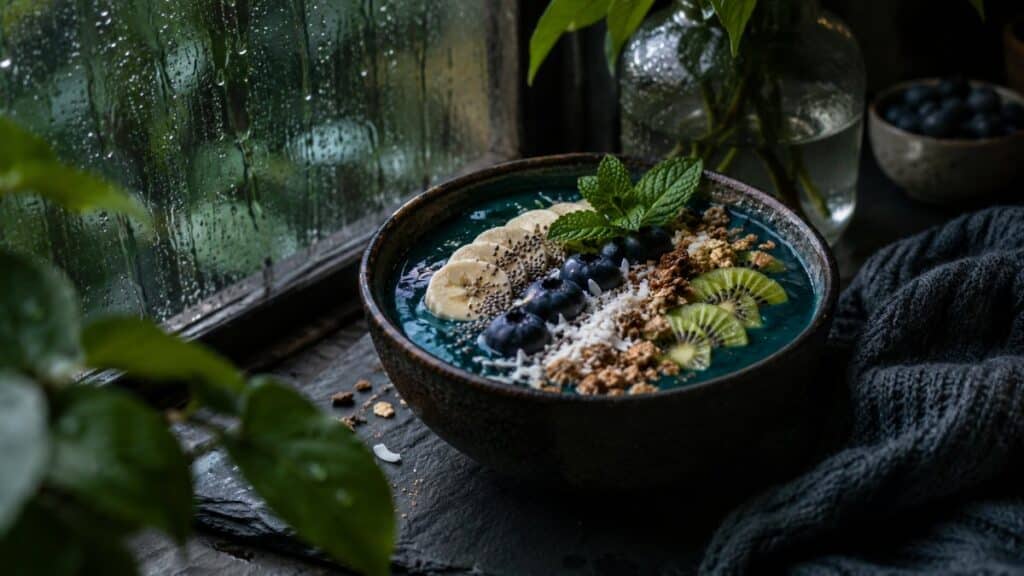
Blue spirulina is not a different alga. It is an extract of the blue pigments, called phycocyanins, made by filtering a water extract of dried Arthrospira platensis. In the US it is approved as a colour additive for sweets, ice cream, drinks, yogurts and even supplement coatings. A bright blue smoothie bowl gets its colour from spirulina, but not the protein, iron or copper in the table above.
How much spirulina should you take per day?
There is no official recommended dose. What we have is the range used in trials: 1 to 8 g a day in the blood pressure studies, and 4.5 to 6 g a day in small studies cited by LiverTox. For most people a sensible routine looks like this:
- Start with half a teaspoon (about 1 g) a day for a week, to see how your stomach and taste buds react.
- Move to one teaspoon (2 to 2.5 g) if you are happy with it.
- Stay at or below one tablespoon (7 g) a day, the upper end of what most trials used.
With tablets or capsules, check how many milligrams each one contains and add them up: 2 g might mean four tablets of one brand and eight of another.
What does Ayurveda say about spirulina?
Spirulina does not appear in the classical Ayurvedic texts, so there is no traditional verdict on it. Modern Ayurvedic practitioners describe it through its qualities. Its taste is mostly bitter (tikta) with a salty, marine note, and bitter foods are traditionally seen as cooling (sheeta virya) and light. In that reading, spirulina would suit a warm, intense Pitta or a heavy Kapha type better than a dry, airy Vata, who might find it hard on agni, the digestive fire, if taken cold and raw. If you want to understand these types, start with our guide to the three doshas.
This is a traditional lens, not scientific evidence. A practical Ayurvedic tip: take green powders with food, at midday, rather than on an empty stomach early in the morning.
How do you use spirulina? A simple green smoothie
Fruit, oats and a creamy base cover spirulina’s strong taste. This makes one large glass.
Ingrédients
- 1 ripe banana, frozen in chunks if you like it thick
- 200 ml milk, kefir or unsweetened oat milk
- 2 tablespoons rolled oats
- a handful of fresh épinard or frozen mango
- 1 teaspoon spirulina powder (about 2 g)
- a squeeze of lime or lemon juice
Steps
- Put the milk and oats in the blender first and let them sit for 2 minutes to soften.
- Add the banana, spinach or mango and the citrus juice.
- Add the spirulina last, so it does not stick to the walls of the jug.
- Blend for 45 to 60 seconds until smooth. Taste and add a few drops more citrus if the green flavour is too strong.
For more morning ideas built on whole foods, see our anti-inflammatory breakfast ideas. And if you are building a pantry of powders, our honest superfoods list explains why everyday foods like beans, oats and cabbage often beat expensive extras.
What are the side effects of spirulina and who should avoid it?
Contamination is the main risk
Spirulina itself is generally considered low risk, but it can be contaminated with other blue-green algae that produce liver toxins called microcystins. The NIH LiverTox database rates spirulina as a possible but very rare cause of liver injury, and suggests contamination as one possible explanation for the rare cases. Buy from brands that publish independent tests for microcystins and heavy metals.
Autoimmune disease and immune-suppressing drugs
A 2004 report in Archives of Dermatology described three patients whose autoimmune skin disease (pemphigus vulgaris or dermatomyositis) flared after they started immune-stimulating supplements. Two of the products contained spirulina, and one man was stable on azathioprine and prednisone before the flare. Three cases cannot prove cause, but the authors advise caution. If you have lupus, rheumatoid arthritis, multiple sclerosis or another autoimmune condition, or you take drugs that suppress the immune system, talk to your doctor before trying spirulina.
Phenylketonuria (PKU)
Spirulina is rich in protein, and USDA lists 0.19 g of phenylalanine per tablespoon. If you have PKU, this has to fit into your daily phenylalanine allowance, so check with your metabolic team first.
Other groups
- Pregnancy, breastfeeding and young children: we found no good safety studies, so skip it unless your doctor agrees.
- Warfarin: spirulina is low in vitamin K (about 1.8 µg per tablespoon, USDA), unlike chlorella, but tell your doctor about any new supplement.
- Low-salt diets: a tablespoon adds about 74 mg of sodium, small but not zero.
- Sensitive digestion: start with half a teaspoon with food and increase slowly.
Related reading: moringa powder and how to use it et seaweed in the encyclopedia.
FAQ
Is it safe to take spirulina every day?
For most healthy adults, a daily teaspoon to tablespoon of a tested product appears to be well tolerated in trials lasting up to 12 weeks. People with autoimmune disease, PKU, pregnancy or immune-suppressing medication should ask a doctor first.
Can spirulina replace protein powder?
Not really. A tablespoon gives about 4 g of protein, much less than a serving of most protein powders. Spirulina adds iron, copper and B vitamins, but you would need an unpleasant amount of it to match a protein shake.
Spirulina or chlorella: which should I choose?
Spirulina has the better blood pressure data and is low in vitamin K. Chlorella can contain real vitamin B12 in some products but is high in vitamin K. Our chlorella vs spirulina comparison goes through the evidence point by point.
Is organic spirulina powder safer?
Not automatically. An organic label tells you how the alga was grown, not whether a batch was tested for microcystins or heavy metals. Look for a certificate of analysis from an independent lab, organic or not.
Sources
- U.S. Department of Agriculture. Seaweed, spirulina, dried (FDC ID 170495). FoodData Central, SR Legacy. fdc.nal.usda.gov
- Machowiec P, Ręka G, Maksymowicz M, Piecewicz-Szczęsna H, Smoleń A. Effect of Spirulina Supplementation on Systolic and Diastolic Blood Pressure: Systematic Review and Meta-Analysis of Randomized Controlled Trials. Nutrients, 2021. mdpi.com/2072-6643/13/9/3054
- Watanabe F, Yabuta Y, Bito T, Teng F. Vitamin B12-Containing Plant Food Sources for Vegetarians. Nutrients, 2014. mdpi.com/2072-6643/6/5/1861
- National Institute of Diabetes and Digestive and Kidney Diseases. Spirulina. LiverTox: Clinical and Research Information on Drug-Induced Liver Injury, NCBI Bookshelf, updated 2019. ncbi.nlm.nih.gov/books/NBK548312
- Lee AN, Werth VP. Activation of Autoimmunity Following Use of Immunostimulatory Herbal Supplements. Archives of Dermatology, 2004. jamanetwork.com
- U.S. Code of Federal Regulations. 21 CFR 73.530 Spirulina extract. eCFR. ecfr.gov, 21 CFR 73.530
This article is for information only and is not medical advice. If you have a health condition, are pregnant or take medication, talk to your doctor or pharmacist before changing your diet or starting a supplement.


 Français
 English
 Deutsch
 Español

