
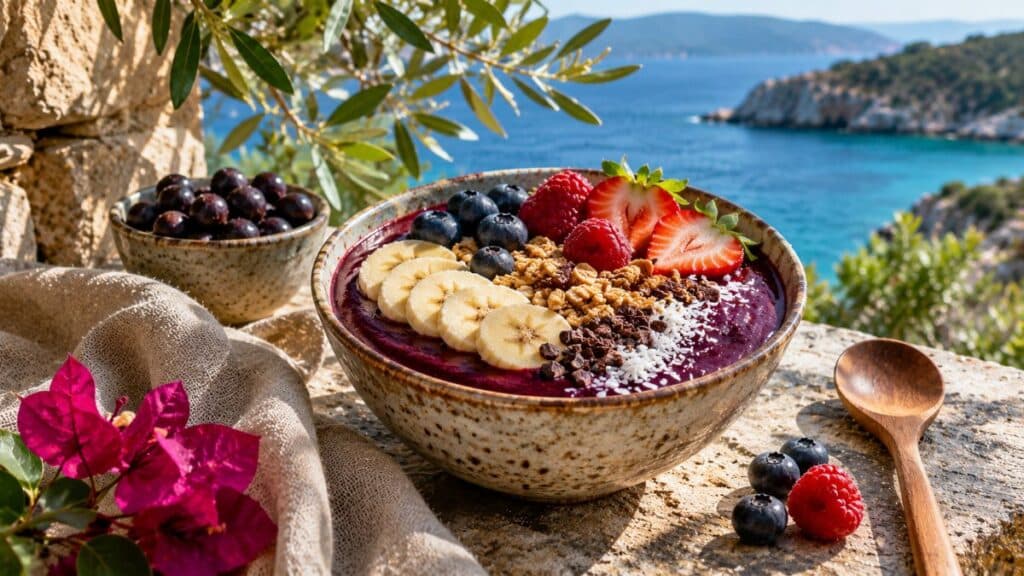
The evidence for acai benefits is thin. NCCIH, the US government’s centre for complementary health, says there is not enough reliable information to say whether acai helps with any health purpose, and no recent peer-reviewed human studies support it for weight loss. Unsweetened acai pulp is a fruit that is unusually rich in fat and fibre and low in sugar, so it can fit a healthy diet, but the real thing to watch is the added sugar in many acai bowls and frozen packs.
This guide is for you if you love acai bowls, keep frozen acai puree in the freezer, or wonder whether acai powder is worth the price. You will find real label numbers for unsweetened acai, what the small human trials found, the safety points that rarely make it onto menus, and a lower-sugar acai bowl you can make at home.
What is acai berry?
Acai (pronounced “ah-sigh-EE”) is the small, round, dark purple fruit of the acai palm, Euterpe oleracea. The palm grows in tropical Central and South America and is especially common in the Brazilian Amazon. In Europe you will almost never see the fresh fruit. What you buy is frozen acai puree (also sold as frozen acai pulp or frozen acai berries in packs), freeze-dried acai powder, juices and capsules.
Parts of the plant have a history in folk medicine, but outside South America acai became famous mainly through marketing, and the claims grew faster than the research. The US Federal Trade Commission has taken action against companies that sold acai weight-loss products with deceptive claims.
What nutrients are in frozen acai pulp?
USDA FoodData Central has no standard reference entry for acai, only brand labels. The table below uses the label of one unsweetened organic frozen acai puree pack listed in the database, whose only other ingredient is a trace of citric acid. One pack is 100 g. Values vary between brands, so read your own label.
| Nährstoff | Per 100 g (1 pack) |
|---|---|
| Energie | 100 kcal |
| Fat, total | 8 g |
| Saturated fat | 1.5 g |
| Carbohydrate | 5 g |
| Fibre | 5 g |
| Total sugars | 0 g |
| Eiweiß | 2 g |
| Kalium | 210 mg |
| Eisen | 0.8 mg |
| Natrium | 5 mg |
Source: USDA FoodData Central, Branded Foods, unsweetened organic acai puree pack (FDC ID 1073529). Label data provided by the manufacturer.
This is not a typical fruit profile. About 72 of the 100 calories come from fat (8 g times 9 kcal), which makes unsweetened acai closer in spirit to Avocado or olives than to blueberries. It has almost no sugar of its own. If your pack lists 10 g or more of sugar per serving, it is a sweetened blend. That changes the picture completely.

What are the health benefits of acai?
Antioxidants: promising in the lab, small in people
Acai is sold above all as an antioxidant fruit. Laboratory studies suggest antioxidant and anti-inflammatory effects, and NCCIH notes that several small studies found acai pulp improved antioxidant defences in people. Higher antioxidant markers in blood are not the same as fewer diseases. No trial has shown that acai prevents any illness.
Blood sugar and cholesterol
The study most often quoted is a 2011 pilot. Ten overweight adults ate 100 g of acai pulp twice a day for 30 days. Fasting glucose, insulin and total cholesterol went down, LDL cholesterol fell only borderline, and blood pressure did not change. There was no control group, so you cannot tell how much of the change came from acai and how much from simply being in a study.
A 2025 systematic review and meta-analysis pooled 8 studies with 411 participants. It found no significant effect of acai on total cholesterol, LDL, HDL or triglycerides. The authors rated the certainty of the evidence as low to very low and called for better trials. In other words, the most complete look at the data so far does not support acai as a cholesterol food.
Gewichtsverlust
NCCIH states that no peer-reviewed human studies from the past five years support claims that acai promotes weight loss. A bowl with 100 g of unsweetened pulp is fine within a balanced diet. A large sweetened bowl with granola and honey can carry more calories than a full meal.
Is an acai bowl healthy?
It depends almost entirely on what goes in with the acai. Unsweetened pulp is low in sugar. Many cafe bowls, though, start with a sweetened acai blend, add banana, apple juice or another fruit juice to help it blend, then finish with granola, honey and syrup. The WHO advises keeping free sugars under 10% of daily energy, about 50 g or 12 level teaspoons for someone eating 2,000 kcal, and ideally under 5%. Free sugars include honey, syrups and fruit juices. A heavily topped bowl can use up a large share of that in one sitting, which is why it appears on our list of “healthy” foods that are often not that healthy.
For a balanced bowl, look for unsweetened acai, fruit as the only sweetener, and a topping with protein or healthy fat. Our article on hochwertige Fette explains why nuts and seeds are a better finish than sweet granola.
Acai powder or frozen acai puree: which is better?
Frozen unsweetened acai puree is the closest to the pulp eaten in Brazil and the easiest to read: one ingredient, clear label. Acai powder is dried pulp, handy for travel or a teaspoon in a smoothie, but you use small amounts, so it adds little beyond colour and flavour. Juices and capsules are the least useful: juices may be sweetened, and capsules may mix acai with other ingredients. Whatever you choose, check for the word “unsweetened” and a short ingredient list.
What does Ayurveda say about acai?
Acai is not described in classical Ayurvedic texts. What follows is an interpretation using Ayurvedic principles, offered as tradition, not as scientific evidence.
- Rasa (taste): unsweetened acai tastes earthy and slightly bitter and astringent (kashaya), with a creamy richness from its fat.
- Virya (energy): a frozen bowl is strongly cooling. Ayurveda would see cold, icy food as damping agni, the digestive fire.
- Dosha: a cool acai bowl may suit Pitta on a hot summer day. Vata and Kapha types would do better with acai at room temperature, a smaller portion, and warming spices.
- Timing: midday, when digestion is considered strongest, rather than late evening.
How to make a lower-sugar acai bowl
This version keeps the acai flavour, uses fruit as the only sweetener, and adds protein and fat so it keeps you full. It works well as an anti-inflammatory breakfast.
- 1 pack (100 g) unsweetened frozen acai puree
- half a small banana, ideally frozen
- 100 ml milk, kefir or unsweetened plant milk
- a handful of blueberries or chopped Erdbeeren
- 1 tablespoon chopped walnuts or Kürbis Samen
- a pinch of cinnamon, or a teaspoon of raw cacao powder
- Run the sealed acai pack under warm tap water for about a minute, then break it into pieces.
- Blend the acai, banana and milk until thick and smooth. Add a splash more milk only if the blender stalls.
- Spoon into a bowl and let it sit for 2 to 3 minutes so it is not ice-cold.
- Top with berries, nuts or seeds and cinnamon or cacao. Eat straight away.
Is acai safe? Precautions
Raw acai juice and Chagas disease
Raw acai fruit and juice can be contaminated with parasites. In rare cases, drinking raw juice has been linked to outbreaks of Chagas disease (American trypanosomiasis), a parasitic infection. A 2019 report described an outbreak of 10 cases in the Brazilian Amazon where the same parasite strain was found in patients’ blood and in samples of the suspected acai juice. This is a concern mainly when travelling in endemic regions and drinking freshly pressed, raw juice.
MRI scans
NCCIH notes that acai might affect the results of an MRI of the digestive tract. If you have an abdominal MRI scheduled and eat or drink acai, tell your doctor beforehand.
Diabetes medicines
Preliminary research suggests acai may raise or lower fasting blood glucose, so it could interfere with diabetes medication. If you take any medicine, talk to your doctor before using acai supplements or large daily amounts.
Pregnancy and long-term use
Acai pulp has been used safely for up to 3 months in clinical research, but overall safety data are limited, and little is known about acai during pregnancy or breastfeeding. Food amounts in a bowl are a different matter from concentrated supplements. When in doubt, ask your doctor.
Related reading: goji berries: benefits and how to eat them, our honest superfoods list, foods that reduce inflammation.
FAQ
Is acai good for you?
Unsweetened acai is a nutritious fruit with fibre and fat and very little sugar. Human evidence for specific health benefits is weak, so enjoy it as food, not as treatment.
Does acai help you lose weight?
No reliable human evidence shows that acai causes weight loss, and NCCIH found no recent peer-reviewed studies supporting it. Sweetened acai bowls can actually add a lot of calories.
Is frozen acai puree better than acai powder?
Frozen unsweetened acai puree gives you a real serving of the pulp with a simple label. Acai powder is convenient, but you use a teaspoon or two, so its nutritional contribution is small.
Can you get Chagas disease from acai?
Rare outbreaks have been linked to raw acai juice in endemic areas of South America. The reported cases are tied to raw, freshly pressed juice drunk in those regions, which is why it matters most when you travel there.
Sources
- National Center for Complementary and Integrative Health (NCCIH). Acai: Usefulness and Safety. Last updated November 2024. nccih.nih.gov/health/acai
- Udani JK, et al. Effects of Açai (Euterpe oleracea Mart.) berry preparation on metabolic parameters in a healthy overweight population: a pilot study. Nutrition Journal, 2011;10:45. PubMed 21569436
- Candeloro BM, Bitencourt THB, Elias SFR, et al. Investigating the Impact of Açai (Euterpe oleracea) on Lipid Profile: A Comprehensive Systematic Review and Meta-Analysis. Nutrition Bulletin, 2025. doi:10.1111/nbu.12735. repositorio.unesp.br
- Santana RAG, Guerra MGVB, Sousa DR, et al. Oral Transmission of Trypanosoma cruzi, Brazilian Amazon. Emerging Infectious Diseases, 2019;25(1):132-135. stacks.cdc.gov
- U.S. Department of Agriculture, Agricultural Research Service. FoodData Central, Branded Foods: unsweetened organic acai puree pack (FDC ID 1073529). fdc.nal.usda.gov
- World Health Organization. Healthy diet. Fact sheet, 2026. who.int
This article is for information only and is not medical advice. If you have a health condition, are pregnant or take medication, talk to your doctor or pharmacist before changing your diet or starting a supplement.


 Deutsch
 English
 Español
 Français

