
← EncyclopediaEnzyklopädie der Lebensmittel
By Nikola · Precision Nutrition L1 · Updated 5 November 2026
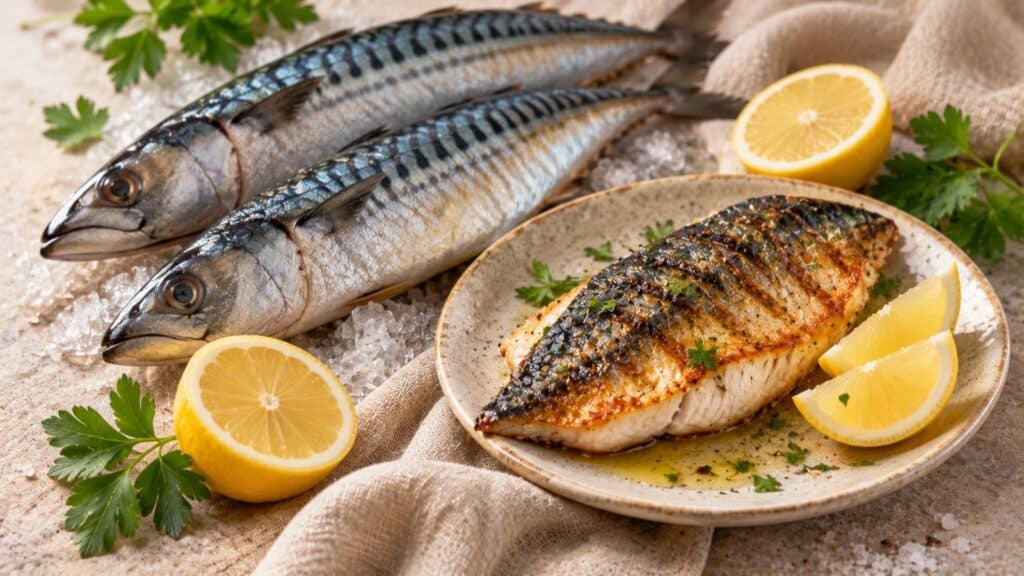
Atlantic mackerel (Scomber scombrus) is an oily sea fish with firm, rich flesh, sold in Europe fresh, frozen, smoked and canned. It is one of the richest everyday sources of the omega-3 fats EPA and DHA: 2.3 g per 100 g of raw fish, more than farmed salmon. It also gives 16 µg of vitamin D per 100 g, about three times the EU reference intake, and plenty of vitamin B12 and selenium. Atlantic mackerel is on the US FDA’s “Best Choices” list for mercury. King mackerel, a different and much larger species, is the opposite: the FDA lists it among the fish to avoid.
Mackerel nutrition per 100 g and per fillet
| Nutrient (raw) | Atlantic mackerel, 100 g | 1 fillet (112 g) | Share of EU reference intake per 100 g* |
|---|---|---|---|
| Energie | 205 kcal | 230 kcal | |
| Eiweiß | 18.6 g | 20.8 g | |
| Fat | 13.9 g | 15.6 g | |
| of which saturated | 3.3 g | 3.7 g | |
| of which monounsaturated | 5.5 g | 6.1 g | |
| of which polyunsaturated | 3.4 g | 3.8 g | |
| EPA (omega-3) | 0.90 g | 1.01 g | |
| DHA (omega-3) | 1.40 g | 1.57 g | |
| Carbohydrate | 0 g | 0 g | |
| Vitamin-D | 16.1 µg | 18.0 µg | about 320% of 5 µg |
| Vitamin B12 | 8.7 µg | 9.8 µg | about 350% of 2.5 µg |
| Selenium | 44.1 µg | 49.4 µg | about 80% of 55 µg |
| Magnesium | 76 mg | 85 mg | about 20% of 375 mg |
| Kalium | 314 mg | 352 mg | about 16% of 2,000 mg |
| Natrium | 90 mg | 101 mg |
Source: USDA FoodData Central, SR Legacy: “Fish, mackerel, Atlantic, raw” (FDC 175119), checked 5 November 2026. The fillet weight (112 g) is from the USDA record; the fillet column is calculated. *Reference intakes for EU labelling (Regulation (EU) No 1169/2011, Annex XIII). Values rounded. Smoked and canned mackerel are not covered by this record; smoked mackerel in particular is much saltier, so check the label.
Next to farmed salmon (208 kcal per 100 g), mackerel has about the same calories but more EPA and DHA (2.3 g against 2.0 g) and more vitamin D (16 µg against 11 µg). It is also usually cheaper.
EPA and DHA per portion
A standard 85 g portion of raw Atlantic mackerel gives about 1.95 g of EPA and DHA, 174 kcal and 15.8 g of protein; one 112 g fillet gives about 2.6 g (calculated from the USDA record). A week of 250 mg a day adds up to 1.75 g, so one portion of mackerel covers more than a full week of that reference amount. Two portions of fish a week, one of them oily, is the pattern the NHS recommends.
Glycemic index
Mackerel has no glycemic index: it contains no carbohydrate. Fish is not listed in the international GI tables. With rice, potatoes or bread, the side decides the blood sugar response of the meal. More in What is the glycemic index? (with food table).
Health benefits: what the evidence says
- Heart function. The EU permits the claim “EPA and DHA contribute to the normal function of the heart” for foods that are at least a source of omega-3 fats, with the effect obtained from 250 mg of EPA and DHA a day (Regulation (EU) No 432/2012). Mackerel gives about nine times that amount per 100 g.
- Brain and vision. Under the same regulation, DHA contributes to the maintenance of normal brain function and normal vision, with 250 mg of DHA a day. Mackerel has 1.4 g of DHA per 100 g.
- Vitamin D. Few foods contain much vitamin D, and oily fish is the main natural one. 100 g of mackerel gives 16 µg. Vitamin D contributes to the maintenance of normal bones and the normal function of the immune system, both permitted EU claims.
- Vitamin B12 and selenium. 100 g gives about three and a half times the reference intake for B12 and about 80% of it for selenium.
- Low in mercury. The FDA lists Atlantic mackerel and Pacific chub mackerel among its “Best Choices” and Spanish mackerel among the “Good Choices”. King mackerel has the highest mercury levels and is on the list of choices to avoid.
Ayurveda: mackerel in the traditional system
Usha and Vasant Lad’s food guidelines do not name mackerel. Sea fish in general is favourable for Vata and on the lists to avoid for Pitta and Kapha, the same pattern as salmon and Sardinen. This is a traditional view, not a clinical finding. More in Ayurvedic diet for beginners.
How to cook and use mackerel
- Grill or bake whole: make two or three cuts on each side, rub with salt, Knoblauch Und Olivenöl, and cook for about 15-20 minutes in a hot oven or on the grill, until the flesh comes away from the bone.
- Fillets in a pan: skin side down in a hot pan for 2-3 minutes until crisp, then a minute on the other side. Mackerel is oily enough to need almost no fat.
- With acid: the richness of mackerel goes well with lemon, Tomaten, pickles or sauerkraut.
- Smoked mackerel: flaked into a salad with boiled potatoes Und Zwiebel, or mixed with Greek yogurt, lemon Und Dill as a spread. Keep the portion small because of the salt.
- Freshness: fresh mackerel should have bright eyes, shiny skin and a clean sea smell. Keep it cold and cook it the same or the next day.
Who should be careful
- Know which mackerel. The FDA advice applies by species: Atlantic and Pacific chub mackerel are low in mercury, king mackerel is high. In Europe the mackerel in shops is almost always Atlantic mackerel; if a label says king mackerel, choose something else, especially in pregnancy and for children.
- Pregnancy and women planning a pregnancy. The NHS advises no more than 2 portions of oily fish such as mackerel a week for girls, women who may become pregnant, and pregnant or breastfeeding women, because oily fish contain more pollutants that can build up in the body.
- Smoked fish in pregnancy. Cold-smoked and cured fish can carry listeria. The NHS says pregnant women should eat smoked fish only when it has been cooked until steaming hot.
- Salt. Fresh mackerel has 90 mg of sodium per 100 g; smoked and canned versions have much more. Compare labels if you watch your salt.
- Fish allergy. Anyone allergic to fish should avoid mackerel in every form.
Related entries and articles
- Sardinen – canned oily fish with calcium from the bones
- Lachs – farmed vs wild
- Sardellen
- Hochwertige Fette
- All about high-quality fats
- Which foods reduce inflammation naturally?
FAQ
Is mackerel high in mercury?
It depends on the species. The FDA lists Atlantic mackerel and Pacific chub mackerel among its “Best Choices”, the lowest-mercury group, while king mackerel is on the list of fish to avoid because of its high mercury levels.
Is mackerel healthier than salmon?
Both are good oily fish. Per 100 g, raw Atlantic mackerel has more EPA and DHA (2.3 g against 2.0 g for farmed salmon) and more vitamin D (16 µg against 11 µg), with a similar calorie count (USDA). Eating both in turn is a sensible choice.
How much vitamin D is in mackerel?
Raw Atlantic mackerel has 16.1 µg of vitamin D per 100 g according to USDA, about three times the EU reference intake of 5 µg. One fillet of 112 g gives about 18 µg.
Sources
- USDA FoodData Central, SR Legacy: Fish, mackerel, Atlantic, raw (FDC 175119). fdc.nal.usda.gov
- Commission Regulation (EU) No 432/2012, list of permitted health claims (EPA/DHA and heart function; DHA, brain function and vision; vitamin D). EUR-Lex
- Regulation (EU) No 1169/2011, Annex XIII – reference intakes for vitamins and minerals. EUR-Lex
- U.S. Food and Drug Administration: Advice about Eating Fish, content current as of 5 March 2024. fda.gov
- NHS: Fish and shellfish. nhs.uk
- NHS: Foods to avoid in pregnancy. nhs.uk
- Atkinson FS, Foster-Powell K, Brand-Miller JC. International Tables of Glycemic Index and Glycemic Load Values: 2008. Diabetes Care 2008;31(12):2281-2283. PMC
- Lad U, Lad V. Food Guidelines for Basic Constitutional Types, from Ayurvedic Cooking for Self-Healing, 2nd ed. The Ayurvedic Institute. ayurveda.com
This page is for information only and is not medical or dietary advice.
Enzyklopädie der Lebensmittel
Sardinen Lachs Sardellen Hochwertige Fette Lemons Canned tuna Omega-3 fatty acids Sardinen
 Deutsch
 English
 Español
 Français

