
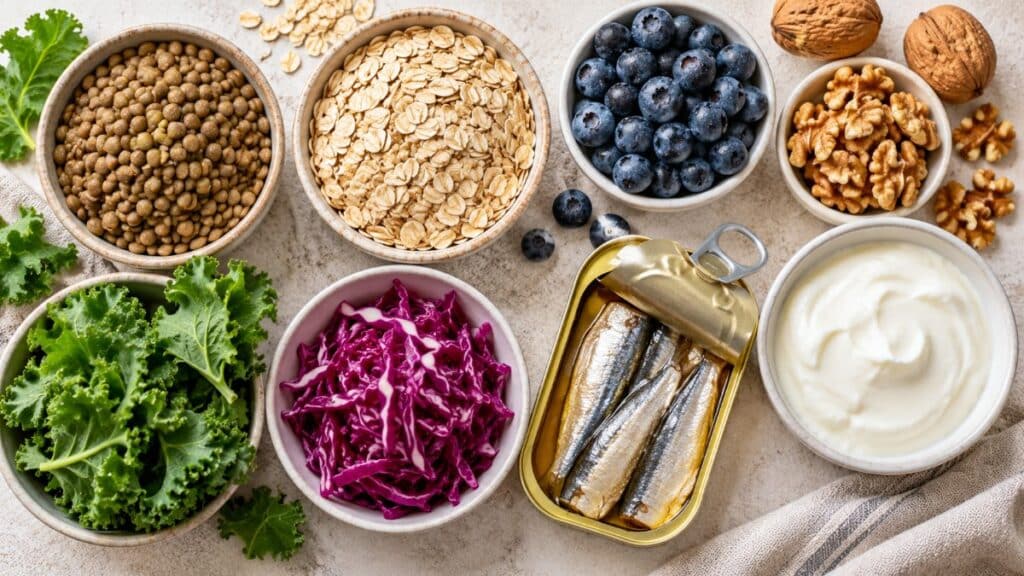
“Superfood” is a marketing word, not a scientific category: there is no official definition, and in the EU a food label may only hint at general health benefits if it also carries a specific, authorised health claim. The foods most often sold as superfoods are simply nutrient-dense, and many of the best ones are cheap and local: lentils, beans, oatscol, col rizada, berries, walnuts, sardines, plain yogurt, flaxseed and chia.
This guide is for anyone who has held a pricey bag of powdered berries and wondered if it is worth it. You will find what the word means, how EU law treats it, and a practical superfoods list with benefits, backed by USDA nutrient data.
What does “superfood” actually mean?
Nothing official. The Harvard T.H. Chan School of Public Health states there is no scientifically based or regulated definition for the word. Foods get the label when they are high in some nutrient or linked to lower disease risk, which covers a huge number of ordinary foods.
Harvard traces the term to a banana marketing campaign around the First World War. Later, blueberries boomed after a USDA database ranked them high for antioxidant capacity. The USDA withdrew that database because test-tube antioxidant scores say little about your body, but the sales boom had already happened.
Treat “superfood” on a package like “artisan” or “premium”: it tells you what the seller wants you to feel.
Is “superfood” allowed on food labels in the EU?
Only with conditions. Under Regulation (EC) No 1924/2006, any health claim on a food is prohibited unless it is authorised and on the EU’s official list. Article 10(3) adds: a reference to general, non-specific benefits for “overall good health or health-related well-being” may only be made if it comes with a specific authorised health claim.
“Superfood” works as exactly that kind of general promise, so a label cannot lean on it alone. When you see it in the EU, look for the specific claim next to it. Often it is about one nutrient, such as vitamin C or fibre, not the food as a whole.
Which foods deserve a place on a superfoods list?
A better question: which foods give a lot of nutrients for their calories and price, and are easy to eat often? Here are twelve, all easy to find in Europe.
Legumes: lentils and white beans
Cooked lentils and beans combine protein and fibre with folate, iron, magnesium and potassium. A bowl of lentil soup costs about as much as a coffee. See how to cook white beans from dry and the full profile of judías blancas.
Avena
Plain rolled oats bring fibre, plant protein and a good dose of magnesium. Choose plain oats rather than sweetened instant sachets and add your own fruit.
Berries
Blueberries are the poster child, but frozen mixed berries, local fresas and blackcurrants play the same role: fibre, vitamin C and colourful plant compounds with few calories.
Walnuts, flaxseed and chia
These are rich plant sources of ALA, an omega-3 fat. The NIH notes that the body converts under 15% of ALA into the longer omega-3s EPA and DHA, so seeds do not replace oily fish, but they still count. Chia also adds a lot of fibre; read our full guide to chia seeds benefits and how to eat them.
Cabbage, kale and broccoli
Here European kitchens quietly beat any imported powder. Raw green cabbage is cheap all winter and gives vitamin C and vitamin K. col rizada is far richer in vitamin K and also supplies calcium and vitamina A. Brócoli sits in between.
sardinas
A tin of sardines with the bones gives you protein, EPA and DHA, vitamin B12, calcium from the soft bones and some vitamin D. It is an affordable way to eat oily fish.
Plain yogurt
Plain, unsweetened yogurt gives calcium and protein, and yogurts with live cultures add fermentation microbes. More on that in our guide to gut health foods.
What nutrients do these superfoods provide per 100 g?
The table compares the foods by weight. Nobody eats 100 g of flaxseed, while 100 g of cabbage is a modest side salad.
| Food (per 100 g) | Energy (kcal) | Protein (g) | Fibre (g) | Rico en |
|---|---|---|---|---|
| Lentils, boiled | 116 | 9.0 | 7.9 | Folate 181 µg, iron 3.3 mg |
| judías blancas, boiled | 139 | 9.7 | 6.3 | Potassium 561 mg, magnesium 63 mg |
| Oats, dry | 389 | 16.9 | 10.6 | Magnesium 177 mg, zinc 4.0 mg |
| Arándanos, crudos | 57 | 0.7 | 2.4 | Vitamin K 19 µg, vitamin C 9.7 mg |
| Walnuts | 654 | 15.2 | 6.7 | ALA omega-3 9.1 g, magnesium 158 mg |
| Flaxseed | 534 | 18.3 | 27.3 | ALA omega-3 22.8 g, magnesium 392 mg |
| Chia seeds, dried | 486 | 16.5 | 34.4 | ALA omega-3 17.8 g, calcium 631 mg |
| Green cabbage, raw | 25 | 1.3 | 2.5 | Vitamin C 36.6 mg, vitamin K 76 µg |
| Kale, raw | 35 | 2.9 | 4.1 | Vitamin K 390 µg, vitamin C 93 mg, calcium 254 mg |
| brócoli, crudo | 34 | 2.8 | 2.6 | Vitamin C 89 mg, vitamin K 102 µg |
| Sardines, canned in oil, with bones | 208 | 24.6 | 0 | EPA + DHA 0.98 g, vitamin B12 8.9 µg, calcium 382 mg |
| Plain whole-milk yogurt | 61 | 3.5 | 0 | Calcium 121 mg |
Source: USDA FoodData Central, SR Legacy (ALA for walnuts and flaxseed listed as fatty acid 18:3).
Legumes and oats are the fibre and protein workhorses. Seeds are dense in everything, calories included, so a tablespoon or two is a sensible portion. The cabbage family gives vitamin C and K for almost no calories. Sardines are the only food here with meaningful EPA, DHA and vitamin B12.
Are expensive superfoods better than everyday foods?
Rarely in any way that matters. A pricey powder may test high for one compound, but your health depends on the whole pattern of what you eat. Harvard’s advice: stop hunting for a star food and build a varied plate.
Fibre shows why boring foods win. Harvard recommends at least 25 to 35 g a day and notes that most Americans get only about 15 g. Beans, oats and vegetables eaten daily get you there; an occasional exotic spoonful will not. The old Mediterranean diet works this way: lots of legumes, vegetables, nuts and fish, with no single hero.
Watch the “healthy” halo too: granola bars built around a superfood can carry a lot of sugar. More traps in 11 “healthy” foods that are actually unhealthy.
What does Ayurveda say about superfoods?
Traditional Ayurveda has no concept of a superfood. In that tradition a food is never good or bad in itself. It is judged by its taste (rasa), its heating or cooling quality (virya), how it suits your constitution (dosha), and above all whether your digestive fire (agni) can handle it.
From that view, a raw kale salad, light, dry and cooling, may suit a strong digestion on a hot day but trouble a weak one, especially in a Vata type. Ayurvedic cooks would sauté the greens with a little ghee, cumin or jengibre. Split mung lentils are classic everyday food, cooked soft and spiced. Nuts count as heavy and warming, best soaked and eaten in small amounts.
This is tradition, not scientific evidence, but the lesson holds: how you prepare a food and how well you digest it matter more than the label.
How do you put superfoods on one plate?
This warm lunch bowl covers legumes, cabbage, seeds and yogurt in one go. It serves two.
Lentil, cabbage and walnut bowl
- 150 g dry brown or green lentils
- a quarter of a small green cabbage (about 250 g), finely shredded
- a handful of walnuts (about 30 g), roughly chopped
- 1 tablespoon ground flaxseed
- 4 tablespoons plain yogurt
- 1 ajo clove, grated
- 1 tablespoon aceite de oliva, juice of half a lemon, salt, pepper, 1 teaspoon cumin seeds
- Rinse the lentils and simmer them in plenty of water for 20 to 25 minutes until tender but not mushy. Drain.
- While they cook, toss the cabbage with the lemon juice and a pinch of salt and squeeze it with your hands for a minute so it softens.
- Warm the olive oil in a pan, add the cumin seeds for 30 seconds, then stir in the drained lentils.
- Mix the yogurt with the garlic and a pinch of salt.
- Divide the lentils and cabbage between two bowls, spoon over the garlic yogurt, and scatter the walnuts and flaxseed on top.
Swap in white beans or kale with the seasons. For more seeds, a chia pudding makes an easy breakfast, and many of these foods also show up in our list of magnesium rich foods.
Who should be careful with these foods?
- People taking warfarin. Kale, broccoli and other greens are rich in vitamin K. The NIH warns that sudden changes in vitamin K intake can strengthen or weaken warfarin, so keep your intake consistent and talk to your doctor before a big change.
- Anyone new to high-fibre eating. A sudden jump in beans, seeds and oats can cause bloating and cramping. Harvard recommends increasing fibre gradually and drinking more fluids.
- Seed portions. Chia and flaxseed are calorie-dense and absorb water. Eat them soaked or mixed into moist food; dry chia in particular should not be swallowed by the spoonful.
- Omega-3 supplements differ from food. The NIH notes that 2 to 15 g a day of EPA and DHA might increase bleeding time. A portion of sardines gives far less.
- Allergies. Fish, nuts, milk and seeds are common allergens.
FAQ
What is the healthiest superfood?
There is no single winner, because “superfood” has no scientific definition. If you want the most nutrition for the least money, legumes such as lentils and beans come close: protein, fibre, folate and minerals in one cheap food.
Are superfoods worth the money?
Imported powders and juices usually are not. Everyday foods like oats, cabbage, frozen berries and tinned sardines give you similar or better nutrition at a fraction of the price.
Are there superfoods for weight loss?
No food burns fat on its own. High-fibre, high-protein foods like legumes, oats and vegetables can make meals more filling, which may help you eat less overall, but seeds and nuts are calorie-dense, so portions still count.
Is “superfood” a legal term in the EU?
No. Under Regulation 1924/2006 a general health promise like this may only appear on a label if it is accompanied by a specific health claim that the EU has authorised.
Sources
- Harvard T.H. Chan School of Public Health. Superfoods or Superhype? The Nutrition Source, last updated 2025. nutritionsource.hsph.harvard.edu/superfoods
- European Parliament and Council. Regulation (EC) No 1924/2006 on nutrition and health claims made on foods (consolidated text, Article 10). EUR-Lex. eur-lex.europa.eu
- U.S. Department of Agriculture, Agricultural Research Service. FoodData Central, SR Legacy, 2018. fdc.nal.usda.gov
- NIH Office of Dietary Supplements. Omega-3 Fatty Acids: Fact Sheet for Health Professionals. ods.od.nih.gov
- NIH Office of Dietary Supplements. Vitamin K: Fact Sheet for Health Professionals. ods.od.nih.gov
- Harvard T.H. Chan School of Public Health. Fiber. The Nutrition Source. nutritionsource.hsph.harvard.edu/carbohydrates/fiber
This article is for information only and is not medical advice. If you have a health condition, are pregnant or take medication, talk to your doctor or pharmacist before changing your diet or starting a supplement.


 Español
 English
 Deutsch
 Français

