
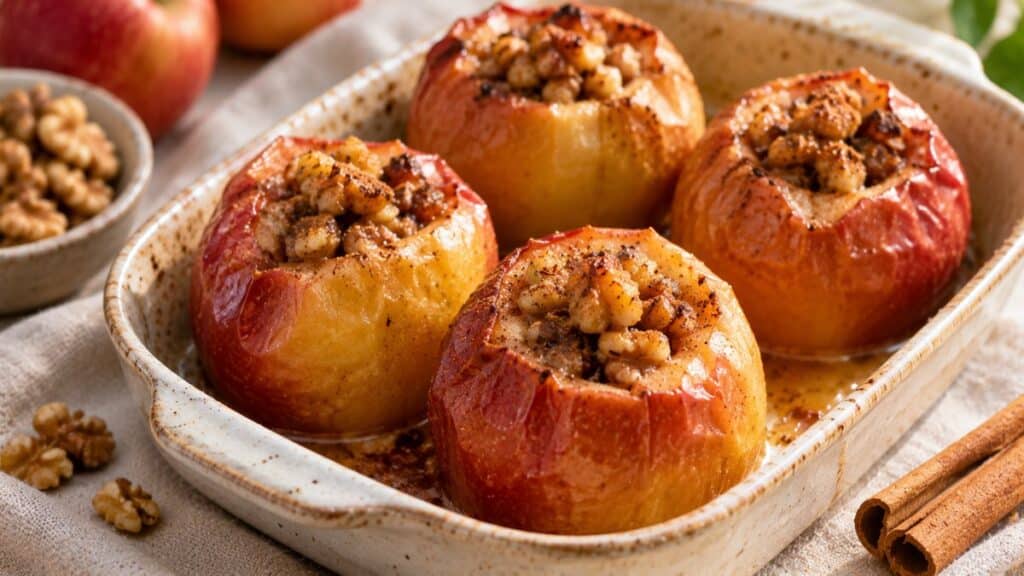
Healthy desserts without sugar get their sweetness from whole fruit, warm spices and texture instead of added sugar, honey or syrup. The WHO advises keeping free sugars below 10% of daily energy, and ideally below 5% (about 25 g a day), and fruit-based desserts such as baked apples with walnuts or a cocoa chia pudding fit easily. Dates and honey are still sugar, so treat them as sweeteners, not free passes.
This guide is for anyone who wants something sweet after dinner, from no sugar sweets to a proper pudding: people cutting back on sugar, parents, and anyone confused by “no added sugar” labels. You’ll find the official limits, what label claims mean, where dates, honey and sweeteners fit, and two recipes.
How much sugar is too much in a day?
The World Health Organization’s 2015 guideline makes two recommendations for adults and children. First, a strong one: keep free sugars below 10% of total energy intake. Second, a conditional one: going below 5%, roughly 25 g or 6 teaspoons a day, brings further benefits.
The key word is free. WHO defines free sugars as sugars added to foods and drinks plus the sugars naturally present in honey, syrups, fruit juices and fruit juice concentrates. Sugars inside whole fruit and vegetables, and the natural sugar in milk, are not counted, because no evidence links them to harm.
The European Food Safety Authority reached a similar place in 2022. It could not set a safe upper limit, and concluded that intakes of added and free sugars should be “as low as possible” within a nutritionally adequate diet. EFSA links these sugars to dental caries and, with varying certainty, to obesity, non-alcoholic fatty liver disease and type 2 diabetes. Evidence on risk below 10% of energy is thin, it noted.
For dessert, the takeaway is practical. A bowl of baked fruit counts toward none of your free-sugar budget. The same fruit drizzled with honey does.
What does “no added sugar” mean on a food label?
In the EU, sugar claims are defined by Regulation (EC) No 1924/2006 on nutrition and health claims. Three are worth knowing:
- With no added sugars: the product contains no added mono- or disaccharides and no other food used for its sweetening properties. If sugars occur naturally, the label must also say “contains naturally occurring sugars”.
- Sugars-free: no more than 0.5 g of sugars per 100 g or 100 ml.
- Low sugars: no more than 5 g of sugars per 100 g for solids, or 2.5 g per 100 ml for liquids.
Two traps follow. A “no added sugar” dessert can still be high in sugar from fruit, and “sugar-free” usually means it is sweetened with something else. Read literally, the “no added sugars” wording also excludes foods added purely to sweeten, such as fruit juice concentrate, but check the ingredient list either way. Our list of “healthy” foods that are actually unhealthy shows how often sweet snacks hide behind a health halo.
Are dates and honey healthier than sugar?
They bring a little more than table sugar, but they are still concentrated sugar. Here is how common dessert ingredients compare.
| Ingredient | Sugars per 100 g | Fibre per 100 g | Free sugar under WHO definition? |
|---|---|---|---|
| Honey | 82.1 g | negligible | Yes |
| Medjool dates | 66.5 g | 6.7 g | Not as whole fruit |
| Banana, raw | 12.2 g | 2.6 g | No |
| Apple, raw, with skin | 10.4 g | 2.4 g | No |
| Walnuts | 2.6 g | 6.7 g | No |
| Cocoa powder, unsweetened | 1.8 g | 37.0 g | No |
Source: USDA FoodData Central, SR Legacy; free-sugar classification from the WHO 2015 sugars guideline.
One tablespoon of honey (21 g) carries about 17 g of sugars, close to 70% of the WHO’s ideal 25 g limit in a single spoon. Honey counts fully as free sugar, whatever its flavour or origin.
Whole dates are different on paper. They are fruit, they bring fibre, and WHO’s definition doesn’t list them as free sugars. But at 66.5 g of sugars per 100 g, even 20 g of Medjool dates adds about 13 g of sugar. Once you blend dates into a paste, they behave like a sweetener in the recipe. WHO’s definition doesn’t spell out puréed dried fruit, so the cautious approach is to measure date paste the way you’d measure honey.
Should you use sweeteners instead of sugar?
Here two questions get mixed up: are sweeteners safe, and are they useful?
On safety, EFSA evaluates each sweetener as a food additive and sets an acceptable daily intake (ADI). For aspartame, its 2013 opinion set the ADI at 40 mg per kg of body weight per day, concluded that typical exposure is well below that, and found it safe for the general population, including pregnant women and children. The exception is people with phenylketonuria (PKU), who must strictly limit phenylalanine.
On usefulness, the WHO’s 2023 guideline recommends against using non-sugar sweeteners to control body weight or reduce the risk of noncommunicable diseases. It covers sweeteners such as aspartame, sucralose, saccharin and stevia. The recommendation is conditional: the review behind it suggested long-term use may be linked to higher risk of type 2 diabetes, cardiovascular disease and mortality, but WHO acknowledged these links may be explained by other factors. It doesn’t apply to people with existing diabetes, and it excludes sugar alcohols (polyols) and low-calorie sugars.
Both can be true: safe within its ADI, yet not much help. WHO suggests fruit and unsweetened foods instead.
How do you make desserts taste sweet without sugar?
- Use riper fruit. Spotty ripe bananas taste far sweeter than green ones, and frozen chunks blend into a soft-serve texture.
- Bake or roast. Heat concentrates flavour. Roasted calabaza con cinnamon and walnuts tastes like dessert with nothing added.
- Lean on “sweet” spices. Cinnamon, vanilla, cardamom and nutmeg read as sweet even though they contain almost no sugar.
- Add a pinch of salt. It rounds out cocoa and fruit and makes them taste fuller.
- Bring richness. Nuts, Greek yogurt or a spoon of nut butter make a small portion feel satisfying.
- Play with temperature and tartness. Warm stewed fruit, or tart blueberries over thick yogurt, feel more like a treat than plain raw fruit.
What does Ayurveda say about sweet desserts?
In Ayurveda, sweet (madhura rasa) is one of six tastes and is considered the most nourishing and grounding. Traditionally it calms vata and pitta and, in excess, increases kapha, the heavy and slow dosha. Sweet foods are also seen as heavy to digest, so the advice is a modest amount, eaten when agni, the digestive fire, is strong.
Several classical habits fit a sugar-free dessert well. Warm, cooked fruit, such as stewed apples with cinnamon and a little ghee, is a traditional gentle sweet. Cardamom, jengibre and cinnamon are added to sweets to make them easier to digest. And classical texts warn against heating or cooking honey, so in Ayurvedic kitchens honey is stirred in only after a dish has cooled. This is traditional guidance, not scientific evidence.
What are easy no sugar desserts to make at home?
Baked apples with walnuts and cinnamon (4 servings)
Firm, tart apples such as Granny Smith hold their shape; sweeter varieties turn softer and jammier. At about 10 g of natural sugar per 100 g of apple, none of it free sugar, this is as close to “free” as dessert gets.
- 4 medium apples
- 40 g walnuts, roughly chopped
- 1 teaspoon ground cinnamon
- 1/4 teaspoon ground cardamom (optional)
- 1 tablespoon butter, ghee or coconut oil
- 4 tablespoons water
- Plain Greek yogurt to serve (optional)
- Heat the oven to 180°C.
- Core the apples with a small knife or corer, leaving the bottom 1 cm intact so the filling stays in.
- Mix walnuts, cinnamon, cardamom and the fat, and press the mixture into each apple.
- Stand the apples in a small baking dish, pour the water around them and bake for 30-40 minutes, until a knife slides in easily.
- Rest for 5 minutes and serve warm with a spoon of yogurt and the juices from the dish.
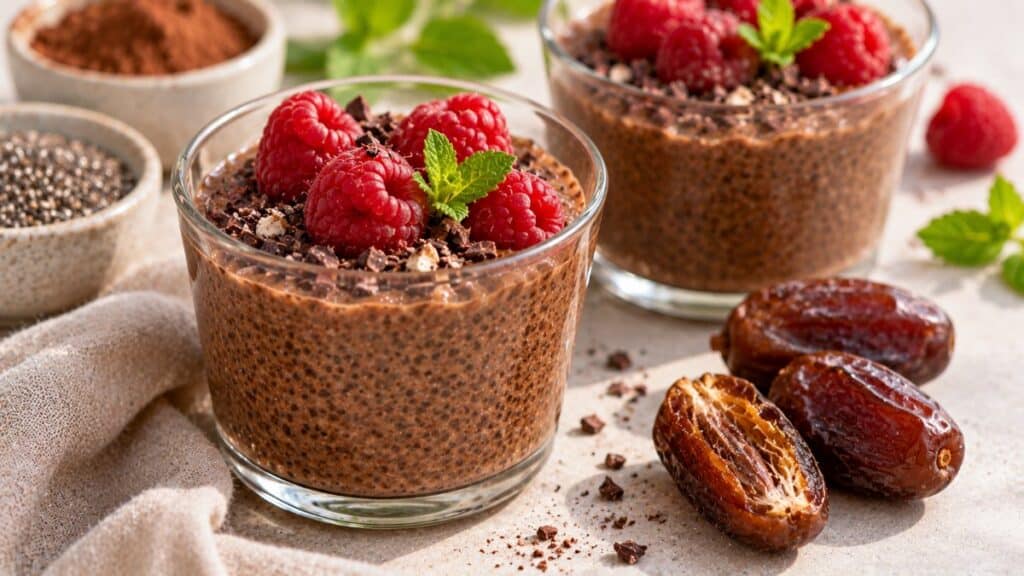
Cocoa chia pudding with dates (2 servings)
Here dates do the sweetening, so they count. The 40 g below adds roughly 13 g of sugars per serving, about half the WHO’s 25 g ideal limit, still well below most chocolate puddings. Read more in our guide to chia seeds and how to eat them.
- 250 ml milk or unsweetened soy drink
- 40 g Medjool dates, pitted
- 10 g unsweetened cocoa powder
- 1/2 teaspoon vanilla extract
- A pinch of salt
- 40 g chia seeds
- Berries to serve
- If the dates are dry, soak them in hot water for 10 minutes, then drain.
- Blend milk, dates, cocoa, vanilla and salt until smooth.
- Pour into a bowl or jar, stir in the chia seeds, wait 5 minutes and stir again to break up clumps.
- Cover and chill for at least 2 hours, or overnight.
- Serve topped with berries.
Who should be careful with sugar-free desserts?
- People with diabetes. Fruit, dates and honey all raise blood glucose. Portion size matters, and our glycemic index table helps you compare foods. WHO’s sweetener guideline does not cover people with existing diabetes, so ask your diabetes team about sweeteners.
- Phenylketonuria (PKU). Avoid aspartame; EFSA’s ADI does not apply to people with PKU.
- Nut allergy. Swap walnuts for toasted oats or seeds.
- Calories still count. Walnuts have about 654 kcal per 100 g. “No added sugar” doesn’t mean “eat the whole tray”.
Related reading: if you want a sweet start to the day that also keeps you full, try our high-protein vegetarian breakfast ideas, and for long-term change see 5 healthy eating habits.
FAQ
Is honey healthier than white sugar?
Not in any way that matters for your sugar limit. Honey is about 82% sugar and counts fully as free sugar under the WHO definition. Enjoy it for flavour, in small amounts.
Are dates a good sugar substitute?
Whole dates bring fibre along with their sugar, which plain sugar doesn’t. But they are about two-thirds sugar by weight, so blended into a dessert they work as a sweetener. Measure them, and expect around 13 g of sugars per 20 g.
Is “sugar-free” the same as “no added sugar”?
No. Under EU rules, “sugars-free” means no more than 0.5 g of sugars per 100 g, while “with no added sugars” means nothing was added to sweeten it, though the food may still be naturally high in sugar. “Sugar-free” products are often sweetened with non-sugar sweeteners.
Are no sugar desserts good for weight loss?
Swapping sugar for sweeteners hasn’t been shown to help long-term weight control, which is why WHO advises against using them for that purpose. Fruit-based desserts in sensible portions are the better habit.
Sources
- World Health Organization. WHO calls on countries to reduce sugars intake among adults and children (Guideline: Sugars intake for adults and children). WHO, 2015. who.int
- World Health Organization. WHO advises not to use non-sugar sweeteners for weight control in newly released guideline. WHO, 2023. who.int
- European Food Safety Authority. Added and free sugars should be as low as possible. EFSA, 2022. efsa.europa.eu
- European Parliament and Council. Regulation (EC) No 1924/2006 on nutrition and health claims made on foods, Annex (consolidated version). EUR-Lex. eur-lex.europa.eu
- European Food Safety Authority. Aspartame (topic page, including the 2013 scientific opinion). EFSA. efsa.europa.eu
- U.S. Department of Agriculture, Agricultural Research Service. FoodData Central, SR Legacy (FDC IDs 169640, 168191, 173944, 171688, 170187, 169593). fdc.nal.usda.gov
This article is for information only and is not medical advice. If you have a health condition, are pregnant or take medication, talk to your doctor or pharmacist before changing your diet or starting a supplement.


 Español
 English
 Deutsch
 Français

