
← Encyclopediaenciclopedia de comida
By Nikola · Precision Nutrition L1 · Updated 5 November 2026
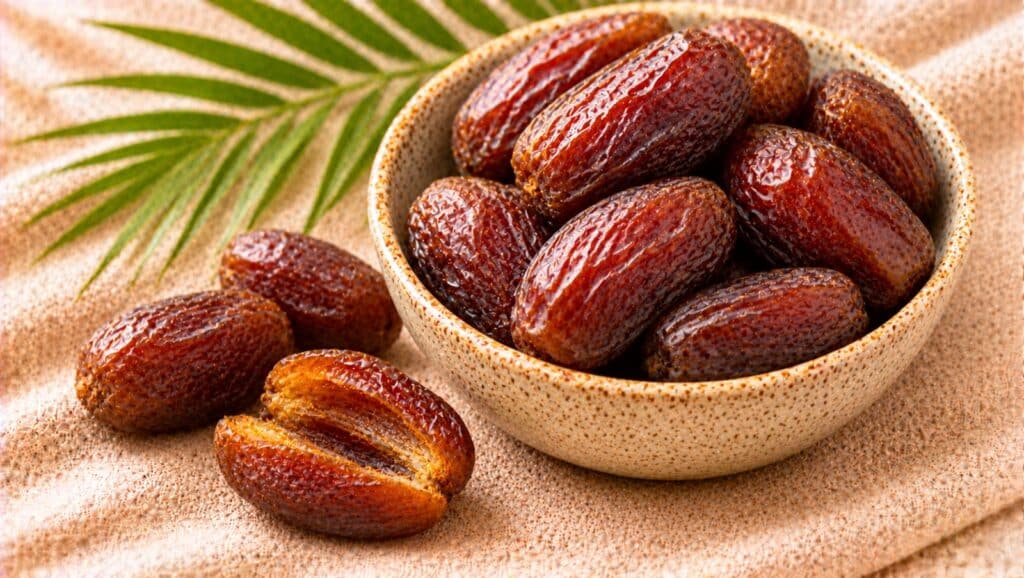
Dates are the fruit of the date palm (Phoenix dactylifera), sold mostly semi-dried, with a sticky, caramel-like flesh around a single long stone. They are one of the sweetest whole foods you can buy: 100 g of Medjool dates have 277 kcal and 66.5 g of sugar, along with 6.7 g of fibre and 696 mg of potassium. One large Medjool date (24 g) gives about 67 kcal. Despite the sugar, raw dates have a low glycemic index of 42, which makes them a better sweet snack than sweets, as long as you keep to two or three.
Date nutrition per 100 g and per date
| Nutritivo | Medjool, 100 g | 1 Medjool date, 24 g | Deglet Noor, 100 g | 1 Deglet Noor date, 7.1 g |
|---|---|---|---|---|
| Energía | 277 kcal | 66 kcal | 282 kcal | 20 kcal |
| Agua | 21.3 g | 5.1 g | 20.5 g | 1.5 g |
| Proteína | 1.8 g | 0.4 g | 2.5 g | 0.2 g |
| Fat | 0.2 g | 0.0 g | 0.4 g | 0.0 g |
| Carbohydrate | 75 g | 18 g | 75 g | 5.3 g |
| of which sugars | 66.5 g | 16 g | 63.4 g | 4.5 g |
| Fibre | 6.7 g | 1.6 g | 8.0 g | 0.6 g |
| Potasio | 696 mg | 167 mg | 656 mg | 47 mg |
| Magnesio | 54 mg | 13 mg | 43 mg | 3 mg |
| Calcio | 64 mg | 15 mg | 39 mg | 3 mg |
| Copper | 0.36 mg | 0.09 mg | 0.21 mg | 0.01 mg |
| Vitamina B6 | 0.25 mg | 0.06 mg | 0.17 mg | 0.01 mg |
Source: USDA FoodData Central, SR Legacy: “Dates, medjool”, FDC ID 168191 y “Dates, deglet noor”, FDC ID 171726, checked 5 November 2026. USDA gives 24 g for one pitted Medjool date and 7.1 g for one pitted Deglet Noor date; the portion columns are calculated from the 100 g values. In USDA data the carbohydrate figure includes fibre. Values rounded.
The two common varieties are close per 100 g. The real difference is size: a Medjool date weighs more than three times as much as a Deglet Noor, so “two dates” can mean 40 kcal or 133 kcal depending on which you buy.
Glycemic index
In the international GI tables (Atkinson 2008), raw dates have a glycemic index of 42 ± 4 (glucose = 100), which is low. The table does not separate varieties. A low GI does not cancel the sugar load: two Medjool dates bring about 36 g of carbohydrate. See What is the glycemic index (with table).
Health benefits: what the evidence says
- Potassium. With around 700 mg per 100 g, dates are among the more potassium-dense fruits. NIH sets adequate intake at 3,400 mg a day for men and 2,600 mg for women; two Medjool dates give about 330 mg.
- Fibre. EFSA considers 25 g of fibre a day adequate for normal bowel function in adults. Two Medjool dates add about 3 g, which helps when they replace sweets that have none.
- A better sweet choice. Dates have a low GI and come with fibre, potassium, magnesium and copper. Used in place of sugar or sweets, a couple of dates give you more than empty calories. They are still energy-dense, so the benefit depends on the swap, not on adding them on top.
- Dates in late pregnancy (weak evidence). A 2024 systematic review in BMC Pregnancy and Childbirth (Salajegheh and colleagues, 48 studies) found that eating dates in late pregnancy was associated with shorter labour, less need for induction and more spontaneous vaginal births. The authors rated the overall evidence quality as unacceptable, with high risk of bias in most studies, and safety was recorded in only four trials. They call for better studies. This is not a recommendation; discuss it with your midwife or doctor.
How to eat dates
- As a snack: two or three dates with a handful of almonds o walnuts. The protein and fat from the nuts make the snack more filling.
- Stuffed: pit a Medjool date and fill it with a walnut half or a teaspoon of peanut butter.
- Natural sweetener: blend soaked dates into a paste and use it in place of part of the sugar in baking, energy balls with oats y cocoa, or smoothies.
- Desayuno: chopped dates in porridge o Greek yogurt con cinnamon; you will not need added sugar.
- Savoury dishes: a few chopped dates in a chickpea or vegetable tagine, or in a salad with orange y cohete.
- Before exercise: one or two dates are a compact, portable source of carbohydrate.
- Storage: keep dates in a closed container in a cool place or the fridge; Medjool dates keep longest refrigerated.
Who should be careful
- Diabetes. Dates have a low GI, but each Medjool date has about 18 g of carbohydrate. Count them as part of the meal’s carbohydrate and pair them with nuts or yogurt.
- Kidney disease and potassium. NIH notes that in chronic kidney disease, or with ACE inhibitors, ARBs or potassium-sparing diuretics, potassium can build up in the blood even at normal intakes. Dates are potassium-dense, so agree portions with your doctor or dietitian.
- Weight management. At roughly 280 kcal per 100 g, dates are easy to overeat. Count them out instead of eating from the box.
- Pregnancy. Because the evidence on dates and labour is weak, and safety data are limited, check with your midwife or doctor before eating large daily amounts, especially if you have gestational diabetes.
Traditional view (Ayurveda)
In Usha and Vasant Lad’s food guidelines, fresh dates are favourable for Vata and dry dates are to be avoided; dates are favourable for Pitta and are on the avoid list for Kapha. This is a traditional system, not evidence from clinical studies.
Related entries and articles
- Figs – another sweet dried fruit with fibre
- Plátanos – a fresh fruit rich in potassium
- Almendras – the natural partner for dates
- Avena – for date-sweetened porridge and energy balls
- Cocoa – with dates in no-sugar treats
- Foods for energy without caffeine
- What is the glycemic index
FAQ
How many dates can I eat a day?
There is no official limit. Two or three dates are a sensible snack portion for most people: two Medjool dates give about 133 kcal, 36 g of carbohydrate and 3 g of fibre. Smaller Deglet Noor dates have about 20 kcal each.
Are dates good for people with diabetes?
They can fit in small amounts. Raw dates have a low GI of 42, but one Medjool date has about 18 g of carbohydrate. Count dates as part of your meal’s carbohydrate and eat them with nuts or yogurt rather than on their own.
Do dates help with labour?
Some studies suggest that eating dates in late pregnancy is linked to shorter labour and less need for induction, but a 2024 review rated the evidence as low quality with limited safety data. Talk to your midwife or doctor before relying on it.
Sources
- USDA FoodData Central, SR Legacy: Dates, medjool (FDC ID 168191). fdc.nal.usda.gov
- USDA FoodData Central, SR Legacy: Dates, deglet noor (FDC ID 171726). fdc.nal.usda.gov
- Atkinson FS, Foster-Powell K, Brand-Miller JC. International Tables of Glycemic Index and Glycemic Load Values: 2008. Diabetes Care 2008;31(12):2281-2283. PMC
- Salajegheh Z, Nasiri M, Imanipour M, et al. Is oral consumption of dates (Phoenix dactylifera L. fruit) in the peripartum period effective and safe integrative care to facilitate childbirth and improve perinatal outcomes: a comprehensive revised systematic review and dose-response meta-analysis. BMC Pregnancy Childbirth 2024;24:12. doi.org
- NIH Office of Dietary Supplements. Potassium: Fact Sheet for Health Professionals. ods.od.nih.gov
- EFSA NDA Panel (2010). Scientific Opinion on Dietary Reference Values for carbohydrates and dietary fibre. EFSA Journal 8(3):1462. efsa.europa.eu
- Lad U, Lad V. Food Guidelines for Basic Constitutional Types, from Ayurvedic Cooking for Self-Healing, 2nd ed. The Ayurvedic Institute. ayurveda.com
This page is for information only and is not medical or dietary advice.
Статии по темата
- A Mediterranean Week on a Budget, Costed in Euros
- Kapha Diet: Foods That Balance Kapha Dosha
- Low Glycemic Fruits List (With GI Values)
- No-Bake Energy Balls with Oats and Dates
- Vata Diet: What to Eat to Balance Vata Dosha
- Anti-Inflammatory Diet Meal Plan for 7 Days
- Maca Root: Benefits, Evidence and Side Effects
- Golden Milk: Recipe and Benefits
 Español
 English
 Deutsch
 Français

