
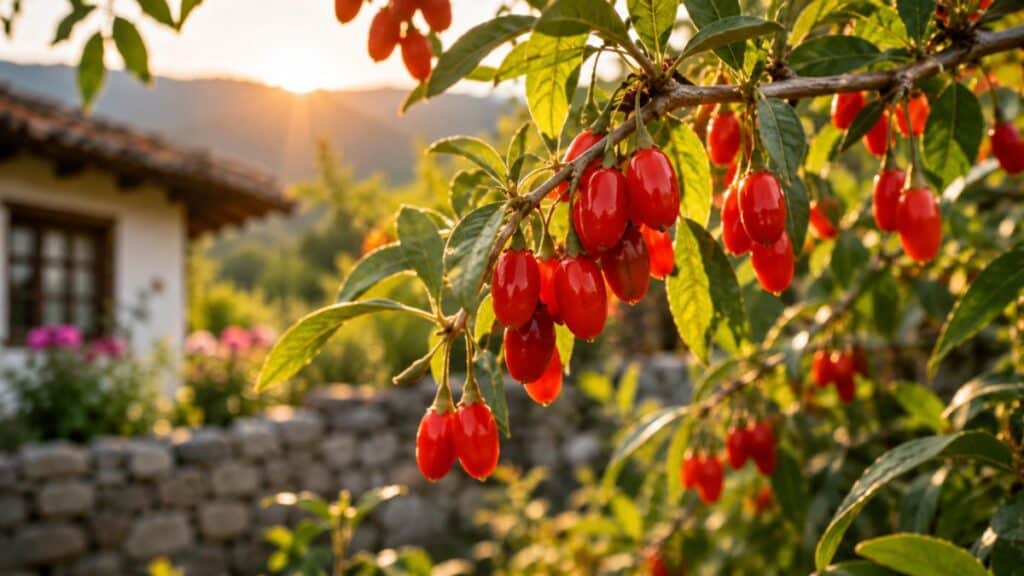
Goji berry benefits are real but modest: dried goji berries give you fibre, some plant protein, iron, vitamin C and a lot of carotenoids, including zeaxanthin, a pigment that collects in the retina. In a small 90-day trial, a 28 g handful eaten five times a week raised macular pigment in healthy middle-aged adults. Goji is not a cure for anything, and it can interact with warfarin, so people on blood thinners should ask their doctor first.
This guide is for you if you have a bag of dried goji berries in the cupboard and want to know whether they are worth it. You will find the USDA nutrition numbers, what the human studies actually measured, how to eat goji berries without overdoing the sugar, a simple goji tea, and the safety points most packets leave out.
What are goji berries?
Goji is the name sold in shops for the small red fruit of Lycium barbarum, also called wolfberry. The shrub belongs to the Solanaceae, or nightshade family, which also includes Tomates, potatoes, pimientos y berenjena. In East Asia it has been used for a very long time both as food and in traditional Chinese medicine.
Most of what you can buy in Europe is dried. Fresh goji berries are delicate and rarely reach supermarkets, though you will sometimes see them at farmers’ markets in late summer. You will also find goji berry powder and juice, which are more concentrated and usually more expensive per gram.
What nutrients are in dried goji berries?
The per-28 g column is calculated from the USDA per-100 g values. Twenty-eight grams is roughly a small handful, and it is the amount used in the eye study described below.
| Nutritivo | Per 100 g | Per 28 g |
|---|---|---|
| Energía | 349 kcal | 98 kcal |
| Proteína | 14.3 g | 4.0 g |
| Fat | 0.4 g | 0.1 g |
| Carbohydrate | 77.1 g | 21.6 g |
| Fibre | 13.0 g | 3.6 g |
| Total sugars | 45.6 g | 12.8 g |
| Calcio | 190 mg | 53 mg |
| Hierro | 6.8 mg | 1.9 mg |
| Sodio | 298 mg | 83 mg |
| Vitamina C | 48.4 mg | 13.6 mg |
| vitamina a | 26,800 IU | 7,504 IU |
Source: USDA FoodData Central, SR Legacy, “Goji berries, dried” (FDC ID 173032). Per-28 g values calculated and rounded.
Two things stand out. First, goji is unusually high in protein for a fruit. Second, almost half of the dried weight is sugar, which is normal for dried fruit but worth remembering if you snack on them straight from the bag. The large vitamin A figure comes from carotenoid pigments, which your body can turn into vitamina A as it needs it.

What are the health benefits of goji berries?
Eye health and zeaxanthin
This is the best-studied benefit. Goji berries are a rich food source of zeaxanthin, one of the two yellow pigments (with lutein) that build up in the macula, the part of the retina you use for sharp central vision. A 2025 review notes that the zeaxanthin in wolfberries is absorbed and raises zeaxanthin levels in the blood.
The most direct human test is a 2021 pilot trial. Twenty-seven healthy adults aged 45 to 65 ate 28 g of dried goji berries five times a week for 90 days, while a comparison group took a supplement with 6 mg lutein and 4 mg zeaxanthin on the same schedule. Macular pigment density rose in the goji group and did not change in the supplement group. Skin carotenoid levels also rose with goji.
Keep the limits in view: 27 people, no blinding, and the outcome was a pigment measurement, not fewer cases of macular degeneration. It is an encouraging signal, not proof that goji protects your eyes.
Blood sugar
The same 2025 review describes a trial in 67 people with type 2 diabetes in which a goji preparation lowered serum glucose. The authors present it as a possible support, not a treatment. Remember that dried goji itself is sugar-dense, so a small portion within a meal is a better idea than handfuls between meals.
Antioxidants and inflammation
Much of the excitement around goji comes from lab and animal studies on its polysaccharides and carotenoids. Those studies are a reason to keep researching, not evidence that eating goji lowers inflammation in people. If inflammation is your concern, the overall pattern of your plate matters far more, and our list of foods that reduce inflammation is a better place to start.
Are goji berries better than other berries?
Not in a way that justifies the price for most people. Goji wins on protein and on zeaxanthin. Everyday blueberries bring their own pigments, more water and far less sugar per bite. Our superfoods list explains why the “superfood” label is a marketing word rather than a scientific category. Goji fits well as one colourful option among many, next to its South American cousin in the hype cycle, acai berry.
What does Ayurveda say about goji berries?
Goji is not part of the classical Ayurvedic texts. It comes from the Chinese tradition. What follows is how an Ayurvedic practitioner might read it using Ayurvedic principles, offered as tradition and interpretation, not as scientific evidence.
- Rasa (taste): mainly sweet (madhura), with a light sour note. Sweet taste is seen as nourishing and grounding.
- Virya (energy): mild. Fresh berries lean cooling. Dried berries are drier and more concentrated.
- Dosha: soaked or cooked goji is usually considered fine for Vata and Pitta. Kapha types would keep portions small, because sweet, dense foods are thought to add heaviness.
- Agni (digestive fire): dried fruit eaten dry is considered hard on weak digestion. Soaking in warm water, or simmering in porridge or tea, is the traditional fix.
How do you eat goji berries?
A sensible everyday amount is a small handful, around 15 to 28 g. The trial above used 28 g five times a week. There is no official recommended dose for goji as a food.
- Soak them for 10 minutes in warm water, then add to oats, yoghurt or a calm, anti-inflammatory breakfast.
- Stir a spoonful into rice, lentil soup or a grain salad in the last few minutes of cooking.
- Chop and fold into no-bake energy balls with oats and dates.
- Steep them as a tea, as below.
Recipe: warm goji tea
Goji berry tea is a gentle way to enjoy the fruit, and you get to eat the softened berries at the end.
- 1 tablespoon dried goji berries (about 10 g)
- 2 thin slices of fresh ginger (optional)
- 300 ml water, just off the boil
- a squeeze of lemon (optional)
- Rinse the berries briefly under the tap.
- Put the berries and ginger in a large mug and pour over the hot water.
- Cover with a saucer and steep for 8 to 10 minutes, until the berries swell and the water turns pale orange.
- Add lemon if you like, sip warm, and eat the berries with a spoon.
Are goji berries safe? Precautions
Warfarin and other medicines
This is the most important caution. Case reports describe people on stable warfarin whose blood clotting tests (INR) climbed after they started goji. One published case involved an 80-year-old woman who had two episodes of high INR after drinking goji herbal tea. A separate 2021 case described a 75-year-old woman on flecainide, a heart rhythm drug, who fainted with a dangerous rhythm after drinking goji tea; the authors suspected goji slowed the drug’s breakdown in the liver. If you take warfarin, flecainide or any medicine with a narrow safety margin, talk to your doctor before adding goji, especially as tea or juice.
Nightshade family and allergy
Goji contains small amounts of the alkaloids typical of nightshades, but the 2025 review reports that the atropine found in tested berries was too low to pose a significant risk. Allergy is a more real concern. People with food allergies, especially to lipid transfer proteins (LTP), may react to goji, with cross-reactions reported with peach, tomate, nuts and mugwort (Artemisia) pollen. If you react to peaches or tomatoes, try goji cautiously or ask an allergist.
Sulphites and quality
Some dried fruit is treated with sulphites to keep its colour. In the EU and UK, sulphur dioxide and sulphites above 10 mg per kg must be declared as an allergen on the label. If you have asthma or know you react to sulphites, read the ingredients. The 2025 review also mentions that some goji samples carried pesticide residues, mostly below legal limits, which is one reason many people choose organic goji berries from a traceable source.
Sugar and portion
Dried goji is nearly half sugar by weight. A handful is fine. A bag in front of the laptop is a dessert. If you are pregnant, breastfeeding or managing diabetes, talk to your doctor before eating goji often or using concentrated goji juice or powder.
Related reading: acai berry benefits and evidence, our honest superfoods list.
FAQ
How many goji berries should I eat a day?
There is no official dose. A small handful of dried goji berries, about 15 to 28 g, is a reasonable food portion. The eye trial used 28 g five times a week.
Are dried goji berries as good as fresh?
Dried goji berries are what most studies and nutrition databases describe, and they keep well. Drying concentrates both the nutrients and the sugar, so the portion is smaller than you might eat of fresh fruit.
Is goji berry tea good for you?
Goji berry tea is a pleasant, low-calorie drink, and you can eat the soaked berries afterwards. The warfarin and flecainide case reports involved goji tea, so the drug caution applies to the tea too.
Are goji berries good for women?
Goji has no proven benefits that are specific to women. The nutrients, such as iron and carotenoids, are useful for anyone. If you are pregnant or breastfeeding, ask your doctor before eating goji regularly.
Sources
- U.S. Department of Agriculture, Agricultural Research Service. FoodData Central, SR Legacy: Goji berries, dried (FDC ID 173032). fdc.nal.usda.gov
- Li X, et al. (University of California, Davis). Goji Berry Intake Increases Macular Pigment Optical Density in Healthy Adults: A Randomized Pilot Trial. Nutrients, 2021;13(12):4409. PubMed 34959963
- Berisha A, Alexa EA, Kelleher R, Zhang T. From botany to bedside: a review of the health benefits of Lycium barbarum as a functional food. Exploration of Foods and Foodomics, 2025;3:101070. explorationpub.com
- Leung H, Hung A, Hui AC, Chan TY. Warfarin overdose due to the possible effects of Lycium barbarum L. Food and Chemical Toxicology, 2008. PubMed 18281140
- Guzmán CE, Guzmán-Moreno CG, Assad-Morell JL, Carrizales-Sepúlveda EF. Flecainide toxicity associated with the use of goji berries: a case report. European Heart Journal Case Reports, 2021. PubMed 34084998
- Regulation (EU) No 1169/2011 on the provision of food information to consumers, Annex II: Substances or products causing allergies or intolerances. legislation.gov.uk/eur/2011/1169/annex/II
This article is for information only and is not medical advice. If you have a health condition, are pregnant or take medication, talk to your doctor or pharmacist before changing your diet or starting a supplement.


 Español
 English
 Deutsch
 Français

