
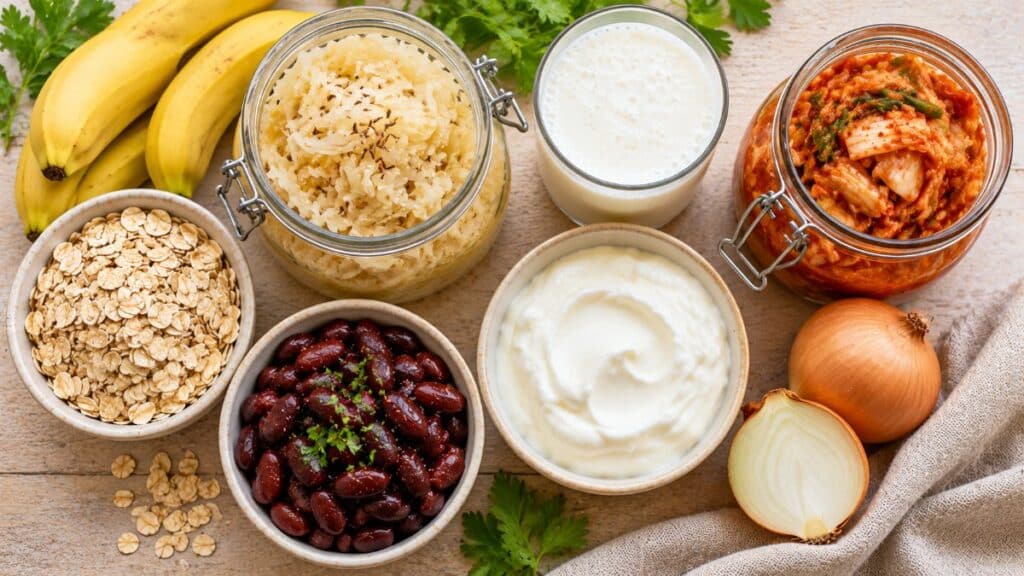
The best gut health foods are fibre-rich plants (beans, lentils, whole grains, vegetables, fruit, nuts and seeds), prebiotic foods such as oignons, ail, poireaux et oats, and fermented foods with live cultures like yogurt, kefir and unpasteurised sauerkraut. EFSA considers 25 g of fibre a day adequate for normal bowel function in adults, and a 2021 randomised study found that a diet high in fermented foods increased gut microbiome diversity and lowered inflammatory markers.
This guide is for anyone who wants a calmer, more regular gut without buying expensive powders. You’ll find how much fibre to aim for, a table of everyday foods with their fibre per serving, what the research on fermented foods and plant variety shows, where probiotic supplements fit, the Ayurvedic view, and a soup you can cook tonight.
What are the best foods for gut health?
The microbes in your large intestine live on what your own enzymes can’t digest: mostly fibre. When they ferment it, they produce short-chain fatty acids, which lower the pH of the colon and shape which microbes thrive there, according to the Harvard T.H. Chan School of Public Health. So gut-friendly eating falls into four practical groups:
- Fibre-rich plants: beans, lentils, chickpeas, petits pois, whole grains, vegetables, fruit, nuts and seeds.
- Prebiotic foods: plants rich in fibres such as inulin, for example onions, garlic, leeks and asperges.
- Fermented foods with live cultures: plain yogurt, kefir, unpasteurised sauerkraut, kimchi, miso and tempeh.
- Variety: many different plants across the week rather than the same three on repeat.
A bowl of slow-cooked white beans, a spoon of yogurt and a few raw onion rings already tick three boxes.
How much fibre do you need per day for a healthy gut?
The European Food Safety Authority (EFSA) considers 25 g of dietary fibre per day adequate for normal laxation in adults, a figure based on bowel function. If your days run on white bread, pasta and cheese, the first job is to add fibre, not to fine-tune it. One portion of common foods gets you a long way:
| Food (cooked unless stated) | Portion | Fibre (g) |
|---|---|---|
| Artichoke | 1 cup | 9.6 |
| Green peas | 1 cup | 8.8 |
| Split peas | 1/2 cup | 8.2 |
| Raspberries, raw | 1 cup | 8.0 |
| Lentilles | 1/2 cup | 7.8 |
| Black beans | 1/2 cup | 7.5 |
| choux de Bruxelles | 1 cup | 6.4 |
| Pois chiches | 1/2 cup | 6.3 |
| haricots blancs | 1/2 cup | 5.7 |
| Pear, raw | 1 medium | 5.5 |
| Brocoli | 1 cup | 5.2 |
| Apple with skin, raw | 1 medium | 4.8 |
| Chia seeds | 1 tablespoon | 4.1 |
| Bulgur | 1/2 cup | 4.1 |
| Pearled barley | 1/2 cup | 3.0 |
Source: Dietary Guidelines for Americans 2020-2025, “Food Sources of Dietary Fiber”, based on USDA FoodData Central. 1 US cup is about 240 ml.
Half a cup of lentils at lunch, a pear in the afternoon and a cup of broccoli with dinner add up to about 18 g. Stir a tablespoon of chia seeds into your morning yogurt and you pass 22 g before counting bread, oats or nuts.
Which prebiotic foods are best for gut health?
Prebiotics are fibres and indigestible carbohydrates that feed beneficial microbes: inulin, resistant starch, pectins and fructooligosaccharides among them. Harvard’s Nutrition Source lists the richest sources, especially eaten raw: ail, oignons, poireaux, asparagus, Jerusalem artichokes, les feuilles de pissenlit, bananas and algue. Beans, fruit, vegetables and whole grains such as wheat, oats and barley also count.
In practice: raw red onion on a salad, a crushed garlic clove in a dressing, leeks melted into soup, oats for breakfast. No supplement needed; these fibres come with ordinary cooking.
Are fermented foods good for gut health?
In 2021 a Stanford team (Wastyk and colleagues) published a randomised study in the journal Cell. Thirty-six healthy adults, 18 per group, followed either a high-fibre or a high-fermented-food diet in a 17-week study.
- Le fermented-food group showed a steady rise in microbiome diversity and a fall in inflammatory markers.
- In the high-fibre group diversity stayed stable and the main immune outcome did not change, although fibre increased the microbial enzymes that break down complex carbohydrates. Responses depended partly on how diverse each person’s microbiome was at the start.
Thirty-six people is a small sample, so treat this as a promising signal, not a final answer. It also doesn’t make fibre useless: fibre is still what your colon bacteria live on. Fibre and fermented foods seem to do different jobs, and you want both.
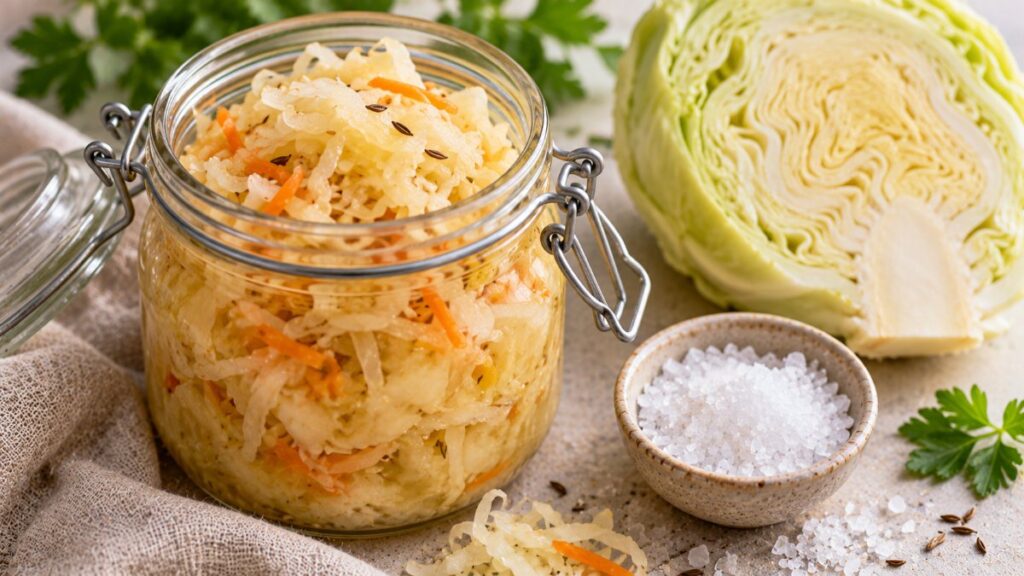
Check the label, too. Harvard notes that not all fermented foods contain live microbes, because heating or pasteurising after fermentation kills them. Sourdough bread is fermented, but baking ends that. Tinned sauerkraut is usually pasteurised; the refrigerated or homemade kind is more likely to be “live”.
Does eating 30 plants a week help your gut?
The “30 plants a week” idea comes from the American Gut Project, a citizen-science study published in mSystems in 2018. Volunteers who reported eating more than 30 plant types per week had more diverse gut microbiomes and fewer antibiotic resistance genes than those eating 10 or fewer, according to the University of California San Diego summary. The two groups were small (41 and 44 people).
This was an observational survey, not a trial, so it shows an association and cannot prove cause. Still, the habit is low-risk: herbs, spices, nuts, seeds, beans and grains all count, so a lentil soup with onion, carotte, céleri, garlic, cumin and persil already gives you seven.
Do you need probiotic supplements, or are probiotic foods enough?
The U.S. National Center for Complementary and Integrative Health (NCCIH) is cautious. Probiotics have shown promise for a few specific uses, such as helping prevent diarrhoea linked to antibiotics. For many other conditions results are mixed, and for irritable bowel syndrome they are promising but inconclusive. Researchers still don’t know which strains help with what, and some products have been found to contain microorganisms other than those on the label.
For a generally healthy person, food comes first: fibre every day, fermented foods several times a week. If you want a supplement for a specific reason, discuss the strain with your pharmacist.
What does Ayurveda say about gut health?
In the traditional Ayurvedic view, health starts with agni, the digestive fire. When agni is steady, food is “cooked” well inside you; when it is weak, tradition says undigested residue called ama builds up and leaves you heavy and bloated. This is a traditional framework, not a scientific finding, but its advice overlaps with modern habits:
- Favour warm, cooked meals, especially in cold seasons or with sensitive digestion. Raw salads are traditionally kept for midday, when agni is said to be strongest.
- Use digestive spices: cumin, fenouil, coriander and fresh gingembre. A thin slice of gingembre with a pinch of salt before a meal is a classic appetiser.
- Drink takra, thin spiced buttermilk (yogurt whisked with water, cumin and salt), after lunch. Classical texts praise it for digestion, and it is also a fermented food.
- Eat at regular times, so one meal is digested before the next arrives.
For more on settling a sensitive stomach, see our guide to natural remedies for better digestion.
What does a healthy gut diet look like every day?
Build each day around three anchors: one legume portion, one fermented food, and as many different vegetables, herbs and spices as you can manage. This soup covers all three.
Recipe: red lentil and leek soup with yogurt
Serves 4. About 40 minutes.
- 200 g red lentils, rinsed
- 1 large leek, sliced
- 1 oignon, haché
- 2 carrots, diced
- 2 garlic cloves, crushed
- 1 teaspoon ground cumin and 1 teaspoon ground coriander
- 1 tablespoon grated fresh ginger
- 2 tablespoons huile d'olive
- 1.2 litres water or vegetable stock
- Salt, black pepper, a handful of parsley
- 4 tablespoons plain live yogurt or kefir
- Warm the oil in a large pot. Cook onion, leek and carrot gently for 8 minutes until soft.
- Stir in cumin, coriander, ginger and half the garlic. Cook for 1 minute.
- Add lentils and water or stock. Bring to the boil, then simmer for 20 to 25 minutes until the lentils fall apart.
- Blend roughly or leave chunky. Season with salt and pepper.
- Off the heat, stir in the remaining raw garlic and chopped parsley.
- Top each bowl with a spoon of cold yogurt or kefir. Adding it off the heat keeps the cultures alive.
The same bean-and-vegetable cooking is the backbone of our plant-based meals for weight loss.
Who should be careful with gut health foods?
- Go slowly with fibre. Harvard warns that a high intake of prebiotic foods, especially if introduced suddenly, can increase gas and bloating. Add one extra portion every few days and drink enough water.
- Irritable bowel syndrome (IBS). Onions, garlic, beans and wheat can trigger symptoms, so start with small amounts. A dietitian can guide a short, structured approach such as a low-FODMAP trial with planned reintroduction, instead of cutting whole food groups for months.
- Weakened immune system or serious illness. NCCIH advises talking to your doctor before taking probiotic supplements, as severe infections have been reported in some high-risk patients, such as premature infants.
- Salt. Sauerkraut, kimchi and miso can be salty. If you watch your blood pressure, keep portions to a forkful.
- Warning signs. Blood in your stool, unexplained weight loss or a lasting change in bowel habits need a doctor, not a new diet.
Related reading: foods that reduce inflammation, green cabbage, the base of sauerkraut.
FAQ
What is the best diet for gut health?
There is no single best diet, but the pattern is consistent: add a portion of beans or lentils, eat a fermented food such as live yogurt or kefir, and widen the range of plants you eat each week. Increase fibre gradually.
Is sauerkraut good for gut health?
Raw, unpasteurised sauerkraut is both a fermented food and a source of cabbage fibre, so it fits well. Tinned or pasteurised sauerkraut no longer contains live bacteria, though it still provides fibre.
What is the difference between prebiotic and probiotic foods?
Prebiotic foods (onions, garlic, leeks, oats, bananas) contain fibres that feed the bacteria already in your gut. Probiotic foods (live yogurt, kefir, raw sauerkraut, kimchi) contain live microbes themselves. A gut-friendly diet includes both.
Which gut health foods are suitable for vegans?
All the fibre and prebiotic foods are plant-based. Vegan fermented options include unpasteurised sauerkraut, kimchi made without fish sauce, miso, tempeh and kombucha. Plant-based yogurts may or may not contain live cultures, so check the label.
Sources
- EFSA Panel on Dietetic Products, Nutrition and Allergies. Scientific Opinion on Dietary Reference Values for carbohydrates and dietary fibre. EFSA Journal, 2010. efsa.europa.eu
- Wastyk HC, et al. Gut-microbiota-targeted diets modulate human immune status. Cell, 2021;184(16):4137-4153. PubMed 34256014
- University of California San Diego, Jacobs School of Engineering. News release on McDonald D, et al. American Gut: an Open Platform for Citizen Science Microbiome Research. mSystems, 2018. jacobsschool.ucsd.edu
- Harvard T.H. Chan School of Public Health. The Microbiome. The Nutrition Source. nutritionsource.hsph.harvard.edu
- National Center for Complementary and Integrative Health (NIH). Probiotics: Usefulness and Safety. nccih.nih.gov
- U.S. Department of Agriculture and HHS. Food Sources of Dietary Fiber. Dietary Guidelines for Americans 2020-2025 (data: USDA FoodData Central). dietaryguidelines.gov
This article is for information only and is not medical advice. If you have a health condition, are pregnant or take medication, talk to your doctor or pharmacist before changing your diet or starting a supplement.


 Français
 English
 Deutsch
 Español

