
← EncyclopediaEncyclopédie de la nourriture
By Nikola · Precision Nutrition L1 · Updated 5 November 2026
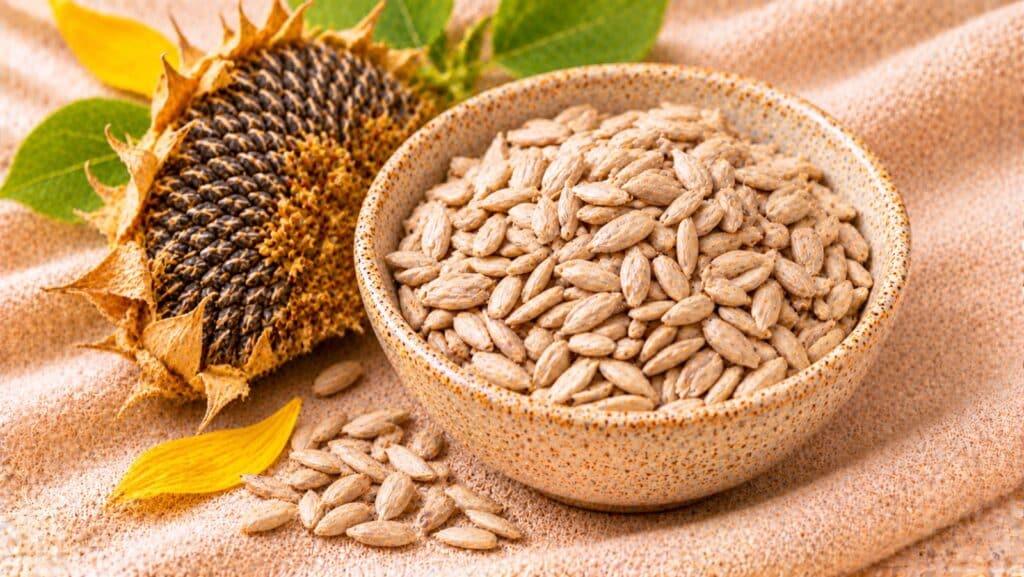
Sunflower seeds are the seeds of the sunflower (Helianthus annuus), sold in the shell for snacking or as shelled kernels for salads, bread and muesli. The kernels are one of the richest everyday foods in vitamin E: 35.2 mg per 100 g, almost three times the EU daily reference intake. 100 g also gives 584 kcal, 20.8 g of protein and a lot of selenium, copper, magnesium and thiamin. A 28 g handful of kernels gives about 164 kcal and about 82% of the daily vitamin E reference.
Sunflower seed nutrition per 100 g and per handful
| Nutritif | Dried kernels, 100 g | Handful, 28 g |
|---|---|---|
| Énergie | 584 kcal | 164 kcal |
| Protéine | 20.8 g | 5.8 g |
| Fat | 51.5 g | 14.4 g |
| of which polyunsaturated | 23.1 g | 6.5 g |
| of which linoleic acid (omega-6) | 23 g | 6.4 g |
| of which monounsaturated | 18.5 g | 5.2 g |
| of which saturated | 4.5 g | 1.2 g |
| Carbohydrate (including fibre) | 20 g | 5.6 g |
| of which sugars | 2.6 g | 0.7 g |
| Fibre | 8.6 g | 2.4 g |
| Vitamine E | 35.2 mg | 9.9 mg |
| Thiamin (B1) | 1.48 mg | 0.41 mg |
| Vitamine B6 | 1.34 mg | 0.38 mg |
| Folate | 227 µg | 64 µg |
| Selenium | 53 µg | 14.8 µg |
| Copper | 1.8 mg | 0.50 mg |
| Magnésium | 325 mg | 91 mg |
| Phosphore | 660 mg | 185 mg |
| Zinc | 5 mg | 1.4 mg |
| Fer | 5.3 mg | 1.5 mg |
Source: USDA FoodData Central, SR Legacy, “Seeds, sunflower seed kernels, dried” (FDC 170562), checked 4 November 2026. Values are for shelled, dried, unroasted and unsalted kernels. The 28 g (1 oz) handful is calculated from the 100 g values; USDA’s measures are 1 cup of kernels = 140 g and 1 cup of seeds in the shell = 46 g of edible kernels. Values rounded.
Against the EU reference intakes (Regulation (EU) No 1169/2011, Annex XIII), 100 g of kernels covers about 293% of the reference for vitamin E (12 mg), 135% for thiamin (1.1 mg), 180% for copper (1 mg), 114% for folate (200 µg), 96% for selenium (55 µg) and 87% for magnesium (375 mg). A 28 g handful gives about 82% of vitamin E, 50% of copper, 37% of thiamin and 27% of selenium.
The fat in sunflower seeds is mostly omega-6 (linoleic acid). There is almost no omega-3 ALA, only 0.06 g per 100 g, so for plant omega-3 walnuts, flaxseed ou chia seeds are better choices.
Glycemic index
Sunflower seeds are not listed in the international glycemic index tables (Atkinson 2008). A handful holds about 5.6 g of carbohydrate, 2.4 g of it fibre, so the effect on blood sugar is small. More in What is the glycemic index? (with food table).
Health benefits: what the evidence says
- Vitamin E. Vitamin E is a fat-soluble antioxidant that helps limit cell damage from free radicals (NIH). The EU permits the claim that vitamin E contributes to the protection of cells from oxidative stress (Regulation (EU) No 432/2012). According to the NIH, 1 ounce (28 g) of dry-roasted sunflower seeds gives 7.4 mg of vitamin E, more than the same amount of almonds ou hazelnuts.
- Selenium. A handful gives almost 15 µg of selenium. Under the same regulation, selenium contributes to normal thyroid function, to the normal function of the immune system and to the protection of cells from oxidative stress.
- Magnesium and thiamin. Magnesium contributes to normal muscle function and to the reduction of tiredness and fatigue; thiamin contributes to normal energy-yielding metabolism and normal heart function (Regulation 432/2012).
- Folate. 227 µg per 100 g. Folate contributes to normal blood formation and to maternal tissue growth during pregnancy (Regulation 432/2012).
- Fibre and protein. A handful gives 2.4 g of fibre and 5.8 g of protein, a useful addition to salads and plant-based dishes. For comparison, EFSA considers 25 g of fibre a day adequate for normal bowel function in adults.
How to eat sunflower seeds
- Roasted salted seeds in the shell: a popular snack across Southern and Eastern Europe, but salted seeds add up to a lot of salt quickly. The WHO recommends adults keep salt under 5 g a day. Choose unsalted or lightly salted seeds and do not finish the whole bag at once.
- Kernels in salads: toast them for a minute in a dry pan and scatter over a tomate salad, a épinard salad or a cabbage slaw.
- Petit-déjeuner: a spoonful of kernels in oat porridge ou Greek yogurt with fruit.
- Bread: add kernels to homemade bread dough or sprinkle them on top.
- Sunflower seed butter: a good alternative to tahini for people who cannot eat sesame. Check the label for sugar and palm oil.
- Storage: shelled kernels are high in polyunsaturated fat and go rancid over time. Keep them in a closed jar somewhere cool, or in the fridge for longer storage. A bitter or stale taste means they have gone rancid.
Who should be careful
- High blood pressure. If your doctor has told you to cut down on salt, choose unsalted seeds. The table is for unsalted kernels; salted seeds contain much more sodium.
- Allergy. Sunflower seeds are not among the 14 allergens that must be declared on labels in the EU (Regulation (EU) No 1169/2011, Annex II), but an allergy to them is possible. If you react to sunflower seeds, talk to an allergist and check the ingredients of bread and muesli.
- If you watch calories. 584 kcal per 100 g. A handful of kernels is a portion, while a bag of seeds in front of the TV easily reaches 2-3 portions.
Traditional view (Ayurveda)
In Usha and Vasant Lad’s food guidelines, sunflower seeds are favourable for Vata and Pitta, and for Kapha in moderation. This is a traditional view, not a clinical finding.
Related entries and articles
- Pumpkin seeds – the other popular snacking seed
- Flaxseed – for plant omega-3
- Sesame seeds – compare with tahini
- Amandes – the other big source of vitamin E
- Avoine – porridge with seeds
- 7 aliments sains à manger au petit-déjeuner
- Plant-based meals for weight loss
FAQ
Are sunflower seeds healthy?
Shelled, unsalted sunflower seeds are very nutritious: a 28 g handful gives about 82% of the daily vitamin E reference, half the copper and over a quarter of the selenium. The catch with roasted snacking seeds is salt and quantity: a bag of salted roasted seeds brings a lot of salt and calories.
How many sunflower seeds should I eat a day?
There is no official recommendation. A handful of kernels (about 28 g, 164 kcal) is a sensible portion and covers a large part of the daily vitamin E reference. Eating more brings no extra benefit, only extra calories.
Raw or roasted sunflower seeds: is there a difference?
A small one. The USDA table is for dried, unroasted kernels, with 9.9 mg of vitamin E in 28 g, while the NIH gives 7.4 mg for the same amount of dry-roasted seeds. The bigger difference is salt: roasted salted seeds carry a lot of sodium, unsalted ones almost none (9 mg per 100 g).
Sources
- USDA FoodData Central, SR Legacy: Seeds, sunflower seed kernels, dried (FDC 170562). fdc.nal.usda.gov
- NIH Office of Dietary Supplements: Vitamin E, Fact Sheet for Health Professionals. ods.od.nih.gov
- Regulation (EU) No 432/2012 – permitted health claims (vitamin E, selenium, magnesium, thiamin, folate). EUR-Lex
- Regulation (EU) No 1169/2011 – Annex II (allergens) and Annex XIII (reference intakes). EUR-Lex
- EFSA NDA Panel (2010). Scientific Opinion on Dietary Reference Values for carbohydrates and dietary fibre. EFSA Journal 8(3):1462. efsa.europa.eu
- World Health Organization: Salt reduction, fact sheet. who.int
- Lad U, Lad V. Food Guidelines for Basic Constitutional Types, from Ayurvedic Cooking for Self-Healing, 2nd ed. The Ayurvedic Institute. ayurveda.com
This page is for information only and is not medical or dietary advice.
 Français
 English
 Deutsch
 Español

