
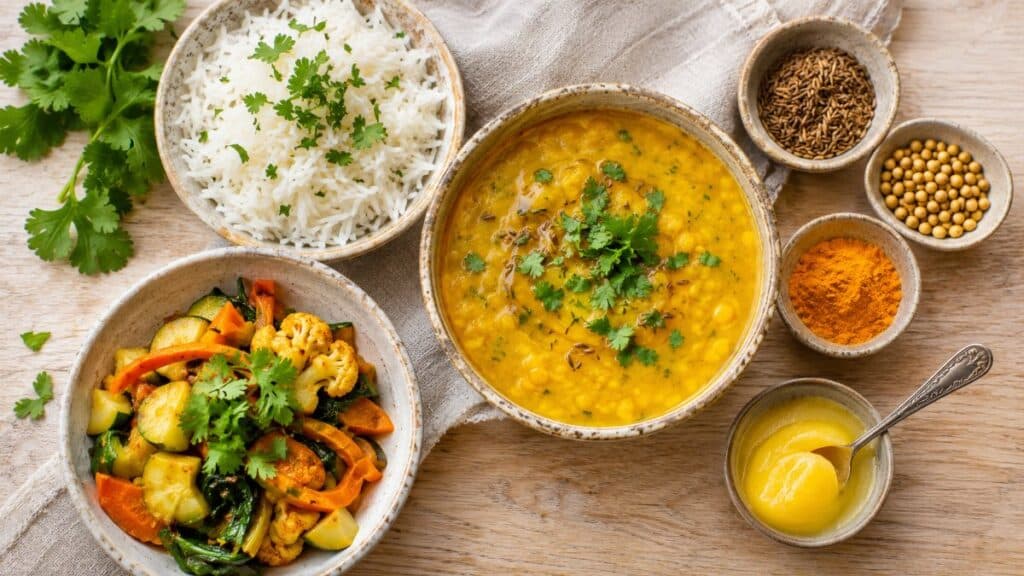
An Ayurvedic diet for beginners starts with a few habits, not a long food list: eat warm, freshly cooked meals at regular times, make lunch your main meal, eat without distraction, and include all six tastes (sweet, sour, salty, pungent, bitter, astringent) over the day. Dosha-specific food rules can come later. They rest on tradition rather than proven science, but the core habits overlap well with what nutrition research supports.
This guide is for you if Ayurveda interests you but the charts of “allowed” and “forbidden” foods feel like too much. You will find the principles worth trying first, a six tastes table, an example day, a beginner recipe and an honest look at where tradition and science agree.
What is an Ayurvedic diet?
Ayurveda is a traditional medical system from India. The US National Center for Complementary and Integrative Health (NCCIH) describes it as one of the world’s oldest medical systems, combining plant-based products with diet, exercise and lifestyle.
An Ayurvedic diet is not one fixed menu. It is a set of ideas about how, when and what to eat, adjusted to your constitution (prakriti), the season and your digestion. Four terms come up often:
- Agni: the “digestive fire”, your capacity to digest a meal.
- Doshas: Vata, Pitta and Kapha, three principles said to combine differently in each person.
- Rasa: taste. Ayurveda names six.
- Virya: the heating or cooling quality of a food. Jengibre is heating, pepino cooling.
Do you need to know your dosha before you start an Ayurvedic diet?
No. Most traditional advice for newcomers is general: regular meals, cooked food, a calm setting, a balance of tastes. It is meant to suit everyone. Starting without a dosha label is also the more honest route: a 2025 critical review that identified 64 prakriti assessment tools concluded that none fully met standard criteria for scale development and validation. If you want to explore the concept anyway, our guide to Ayurveda doshas and how to know yours walks you through a self-observation checklist.
What are the basic principles of Ayurvedic eating?
1. Eat at roughly the same times every day
Ayurveda treats rhythm as part of nutrition: three meals at similar hours, with few snacks in between. Here tradition and research agree. A 2017 American Heart Association scientific statement on meal timing concluded that irregular eating patterns appear less favourable for a healthy cardiometabolic profile.
2. Make lunch your main meal
Classical teaching holds that agni is strongest around midday, so the largest meal belongs there and dinner should be lighter, a few hours before bed. Research on eating earlier in the day is still developing, so treat this as a habit to test, not a proven rule.
3. Prefer warm, cooked and freshly made food
Soups, stews, porridge and lightly spiced vegetables are the backbone of Ayurvedic cooking. Days-old leftovers and iced drinks are discouraged, because tradition says they “dampen” agni. If you live on salads and smoothies, swap one of them for a warm bowl.
4. Eat with attention
Sit down, put the phone away, chew well. This old Ayurvedic instruction has the clearest modern parallel. Harvard’s Nutrition Source cites a review of 68 studies in which mindful eating slowed meals and improved recognition of fullness, though it did not consistently reduce body weight. The same AHA statement suggests that intentional eating, with attention to the timing and frequency of meals, could support better management of cardiometabolic risk.
5. Stop before you are completely full
Ayurveda advises leaving some space in the stomach. Harvard’s mindful eating guidance says something similar: stop at about 80 percent full.
6. Sip something warm with meals
Small sips of warm water or a mild ginger tea are the traditional choice. Strong evidence that cold water harms digestion is lacking, so treat this as a comfort habit, not a rule.
What are the six tastes in Ayurveda food?
Ayurveda suggests that a satisfying day includes all six tastes, ideally with each main meal touching most of them. In practice this pushes you towards variety: something starchy, something sour, a little salt, a pungent spice, a bitter green and a legume or fruit.
| Taste (rasa) | Everyday examples | Traditional effect on the doshas |
|---|---|---|
| Sweet | Rice, oats, batata, dates, milk, ghee | Calms Vata and Pitta, increases Kapha |
| Sour | Yogurt, lemon, sauerkraut, Tomates | Calms Vata, increases Pitta and Kapha |
| Salty | Sea salt, olives, algas marinas, miso | Calms Vata, increases Pitta and Kapha |
| Pungent | Ginger, black pepper, chilli, ajo, mustard seeds | Calms Kapha, increases Vata and Pitta |
| Bitter | Verduras de hoja verde, cúrcuma, fenugreek, cohete | Calms Pitta and Kapha, increases Vata |
| Astringent | lentejas, beans, pomegranate, green tea, apples | Calms Pitta and Kapha, increases Vata |
Source: traditional Ayurvedic classification of rasa, summarised by Nutriveda. These are traditional associations, not measured physiological effects.

Is an Ayurvedic diet healthy? What does science say?
The diet itself has not been tested in large, well-designed trials, and NCCIH notes that most studies of Ayurvedic approaches are small or poorly designed. What you can judge is how its habits line up with mainstream advice:
| Ayurvedic habit | What mainstream evidence says | How well they match |
|---|---|---|
| Regular meal times | AHA (2017): irregular eating appears less favourable for cardiometabolic health | Good match |
| Eating slowly, without distraction | Review of 68 studies: slower meals, better fullness recognition, no consistent weight loss | Good match, modest effects |
| Plenty of vegetables, legumes and whole grains | Harvard Healthy Eating Plate: half the plate vegetables and fruit, a quarter whole grains, a quarter healthy protein | Good match |
| Main meal at midday | Evidence on calorie timing is still emerging | Plausible, unproven |
| Eating by dosha | Dosha assessment tools are not yet validated | Tradition only |
Sources: St-Onge et al., Circulation 2017; Harvard T.H. Chan School of Public Health (Healthy Eating Plate, Mindful Eating); Venkatesh et al., Frontiers in Medicine 2025.
A traditional plate of rice, dal, cooked vegetables and yogurt looks a lot like the pattern behind the Mediterranean diet: mostly plants, minimally processed, eaten at a table.
What does Ayurveda say about agni, the digestive fire?
In the traditional view, health depends less on any single food and more on how well you digest it. Strong agni means steady appetite at mealtimes and comfortable digestion. Weak agni shows up as heaviness, bloating or little appetite; too much “fire” as acidity and irritability.
The classic kitchen tools for kindling agni: a thin slice of fresh ginger root with a pinch of salt and a few drops of lemon before lunch, cumin, coriander and hinojo seeds in cooking or as a tea, a little ghee to carry the flavour of spices, and cúrcuma in dals and soups. Avoiding constant snacking matters as much, because each meal should be digested before the next arrives. Read this as tradition: “kindling agni” is a traditional concept, not a measured effect.
How do you start an Ayurvedic diet? An example day and a beginner recipe
Change one meal at a time. Breakfast is the easiest: a warm, spiced porridge instead of cold cereal. If you like structure, pair it with one of these habitos de comer saludable and a calm rutina de la mañana.
An example Ayurvedic day of meals
- On waking: a cup of warm water, or water with a slice of fresh ginger.
- Breakfast (7:00 to 8:30): oats cooked in water or milk with cinnamon, cardamom, a chopped apple and a few walnuts.
- Lunch, the main meal (12:00 to 13:30): kitchari (recipe below) or rice with dal, cooked greens, a spoon of yogurt and lemon. All six tastes on one plate.
- Afternoon, if hungry: a piece of fruit or a few soaked almonds.
- Dinner, lighter (18:00 to 19:30): vegetable soup with calabaza, zanahoria and a pinch of cumin, plus a slice of wholegrain bread.
Recipe: beginner’s kitchari (serves 2)
Kitchari is the classic Ayurvedic one-pot meal of rice and split mung beans: mild, filling and forgiving.
- 100 g white basmati rice
- 100 g split yellow mung beans (moong dal)
- 1 tablespoon ghee or aceite de oliva
- 1 teaspoon cumin seeds
- 1 teaspoon grated fresh ginger
- 1/2 teaspoon ground turmeric
- 1/2 teaspoon ground coriander
- About 1 litre of water
- 2 handfuls of chopped vegetables (carrot, calabacín, espinaca)
- Salt, lemon and fresh coriander to finish
- Rinse the rice and mung beans together until the water runs clear.
- Warm the ghee in a pot, add the cumin seeds and let them sizzle for about 30 seconds.
- Stir in the ginger, turmeric and coriander for a few seconds, then add the rice, beans and water.
- Bring to a boil, lower the heat, cover and simmer for about 25 minutes, stirring now and then.
- Add the vegetables and cook 10 more minutes, until soft and porridge-like. Add hot water if it gets too thick.
- Season with salt, finish with lemon juice and hojas de cilantro.
Who should be careful with an Ayurvedic diet?
The food habits above are low-risk for most adults. The risks sit around supplements and replacing medical care.
- Ayurvedic herbal products: NCCIH warns that some contain lead, mercury or arsenic at harmful levels. In a 2015 survey of Ayurvedic product users, 40 percent had high blood lead levels. Kitchen spices are a different matter from remedies bought online.
- Practitioners: NCCIH notes that no US state licenses Ayurvedic practitioners. Check credentials wherever you live.
- Medical conditions: don’t swap prescribed treatment for an Ayurvedic plan. With diabetes, watch portions of white rice, dates and sweets.
- Pregnancy and medication: talk to your doctor before using any herbal preparation.
- Grasas: ghee is a concentrated fat. Harvard’s Healthy Eating Plate favours plant oils such as olive oil, so use ghee as a flavouring in small amounts.
- Restrictive eating: if lists of forbidden foods make you anxious, skip the dosha rules. Eating disorders need qualified care.
Related reading: Ayurveda doshas explained y how to make ginger tea.
FAQ
Can I follow an Ayurvedic diet without knowing my dosha?
Yes. Regular meals, warm cooked food, a calm setting and all six tastes are general advice for everyone. Dosha rules are optional, and dosha tests are not yet scientifically validated.
Is the Ayurvedic diet vegetarian?
Traditional Ayurvedic cooking is largely lacto-vegetarian: grains, legumes, vegetables, spices, milk, yogurt and ghee. Classical texts do discuss meat, and the core principles work either way.
What is a good Ayurvedic breakfast for beginners?
A warm, lightly spiced porridge: oats cooked with cinnamon and cardamom, topped with stewed apple or pear and a few nuts. Easy to digest by Ayurvedic standards, solid by modern ones.
Can an Ayurvedic diet help with weight loss?
No large, well-designed trials answer that. Regular meals, eating slowly and plenty of vegetables and legumes can help you eat less without counting, but expect results from the habits, not the label.
Sources
- National Center for Complementary and Integrative Health (NCCIH). Ayurvedic Medicine: In Depth. NIH, updated 2019. nccih.nih.gov
- St-Onge MP, Ard J, Baskin ML, et al. Meal Timing and Frequency: Implications for Cardiovascular Disease Prevention. A Scientific Statement from the American Heart Association. Circulation, 2017. Record and abstract
- Harvard T.H. Chan School of Public Health. Mindful Eating. The Nutrition Source. nutritionsource.hsph.harvard.edu
- Harvard T.H. Chan School of Public Health. Healthy Eating Plate. The Nutrition Source. nutritionsource.hsph.harvard.edu
- Venkatesh A, Johansson L, Sivanandan PV, et al. Prakriti (constitutional typology) in Ayurveda: a critical review of Prakriti assessment tools and their scientific validity. Frontiers in Medicine, 2025. frontiersin.org
This article is for information only and is not medical advice. If you have a health condition, are pregnant or take medication, talk to your doctor or pharmacist before changing your diet or starting a supplement.
 Español
 English
 Deutsch
 Français

