
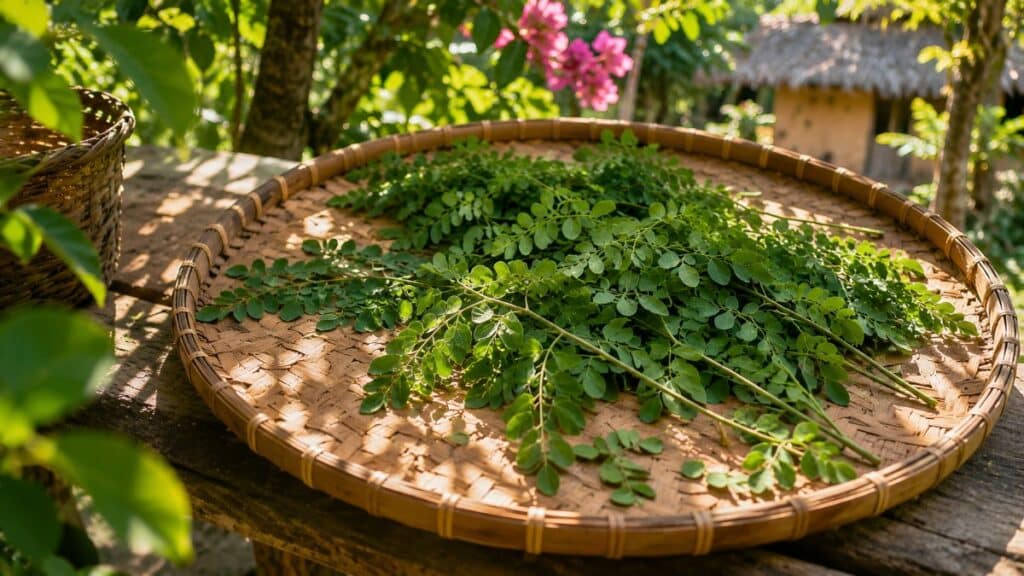
Moringa powder is made from the dried leaves of the moringa tree (Moringa oleifera). Fresh moringa leaves are rich in protein, calcium, iron, vitamin C, vitamin B6 and vitamine A, so the powder is a useful way to add those nutrients to food. The health claims are weaker: a 2025 meta-analysis of 9 randomised trials found no consistent effect on blood sugar, cholesterol or weight, with very low certainty, so treat moringa as a nutritious green, not a treatment.
This guide is for you if you have seen moringa powder sold as the next big green and want a straight answer: what is in the leaves, what human studies show, how to use it, and who should be careful.
What is moringa powder?
Moringa oleifera is a fast-growing tree, often called the drumstick tree after its long seed pods. It is widely grown in India and across the tropics, where the leaves, pods, seeds, flowers, bark and roots all have a place in cooking or traditional medicine.
The powder sold in Europe is almost always ground, dried leaf. It is bright green and tastes slightly bitter and peppery, a bit like fusée. That matters, because the leaf is the part with the most human data. Root and bark are a different story (see the precautions).
What nutrients are in moringa leaves?
USDA FoodData Central lists fresh moringa leaves under the name “drumstick leaves, raw”. The table compares them with raw épinard, a leafy green most people already eat, per 100 g.
| Per 100 g, raw | Moringa leaves | Épinard |
|---|---|---|
| Énergie | 64 kcal | 23 kcal |
| Protéine | 9.4 g | 2.86 g |
| Fibre | 2.0 g | 2.2 g |
| Calcium | 185 mg | 99 mg |
| Fer | 4.0 mg | 2.71 mg |
| Magnésium | 42 mg | 79 mg |
| Potassium | 337 mg | 558 mg |
| Vitamine C | 51.7 mg | 28.1 mg |
| Vitamine B6 | 1.20 mg | 0.195 mg |
| Folate | 40 µg | 194 µg |
| Vitamin A (RAE) | 378 µg | 469 µg |
Source: USDA FoodData Central, SR Legacy: Drumstick leaves, raw (FDC ID 168416); Spinach, raw (FDC ID 168462).
Moringa leaves have about three times the protein of spinach and more calcium, iron, vitamin C and vitamin B6. Spinach wins on folate, magnesium and potassium. Neither is a “superfood” in any scientific sense; both are good greens doing different jobs. You can compare more greens in our entries on épinard et chou frisé.
Fresh leaves are 78.7% water, so drying concentrates the nutrients into less weight. But the USDA figures are for fresh leaves, and powders vary with growing, drying and storage, so for your powder the nutrition label is the number to trust. The vitamin A in plants comes as carotenoids, which your body converts as needed; our vitamin A guide explains how that works.
Does moringa lower blood sugar?
This is the most studied claim, and the honest answer is: not reliably, based on current human evidence.
The strongest numbers come from rodent studies with concentrated extracts, and rats with induced diabetes are not people eating a teaspoon of powder in soup.
In humans, a 2020 systematic review in Nutrients found 8 studies. Some small ones looked encouraging. When people with diabetes ate 20 g of dried leaf powder with a meal, their blood sugar after the meal was lower than after the same meal without it, while healthy people showed no difference. On the other hand, a placebo-controlled trial in people with type 2 diabetes using 4 g a day for four weeks found no difference in fasting glucose or HbA1c. The authors called the evidence “limited but promising” and pointed to small samples and design flaws.
The most recent and strictest look is a 2025 meta-analysis of 9 randomised controlled trials with 649 participants. Doses ranged from 1 g to 30 g of leaf a day, for 2 weeks to 6 months. Moringa did not significantly change fasting blood glucose, HbA1c, triglycerides or cholesterol. Only diastolic blood pressure fell slightly, and that result did not hold up in sensitivity analysis. Every outcome was rated very low certainty, and the authors concluded that moringa should not be recommended as a standalone strategy for cardiometabolic risk. LiverTox, the US government database on liver safety, reaches a similar view: small trials suggest modest effects on fasting sugar of unclear clinical benefit.
If blood sugar is your concern, the basics do far more: fibre, legumes, whole grains and meal composition. Our glycemic index table is a practical place to start.

Can moringa powder help with weight loss or energy?
There is no good evidence for either. The 2025 meta-analysis also looked at body measures and found inconsistent results with very low certainty, and no good trials show moringa improves energy or fatigue. A lift after a moringa lentil soup more likely comes from the meal itself. If tiredness is the real question, our guide to energy foods without caffeine covers what helps.
Is moringa powder good for breastfeeding?
Moringa is one of the most studied galactagogues, foods or herbs used to support milk supply. The US LactMed database cites a meta-analysis of 14 studies with 865 women in which moringa increased prolactin and milk volume, though some papers had methodological problems. LactMed reports no serious short-term side effects in mothers or babies, but long-term effects on infants are not well studied. If milk supply is the issue, start with a lactation consultant, not a supplement.
What does Ayurveda say about moringa?
In Ayurveda, moringa is known as shigru, and the traditional view treats it as a medicinal vegetable rather than a daily tonic. This is the classical framework, not scientific evidence.
- Rasa (taste): pungent and bitter, which matches the peppery, slightly bitter flavour of the leaf.
- Virya (potency): heating.
- Dosha: traditionally used to reduce kapha and vata. Because it is heating and pungent, it is used with care when pitta is high, for example in hot weather or if you run hot and get acid reflux.
- Agni (digestive fire): pungent, light foods are thought to kindle agni, so the leaves are cooked into dals and soups with cumin.
The practical takeaway from tradition is sensible: use moringa as a cooked green in small amounts within a meal, not as a large raw dose on an empty stomach. Tradition and nutrition science agree on one more point: no single food should carry your diet, which is the idea behind our superfoods list.
How do you use moringa powder?
Start small. Half a teaspoon a day is enough to get used to the taste, and many people stay at one teaspoon. Supplement products recommend anything from 500 mg to 5 or 6 g a day, according to LiverTox, so check your label. The powder works best when its grassy bitterness has something to hide behind:
- stirred into lentil soup, dal or a vegetable stew at the end of cooking,
- whisked into a lemon and yogurt dressing for salads,
- blended into a smoothie with banana and oats,
- mixed into hummus or a green pesto with basilic.
Steeped as moringa powder tea, it tastes like grassy green tea; a slice of fresh ginger helps.
Recipe: red lentil soup with moringa and lemon
Serves 2. Moringa behaves here like the spinach you would add at the end.
- 150 g red lentils, rinsed
- 1 small onion, finely chopped
- 1 carotte, en dés
- 1 tablespoon huile d'olive or ghee
- 1 teaspoon cumin seeds
- half a teaspoon ground curcuma
- 800 ml water or light vegetable stock
- 1 teaspoon moringa powder
- juice of half a lemon, salt and black pepper
- Warm the oil in a pot, add the cumin seeds and let them sizzle for 30 seconds.
- Add the onion and carrot and cook for 5 minutes until soft.
- Stir in the turmeric, then the lentils and water. Simmer for about 20 minutes, until the lentils fall apart.
- Take the pot off the heat. Whisk the moringa powder with two tablespoons of the hot soup in a cup until smooth, then stir it back in.
- Season with salt, pepper and lemon juice, and serve.
Is moringa safe? Side effects and who should avoid it
Moringa leaf appears well tolerated. LiverTox rates it D, a possible rare cause of liver injury, based on one convincing case, and notes no liver enzyme rises in trials. Be careful in these situations:
- Pregnancy: avoid moringa supplements. Its safety in pregnancy is not established, and extracts of the root, bark and leaves have shown abortifacient effects in laboratory animals, according to a university herbal safety monograph.
- Root and bark: do not use them. They are traditional medicines, not foods, and they lack safety data. Buy only products made from leaf.
- Diabetes medication: no interaction is documented in LiverTox, but because some studies show lower post-meal glucose, adding moringa to insulin or other glucose-lowering drugs could in theory add to their effect. Tell your doctor and check your levels if you start.
- Blood clots: LactMed advises caution for people at high risk of clots, citing a case of pulmonary embolism linked to a leaf extract.
- Quality: a 2015 Salmonella outbreak was linked to a moringa leaf powder product, and LiverTox notes concern about heavy metals and mycotoxins. Choose brands that publish lab testing.
For more products that promise more than they deliver, see our list of “healthy” foods that are not what they seem.
Related reading: maca root benefits and side effects, et spirulina benefits and how much to take.
FAQ
What are the main moringa powder benefits?
The clearest benefit is nutritional: moringa leaves are rich in protein, calcium, iron, vitamin C, vitamin B6 and vitamin A. Claims about blood sugar, cholesterol and weight loss are not supported by consistent human trials.
Is moringa powder better than spinach?
Not better, different. Per 100 g of fresh leaves, moringa has more protein, calcium, iron and vitamin C, while spinach has more folate, magnesium and potassium. Eating both, along with other greens, gives you the widest range.
Are there moringa powder benefits for females?
The iron and calcium in the leaves are useful for women, and moringa has been studied for breastfeeding with some positive results. It should be avoided during pregnancy, because its safety there has not been established.
Can I take moringa powder every day?
For most healthy adults, a teaspoon a day in food seems reasonable based on the safety data available, though long-term studies are lacking. Talk to your doctor first if you are pregnant, take diabetes medication or have a high risk of blood clots.
Sources
- Crișan D, Gavrilaș L, Păltinean R, Frumuzachi O, Mocan A, Crișan G. Effects of Moringa oleifera Lam. Supplementation on Cardiometabolic Outcomes: A Meta-Analysis of Randomized Controlled Trials with GRADE Assessment. Nutrients, 2025. PubMed 41305552
- Nova E, Redondo-Useros N, Martínez-García RM, Gómez-Martínez S, Díaz-Prieto LE, Marcos A. Potential of Moringa oleifera to Improve Glucose Control for the Prevention of Diabetes and Related Metabolic Alterations: A Systematic Review of Animal and Human Studies. Nutrients, 2020. mdpi.com/2072-6643/12/7/2050
- LiverTox: Clinical and Research Information on Drug-Induced Liver Injury. Moringa. National Institute of Diabetes and Digestive and Kidney Diseases, 2024. ncbi.nlm.nih.gov/books/NBK605172
- Drugs and Lactation Database (LactMed). Moringa. National Library of Medicine, 2026. ncbi.nlm.nih.gov/books/NBK501899
- U.S. Department of Agriculture. FoodData Central, SR Legacy: Drumstick leaves, raw (FDC ID 168416); Spinach, raw (FDC ID 168462). fdc.nal.usda.gov
- Gonzalez Stuart A. Moringa. Herbal Safety, The University of Texas at El Paso. utep.edu/herbal-safety
This article is for information only and is not medical advice. If you have a health condition, are pregnant or take medication, talk to your doctor or pharmacist before changing your diet or starting a supplement.


 Français
 English
 Deutsch
 Español

