
← EncyclopediaEncyclopédie de la nourriture
By Nikola · Precision Nutrition L1 · Updated 4 November 2026
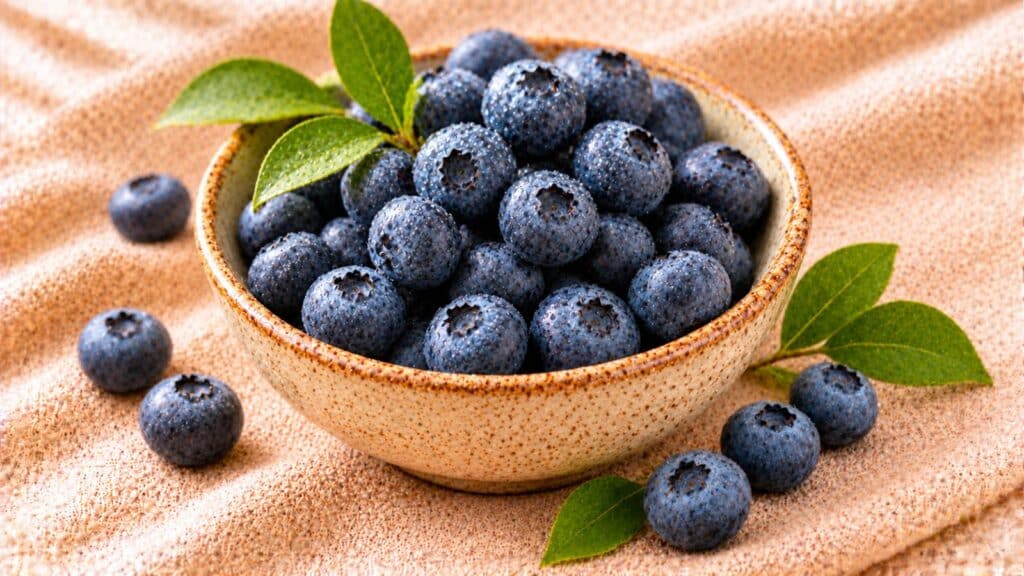
Blueberries (Vaccinium spp.) are small, dark blue berries eaten fresh, frozen or baked. A cup (148 g) gives about 84 kcal, 21 g of carbohydrate, 3.6 g of fibre, 29 µg of vitamin K and 0.5 mg of manganese. They are rich in anthocyanins, a group of polyphenols that researchers link to the cardiometabolic findings for blueberries. In a large US study, people who ate blueberries more often had a lower risk of type 2 diabetes, a stronger link than for grapes, apples ou bananas, although this kind of study cannot prove cause and effect.
Blueberry nutrition per 100 g and per cup
| Nutritif | Per 100 g | Cup, 148 g |
|---|---|---|
| Énergie | 57 kcal | 84 kcal |
| Eau | 84.2 g | 125 g |
| Protéine | 0.7 g | 1.1 g |
| Fat | 0.3 g | 0.5 g |
| Carbohydrate | 14.5 g | 21.5 g |
| of which sugars | 10.0 g | 14.7 g |
| Fibre | 2.4 g | 3.6 g |
| Vitamine K | 19.3 µg | 28.6 µg |
| Vitamine C | 9.7 mg | 14.4 mg |
| Manganese | 0.34 mg | 0.50 mg |
| Vitamine E | 0.57 mg | 0.84 mg |
| Potassium | 77 mg | 114 mg |
Source: USDA FoodData Central, SR Legacy, “Blueberries, raw”, FDC ID 171711, checked 4 November 2026. USDA gives 148 g for a cup of blueberries; the cup column is calculated from the 100 g values. The record is for cultivated blueberries as sold in shops; wild berries and related species such as bilberries are not covered by these figures. In USDA data the carbohydrate figure includes fibre. Values rounded.
Glycemic index
Blueberries are not listed in the international GI tables (Atkinson 2008), so we do not give a number. A cup has about 21.5 g of carbohydrate, of which 3.6 g is fibre, so a handful on porridge or yogurt adds only a modest carbohydrate load. Blueberry jam, muffins and sweetened dried blueberries are a different matter because of the added sugar. See What is the glycemic index (with table).
Health benefits: what the evidence says
- Type 2 diabetes risk (observational). In three large US cohorts with over 187,000 people followed for years, every three servings a week of blueberries was associated with about 26% lower risk of type 2 diabetes. That was a stronger link than for grapes, apples or bananas in the same analysis, while fruit juice was associated with a higher risk (Muraki 2013). It shows an association, not proof that blueberries prevent diabetes.
- Heart and metabolism. A 2020 review in Advances in Nutrition (Kalt et al.) summarises epidemiological studies that link regular, moderate intake of blueberries and anthocyanins with lower risk of cardiovascular disease, death and type 2 diabetes, and human studies suggesting benefits for blood vessel function and blood sugar control. The authors say more human clinical evidence is needed. The review’s authors received honoraria from the US Highbush Blueberry Council, which is worth knowing when you read it.
- Vitamin K and manganese. A cup of blueberries gives about 29 µg of vitamin K and 0.5 mg of manganese.
- Fibre at a low energy cost. 3.6 g of fibre for 84 kcal per cup. EFSA considers 25 g of fibre a day adequate for normal bowel function in adults.
Ayurveda: blueberries in the traditional system
Usha and Vasant Lad’s food guidelines list berries as a group rather than blueberries specifically. Berries are favourable for Vata and for Kapha. For Pitta, sweet berries are favourable and sour berries are best avoided, so ripe, sweet blueberries fit, while very tart ones are better left for the other types. This is a traditional view, not a clinical finding.
How to use blueberries
- Petit-déjeuner: a handful on porridge, in Greek yogurt or in chia pudding. Frozen blueberries work well in hot porridge, which thaws them in a minute.
- Smoothies: blend with banana et kefir or milk for a naturally sweet drink with no added sugar.
- Salads: fresh blueberries with épinard, walnuts and a little soft cheese make a sweet-savoury salad.
- Snacks and desserts: a bowl of berries with a few almonds, or mixed with des fraises, instead of biscuits.
- Buying and storage: choose firm, dry berries without mould. Keep them unwashed in the fridge and rinse just before eating. Frozen blueberries are a practical choice outside the summer season.
Who should be careful
- Warfarin and similar anticoagulants. Blueberries contain vitamin K: the NIH lists half a cup at 14 µg. The NIH advises people taking warfarin to keep their vitamin K intake from food consistent, because sudden changes can alter the effect of the drug. You do not have to avoid blueberries, but avoid big swings, such as suddenly eating large amounts every day, and talk to your doctor before changing your diet.
- Diabetes. Whole blueberries are a reasonable fruit choice. Watch blueberry jams, sweetened dried berries, muffins and juices, which add sugar.
Related entries and articles
- Des fraises – another berry for breakfast bowls
- Greek yogurt – protein to pair with berries
- Avoine – blueberry porridge
- Pomegranate – another fruit with a useful amount of vitamin K
- Chia seeds
- 7 healthy foods for breakfast
- Which foods reduce inflammation naturally?
FAQ
Are blueberries good for people with diabetes?
They are a sensible fruit choice. A cup has about 21.5 g of carbohydrate with 3.6 g of fibre, and in a large US study blueberry intake was associated with a lower risk of type 2 diabetes. Count them as a fruit portion and skip versions with added sugar.
Can I eat blueberries if I take warfarin?
Usually yes, as long as your intake stays steady. Blueberries contain vitamin K, about 29 µg per cup, and the NIH advises people on warfarin to keep vitamin K intake from food consistent. Check any big change in diet with your doctor.
How many calories are in a cup of blueberries?
About 84 kcal for a 148 g cup, according to USDA data. The same cup gives 3.6 g of fibre and 14.7 g of natural sugars.
Sources
- USDA FoodData Central, SR Legacy: Bleuets, crus (FDC ID 171711). fdc.nal.usda.gov
- Muraki I, Imamura F, Manson JE, et al. Fruit consumption and risk of type 2 diabetes: results from three prospective longitudinal cohort studies. BMJ 2013;347:f5001. PMC
- Kalt W, Cassidy A, Howard LR, et al. Recent Research on the Health Benefits of Blueberries and Their Anthocyanins. Adv Nutr 2020;11(2):224-236. PMC
- NIH Office of Dietary Supplements. Vitamin K: Fact Sheet for Health Professionals. ods.od.nih.gov
- EFSA NDA Panel (2010). Scientific Opinion on Dietary Reference Values for carbohydrates and dietary fibre. EFSA Journal 8(3):1462. efsa.europa.eu
- Atkinson FS, Foster-Powell K, Brand-Miller JC. International Tables of Glycemic Index and Glycemic Load Values: 2008. Diabetes Care 2008;31(12):2281-2283. PMC
- Lad U, Lad V. Food Guidelines for Basic Constitutional Types, from Ayurvedic Cooking for Self-Healing, 2nd ed. The Ayurvedic Institute. ayurveda.com
This page is for information only and is not medical or dietary advice.
Encyclopédie de la nourriture
Des fraises Greek yogurt Avoine Chia seeds Pomegranate Kefir Pomegranate
 Français
 English
 Deutsch
 Español

