
← EncyclopediaEncyclopédie de la nourriture
By Nikola · Precision Nutrition L1 · Updated 5 November 2026
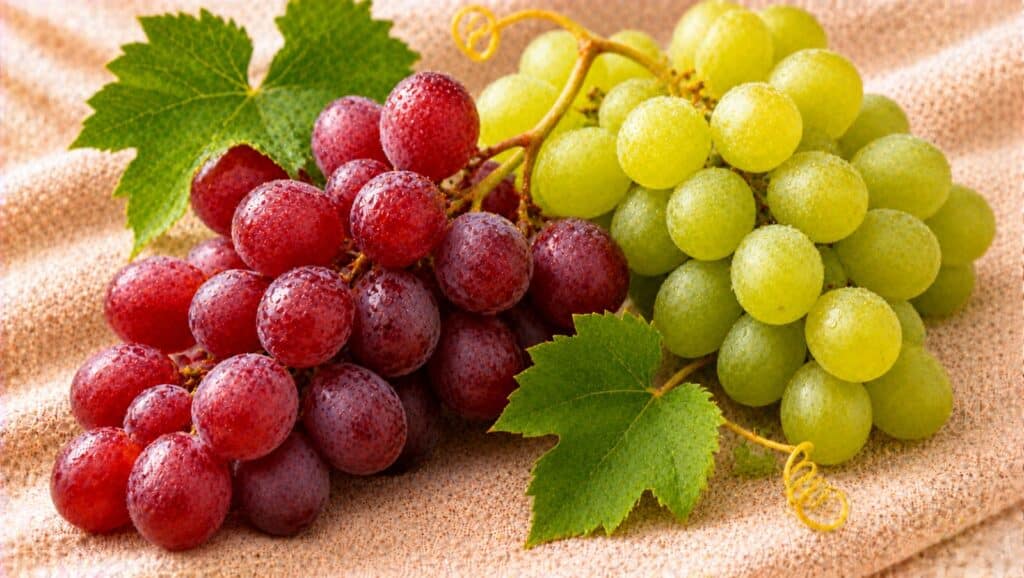
Grapes (Vitis vinifera) are the small, juicy berries of the grapevine, eaten fresh as table grapes, dried as raisins or pressed for juice and wine. A cup of red or green grapes (151 g) gives about 104 kcal, 27 g of carbohydrate (23 g of it sugar), 1.4 g of fibre and 22 µg of vitamin K. They are mostly water and natural sugar, with little fibre compared with other fruits. In a large US study, people who ate more grapes or raisins had a lower risk of type 2 diabetes, while fruit juice was linked with a higher one.
Grape nutrition per 100 g and per cup
| Nutritif | Per 100 g | 1 cup, 151 g |
|---|---|---|
| Énergie | 69 kcal | 104 kcal |
| Eau | 80.5 g | 122 g |
| Protéine | 0.7 g | 1.1 g |
| Fat | 0.2 g | 0.2 g |
| Carbohydrate | 18.1 g | 27.3 g |
| of which sugars | 15.5 g | 23.4 g |
| Fibre | 0.9 g | 1.4 g |
| Potassium | 191 mg | 288 mg |
| Vitamine K | 14.6 µg | 22.0 µg |
| Copper | 0.13 mg | 0.19 mg |
| Vitamine C | 3.2 mg | 4.8 mg |
| Vitamine B6 | 0.09 mg | 0.13 mg |
Source: USDA FoodData Central, SR Legacy, “Grapes, red or green (European type, such as Thompson seedless), raw”, FDC ID 174683, checked 5 November 2026. USDA gives 151 g for one cup of grapes and 126 g as a standard serving; the cup column is calculated from the 100 g values. In USDA data the carbohydrate figure includes fibre. Values rounded. USDA groups red and green European-type grapes together, so the table does not show differences between colours.
Compared with a kiwi (3 g of fibre per 100 g) or a fresh fig (2.9 g), grapes are low in fibre. What they do offer is water, potassium, some vitamin K and copper, and an easy, portable sweetness.
Glycemic index
Fresh grapes are not listed in the international GI tables (Atkinson 2008), so we do not give a number. From USDA data, a cup of grapes has about 27 g of carbohydrate with little fibre to slow it down, so the portion is what matters most. See What is the glycemic index (with table).
Health benefits: what the evidence says
- Type 2 diabetes risk (observational). In three large US cohorts with more than 187,000 people followed for years (Muraki 2013), every three servings a week of grapes or raisins was associated with a 12% lower risk of type 2 diabetes (hazard ratio 0.88). Myrtilles et apples showed similar links, while fruit juice was associated with an 8% higher risk. This is an association, not proof that grapes cause the effect.
- Vitamin K. A cup of grapes has about 22 µg of vitamin K, according to USDA. Vitamin K is needed for normal blood clotting; NIH lists grapes among fruits that provide it.
- Potassium and water. At 80% water and 191 mg of potassium per 100 g, grapes are a hydrating snack, and a cup gives about 288 mg of potassium.
- Whole grapes over juice. The same study is a good reason to eat grapes whole. Juice keeps the sugar but not the chewing, and fruit juice as a group was linked with higher risk.
How to eat grapes
- Wash well: rinse grapes under running water just before eating and keep the rest unwashed in the fridge.
- Collation : a cup of grapes with a few walnuts ou almonds, or with a piece of feta ou white cheese, makes a balanced small meal.
- Salads: halved grapes go well in a chicken or quinoa salad, with épinard and a light huile d'olive dressing.
- Frozen: freeze washed, dried grapes on a tray for a cold summer snack.
- Petit-déjeuner: halved grapes in Greek yogurt or on porridge.
- Roasted: roast grapes for 15-20 minutes until they burst, and serve with cheese or roast meat.
- Portion: because grapes are easy to eat by the handful, put a cup in a bowl rather than eating from the bunch.
Who should be careful
- Young children: choking. MedlinePlus advises keeping infants away from grapes, nuts, popcorn and other small items, and cutting food into easily chewable pieces. For toddlers, cut grapes into small pieces and always supervise while they eat.
- Warfarin. NIH lists 11 µg of vitamin K in half a cup of grapes and advises people on warfarin to keep vitamin K intake consistent. Grapes are fine, but avoid sudden large changes in how much you eat.
- Blood sugar. Grapes are low in fibre and a large bunch can carry a lot of sugar. People with diabetes do best with a measured portion, eaten with a meal or with nuts.
- Juice. Grape juice is concentrated sugar without the fruit’s structure. Keep it occasional and small.
Traditional view (Ayurveda)
In Usha and Vasant Lad’s food guidelines, grapes are favourable for Vata; for Pitta, red and purple grapes are favourable and green ones are best avoided; for Kapha, grapes are fine in moderation. This is a traditional system, not evidence from clinical studies.
Related entries and articles
- Myrtilles – the fruit with the strongest link to lower diabetes risk in the same study
- Pommes – more fibre per bite
- Kiwi – for comparison on fibre and vitamin C
- Walnuts – a good snack partner
- Mediterranean diet
- What is the glycemic index
- Plant-based meals for weight loss
FAQ
How many calories are in grapes?
About 69 kcal per 100 g and 104 kcal per cup (151 g), according to USDA. A cup also has about 23 g of sugar and 1.4 g of fibre.
Are grapes good for people with diabetes?
They can fit in measured portions. In a large US study, eating grapes or raisins was associated with a lower risk of developing type 2 diabetes. A cup still has about 27 g of carbohydrate with little fibre, so count it and eat it with a meal or nuts.
Are red grapes healthier than green grapes?
USDA lists red and green European-type grapes together, with the same values per 100 g, so there is no data here to show one is more nutritious. Choose the ones you enjoy and eat them whole rather than as juice.
Sources
- USDA FoodData Central, SR Legacy: Grapes, red or green (European type, such as Thompson seedless), raw (FDC ID 174683). fdc.nal.usda.gov
- Muraki I, Imamura F, Manson JE, et al. Fruit consumption and risk of type 2 diabetes: results from three prospective longitudinal cohort studies. BMJ 2013;347:f5001. PMC
- NIH Office of Dietary Supplements. Vitamin K: Fact Sheet for Health Professionals. ods.od.nih.gov
- MedlinePlus. Choking – infant under 1 year. medlineplus.gov
- Atkinson FS, Foster-Powell K, Brand-Miller JC. International Tables of Glycemic Index and Glycemic Load Values: 2008. Diabetes Care 2008;31(12):2281-2283. PMC
- Lad U, Lad V. Food Guidelines for Basic Constitutional Types, from Ayurvedic Cooking for Self-Healing, 2nd ed. The Ayurvedic Institute. ayurveda.com
This page is for information only and is not medical or dietary advice.
 Français
 English
 Deutsch
 Español

