
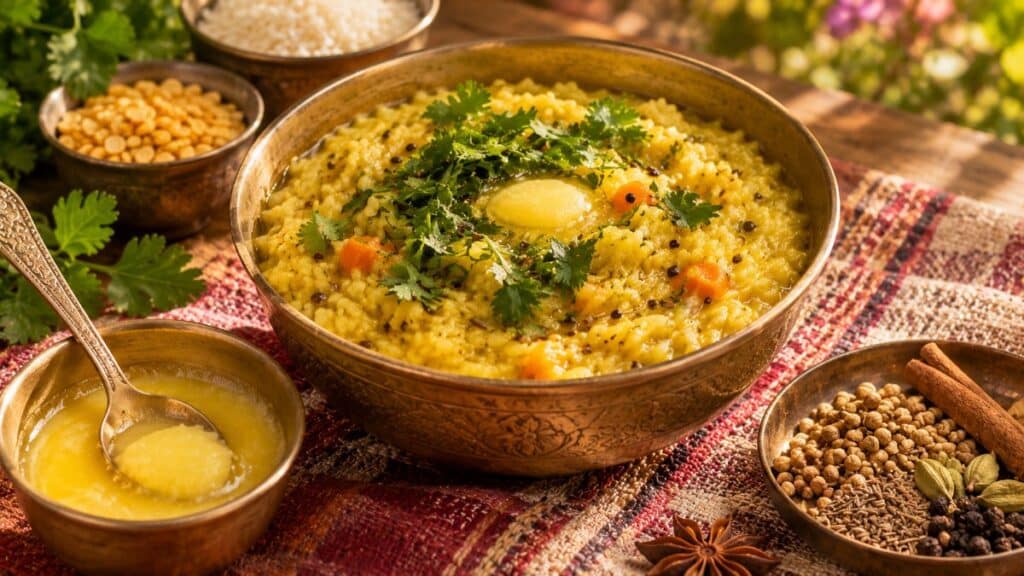
Kitchari (khichdi) is the classic Ayurvedic one-pot meal of split yellow mung dal and white basmati rice, cooked with ghee, cumin, cúrcuma y jengibre until soft and porridge-like. A reliable kitchari recipe uses equal weights of dal and rice, about five times their weight in water and 35 to 40 minutes of simmering. One of four servings gives roughly 296 kcal, 10 g protein and 7 g fibre. It is gentle and filling, but it is not a detox: there is no good evidence that a kitchari cleanse removes toxins.
This is for you if you want one dependable, precise recipe instead of ten vague ones, and an honest answer about what kitchari can and cannot do. You will find exact quantities and times, a ratio guide for thicker or soupier versions, nutrition per serving calculated from USDA data, why it sits well in the stomach, and how Ayurveda adapts it for each dosha.
What is kitchari?
Kitchari, spelled khichdi or khichri in India, means a dish of rice and lentils cooked together. Indian home cooking has dozens of versions; the Ayurvedic one is the mildest, built on split yellow mung dal (moong dal), white basmati rice, ghee and a few digestive spices. It is the meal Ayurveda turns to during recovery from illness, at the change of seasons and during traditional cleansing programmes, when people may eat kitchari alone for several days, a so-called kitchari mono diet.
Split yellow mung dal is the whole green mung bean with the hull removed and the bean split. That is why it cooks in about half an hour and melts into the rice, while whole beans stay firm.
How do you make kitchari? A precise recipe
Ingredients (serves 4)
- 125 g split yellow mung dal (moong dal)
- 125 g white basmati rice
- 2 tablespoons ghee (about 25 g)
- 1 teaspoon cumin seeds
- 1 teaspoon ground cúrcuma
- 1 teaspoon ground coriander
- 2 teaspoons finely grated fresh ginger
- 1 pinch asafoetida (hing), optional
- 1 medium zanahoria (about 60 g), diced
- 1 small calabacín (about 120 g), diced
- 3/4 teaspoon salt
- 1.2 litres water, plus up to 300 ml hot water
- To finish: lemon juice and fresh hojas de cilantro
Method
- Soak (3 hours). Rinse the dal in a sieve until the water runs clear, cover with plenty of cold water and soak for at least 3 hours. Drain and discard the soaking water. Rinse the rice two or three times just before cooking.
- Temper the spices (1 minute). Melt the ghee in a heavy pot over medium heat. Add the cumin seeds and let them sizzle for about 30 seconds, until fragrant. Add the asafoetida and ginger for 20 seconds, then the turmeric and coriander for 10 seconds. Do not let them burn.
- Toast (1 minute). Add the drained dal and rice and stir for a minute so every grain is coated.
- Simmer (20 minutes). Pour in 1.2 litres of water, add the salt and bring to a boil. Skim off any foam, lower the heat, set the lid slightly ajar and simmer gently for 20 minutes, stirring now and then.
- Add vegetables (15 minutes). Stir in the carrot and calabacín and simmer for 15 minutes more, until the dal has broken down and the vegetables are soft. Add hot water a little at a time if it gets too thick.
- Rest and finish (5 minutes). Take the pot off the heat, cover and rest for 5 minutes. Serve with a squeeze of lemon and chopped coriander leaves.
Ratios: thicker or soupier kitchari
| Style | Dal : rice (by weight) | Water for 250 g dal and rice | Simmer time |
|---|---|---|---|
| Thick, pilaf-like | 1 : 1 | 750 ml | 25 minutes |
| Classic, porridge-like (recipe above) | 1 : 1 | 1.2 litres | 35 to 40 minutes |
| Soupy, for a light day | 1 : 1 | 1.5 litres | 40 minutes |
| Milder, more rice | 1 : 2 | 1.2 litres | 35 minutes |
| Higher protein, more dal | 2 : 1 | 1.3 litres | 40 minutes |
Source: Nutriveda test-kitchen guidance for soaked split mung dal; times vary with your pot and stove.
How many calories and how much protein are in kitchari?
We calculated the recipe above ingredient by ingredient from USDA FoodData Central values per 100 g, then divided the pot by four.
| Nutritivo | Per serving (1/4 of the pot) | Whole pot |
|---|---|---|
| Energía | 296 kcal | 1,185 kcal |
| Proteína | 10.5 g | 41.8 g |
| Carbohydrate | 48.1 g | 192.4 g |
| Fibre | 6.7 g | 26.6 g |
| Fat | 7.3 g | 29.2 g |
| of which saturated | 4.2 g | 16.7 g |
| Sodio | 457 mg | 1,829 mg |
| Potasio | 588 mg | 2,351 mg |
| Hierro | 3.4 mg | 13.4 mg |
Source: Nutriveda calculation from USDA FoodData Central, SR Legacy: mung beans, mature seeds, raw (174256); rice, white, long-grain, raw, unenriched (169756); butter oil, anhydrous (173412); cumin seed (170923); turmeric, ground (172231); coriander seed (170922); ginger root, raw (169231); carrots, raw (170393); zucchini, raw (169291); table salt (173468). Lemon, fresh coriander and asafoetida not included.
Two notes on method. USDA has no separate entry for split, dehulled mung dal, so we used whole mung beans; split dal loses the hull, so treat the fibre figure as an upper estimate. Basmati is calculated as plain long-grain white rice.
For context, Harvard’s Nutrition Source cites a fibre goal of at least 30 g a day, so one bowl covers a little over a fifth of it. The sodium, 457 mg, is under a quarter of the WHO limit of less than 2,000 mg a day. Most of the saturated fat comes from the ghee; use 1 tablespoon instead of 2 and it drops to about 2.2 g per serving.

Why is kitchari easy to digest?
No trial has measured kitchari digestion directly, but the reasons it feels gentle are easy to see. Everything is cooked until soft. The split dal has no tough hull. Fat is moderate, and the fibre, about 7 g per bowl, is plenty without being a lot at once.
Legumes can also cause gas. Harvard’s Nutrition Source explains that legumes contain fibre, resistant starch and oligosaccharides that gut bacteria ferment, which can cause bloating and cramps in some people, and that soaking dried beans for at least 3 hours and cooking them may help. Soaking water matters too: in a study on common beans, soaking before cooking and discarding the soaking water reduced raffinose by 25.0 percent, stachyose by 24.8 percent and verbascose by 41.7 percent, the sugars most linked to gas, without lowering the beans’ nutritive value in rats. That study was not on mung beans, so take it as a principle, not a mung-specific number.
If legumes usually bother you, start with the soupy, more-rice version and a smaller bowl, and see our guide to natural remedies for better digestion.
Is a kitchari cleanse a real detox?
No. Ayurveda uses kitchari during cleansing programmes, but “cleansing” there is a traditional concept. The US National Center for Complementary and Integrative Health (NCCIH) says only a small number of studies, generally of low quality, have looked at detox programmes in people, that a 2015 review found no compelling research supporting “detox” diets for weight management, and that no studies have looked at their long-term effects.
Seen plainly, a few days of kitchari is a simple, warm, plant-based diet with moderate calories and no alcohol, ultra-processed food or added sugar. Many people feel lighter on it for those reasons. Eaten for longer, a single dish narrows the variety your diet needs, so add cooked greens, other vegetables, yogurt and fruit at other meals.
What does Ayurveda say about kitchari?
Ayurveda calls kitchari tridoshic, suitable for Vata, Pitta and Kapha alike. Mung dal is considered the lightest legume, basmati rice the most digestible grain, and the spices are there to support agni, the “digestive fire”. Ghee is said to carry the spices and nourish the tissues. These are traditional views, not measured effects. The classic tweaks by dosha:
- Vata: a little more ghee, the soupy version, extra ginger and cumin, root vegetables. See our Vata diet guide.
- Pitta: less ginger, more fresh coriander and hinojo, courgette and greens, no chilli. See the Pitta diet.
- Kapha: half the ghee, more dal than rice, black pepper and extra ginger, plenty of leafy greens. See the Kapha diet.
New to these ideas? Our Ayurvedic diet for beginners explains agni and the six tastes.
Who should be careful with kitchari?
- Diabetes: a large bowl of white rice and dal is a sizeable carbohydrate load, 48 g per serving here. Try the 2 : 1 dal-heavy version or brown basmati, add more vegetables, and talk to your care team before any mono diet; NCCIH advises people with diabetes to follow their care team’s plan before major diet changes.
- Salt and saturated fat: if you are watching blood pressure or cholesterol, cut the salt and use 1 tablespoon of ghee or switch to aceite de oliva.
- Ayurvedic cleanse products: some cleanse kits add herbal powders. NCCIH warns that some Ayurvedic preparations contain toxic amounts of lead, mercury or arsenic.
- Pregnancy, children, older adults, medication: a kitchari meal is fine; a multi-day kitchari-only plan is not something to start without your doctor.
- Restrictive eating: if “cleansing” turns into a way to restrict food, drop the plan and get support.
FAQ
Can I eat kitchari every day?
Yes, as one meal among others. Rice and mung dal with vegetables is a balanced plate. Kitchari as your only food for many days narrows variety, so keep other meals colourful.
Is kitchari good for weight loss?
It can help as a filling, moderate-calorie meal, about 296 kcal per serving here. There is no evidence that a kitchari cleanse causes lasting weight loss; NCCIH notes detox diets lack compelling research for weight management.
Can I use red lentils instead of mung dal?
Yes. Red lentils cook in a similar time and give a similar texture. The nutrition values above are for mung beans and will change slightly.
Is kitchari vegan?
The classic recipe uses ghee, so it is vegetarian. For a vegan kitchari, use 2 tablespoons of olive, sesame or coconut oil instead.
Sources
- U.S. Department of Agriculture. FoodData Central, SR Legacy (FDC IDs 174256, 169756, 173412, 170923, 172231, 170922, 169231, 170393, 169291, 173468). fdc.nal.usda.gov
- Harvard T.H. Chan School of Public Health. Legumes and Pulses. The Nutrition Source. nutritionsource.hsph.harvard.edu
- Queiroz KS, de Oliveira AC, Helbig E, Reis SM, Carraro F. Soaking the common bean in a domestic preparation reduced the contents of raffinose-type oligosaccharides but did not interfere with nutritive value. Journal of Nutritional Science and Vitaminology, 2002. PubMed 12489819
- National Center for Complementary and Integrative Health (NCCIH). “Detoxes” and “Cleanses”: What You Need To Know. NIH, updated 2025. nccih.nih.gov
- National Center for Complementary and Integrative Health (NCCIH). Ayurvedic Medicine: In Depth. NIH, updated 2019. nccih.nih.gov
- World Health Organization. Sodium reduction. Fact sheet, 2026. who.int
This article is for information only and is not medical advice. If you have a health condition, are pregnant or take medication, talk to your doctor or pharmacist before changing your diet or starting a supplement.


 Español
 English
 Deutsch
 Français

