
← EncyclopediaEncyclopédie de la nourriture
By Nikola · Precision Nutrition L1 · Updated 4 November 2026
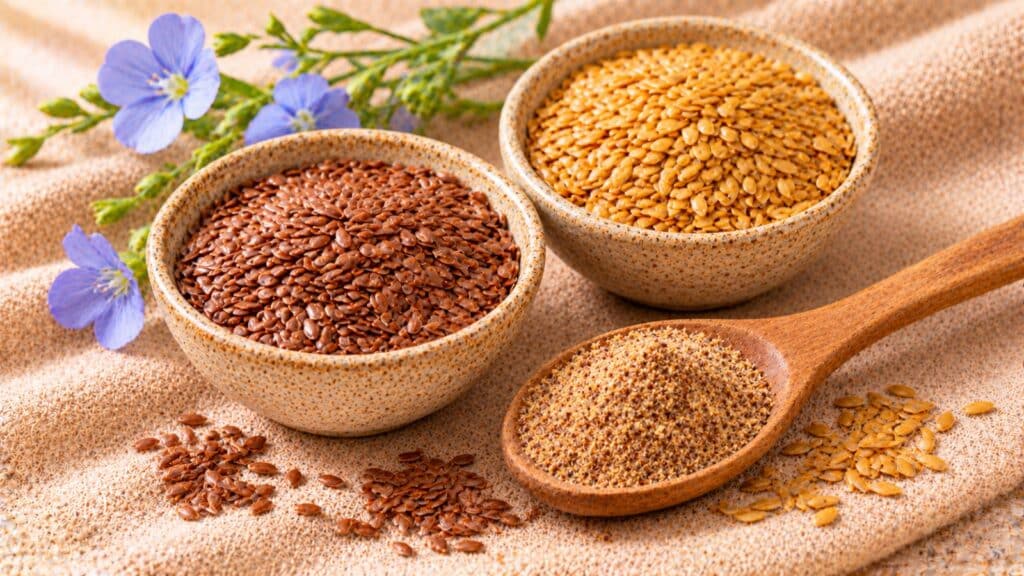
Flaxseed, also called linseed, is the small brown or golden seed of the flax plant (Linum usitatissimum). It is one of the richest plant sources of alpha-linolenic acid (ALA), the plant omega-3: 22.8 g per 100 g, according to USDA. Two tablespoons of ground flaxseed (14 g) give about 3.2 g of ALA and 3.8 g of fibre for 75 kcal. Grinding matters: in a controlled study, milled flaxseed raised blood ALA levels while whole seeds did not.
Flaxseed nutrition per 100 g and per portion
| Nutritif | Flaxseed, 100 g | Portion: 2 tablespoons ground (14 g) |
|---|---|---|
| Énergie | 534 kcal | 75 kcal |
| Protéine | 18.3 g | 2.6 g |
| Fat | 42.2 g | 5.9 g |
| of which polyunsaturated | 28.7 g | 4.0 g |
| of which ALA (omega-3) | 22.8 g | 3.2 g |
| of which linoleic acid (omega-6) | 5.9 g | 0.8 g |
| of which monounsaturated | 7.53 g | 1.1 g |
| of which saturated | 3.66 g | 0.5 g |
| Carbohydrate (including fibre) | 28.9 g | 4.0 g |
| of which sugars | 1.55 g | 0.2 g |
| Fibre | 27.3 g | 3.8 g |
| Thiamin (B1) | 1.64 mg | 0.23 mg |
| Magnésium | 392 mg | 55 mg |
| Phosphore | 642 mg | 90 mg |
| Fer | 5.73 mg | 0.8 mg |
| Copper | 1.22 mg | 0.17 mg |
| Manganese | 2.48 mg | 0.35 mg |
| Selenium | 25.4 µg | 3.6 µg |
Source: USDA FoodData Central, Seeds, flaxseed, FDC ID 169414 (fdc.nal.usda.gov), checked 4 November 2026. ALA and linoleic acid are the record’s undifferentiated 18:3 and 18:2 values. USDA household measures: 1 tablespoon ground = 7 g, 1 tablespoon whole = 10.3 g; the 14 g column is calculated. USDA carbohydrate includes fibre. Values rounded.
Almost all of the carbohydrate is fibre: of 28.9 g, 27.3 g. Against the EU nutrient reference values (Regulation (EU) No 1169/2011, Annex XIII), 100 g of flaxseed covers about one and a half times the reference intake for thiamin (1.1 mg) and slightly more than the reference for magnesium (375 mg) and copper (1 mg). A 14 g portion gives about 21% of the thiamin reference and 15% of magnesium.
Glycemic index of flaxseed
Flaxseed is not listed in the international GI tables (Atkinson 2008). With only about 1.6 g of carbohydrate per 100 g that is not fibre, a spoonful adds almost no digestible carbohydrate to a meal.
Health benefits: what the evidence says
- ALA and cholesterol. The EU permits the claim that ALA contributes to the maintenance of normal blood cholesterol levels, with the information that the effect is obtained with a daily intake of 2 g of ALA (Regulation (EU) No 432/2012). About 9 g of flaxseed provides 2 g of ALA. NIH lists 2.35 g of ALA in one tablespoon of whole flaxseed and 7.26 g in one tablespoon of flaxseed oil.
- Blood pressure. A meta-analysis of 14 controlled trials found that flaxseed products eaten for at least two weeks lowered systolic blood pressure by 1.77 mmHg and diastolic by 1.58 mmHg on average. The drop in diastolic pressure was larger with whole flaxseed (1.93 mmHg) and with intake for 12 weeks or more (2.17 mmHg) (Khalesi and colleagues, 2015). The effect is small, but blood pressure responds to many small changes added together.
- Grind it to get the ALA. In a three-month study where people ate 30 g of flaxseed a day baked into muffins, milled flaxseed significantly raised plasma ALA, whole seeds did not, and flaxseed oil raised it the most (Austria and colleagues, 2008).
- ALA is not fish oil. NIH describes the body’s conversion of ALA into EPA and DHA as very limited, with reported rates below 15%. Flaxseed is an excellent ALA source but does not replace oily fish. For reference, the adequate intake of ALA is 1.6 g a day for men and 1.1 g for women (NIH).
- Fibre. Two tablespoons give 3.8 g of fibre, about 15% of the 25 g a day EFSA considers adequate for normal bowel function in adults.
Ayurveda: flaxseed in the traditional system
In Usha and Vasant Lad’s food guidelines, flax seeds are favourable for Vata and for Pitta, and favourable in moderation for Kapha. Unlike sesame, which the same lists place under “avoid” for Pitta and Kapha, flax suits all three doshas. This is a traditional view, not a clinical finding.
How to buy, prepare and use flaxseed
- Grind small batches. Use a coffee or spice grinder and grind enough for a few days. Keep ground flaxseed in a closed jar in the fridge, because its polyunsaturated fat oxidises more easily once the seed is broken.
- Petit-déjeuner: stir 1-2 tablespoons into porridge ou Greek yogurt avec blueberries ou banana.
- Smoothies: add a tablespoon of ground flax with enough liquid.
- Baking: replace a few spoonfuls of flour with ground flax in bread, muffins or pancakes, or sprinkle whole seeds on top of a loaf.
- Flax “egg”: 1 tablespoon of ground flaxseed mixed with 3 tablespoons of water and left for 10 minutes can replace one egg in pancakes and muffins.
- Flaxseed oil: it has the ALA but none of the fibre. Use it cold, in dressings or drizzled over finished dishes, and keep the bottle in the fridge.
Who should be careful
- Digestion. NCCIH notes that higher amounts may cause bloating, fullness and diarrhoea. Start with a teaspoon or two, build up slowly and drink enough water.
- Raw or unripe seeds. NCCIH advises against eating raw or unripe flaxseeds because they may contain potentially toxic compounds. Buy flaxseed sold as food from a trusted source and keep to normal kitchen amounts.
- Blood-thinning medicines. According to NCCIH, flaxseed or flaxseed oil might interact with anticoagulant or antiplatelet drugs. If you take them, talk to your doctor before eating flaxseed regularly in larger amounts.
- Pregnancy and breastfeeding. NCCIH says some studies suggest flaxseed is possibly unsafe in pregnancy, though the evidence is not conclusive, and that little is known about breastfeeding. Ask your doctor or midwife before using it in more than small culinary amounts.
Related entries and articles
- Chia seeds – the other seed rich in ALA and fibre
- Walnuts – the nut with the most ALA
- Saumon – for EPA and DHA, which flax does not supply directly
- Avoine – porridge with ground flax
- Pumpkin seeds
- All about high-quality fats
- Natural remedies for better digestion
FAQ
Is ground or whole flaxseed better?
Ground. In a three-month study, milled flaxseed raised blood ALA levels while whole seeds did not. Grind small amounts at home or buy ground flax and keep it in the fridge.
How much flaxseed should I eat per day?
There is no official daily amount. One to two tablespoons of ground flaxseed (7-14 g) is a common portion; about 9 g already gives the 2 g of ALA linked to the EU cholesterol claim. Start smaller if you are not used to fibre.
Can flaxseed replace fish oil?
No. Flaxseed gives ALA, and NIH reports that the body converts less than 15% of ALA into EPA and DHA, the omega-3s found in fish. Flax is a valuable plant source of omega-3, but it is not a substitute for oily fish.
Sources
- USDA FoodData Central: Seeds, flaxseed (FDC ID 169414). fdc.nal.usda.gov
- NIH Office of Dietary Supplements: Omega-3 Fatty Acids, Fact Sheet for Health Professionals. ods.od.nih.gov
- Khalesi S, Irwin C, Schubert M. Flaxseed consumption may reduce blood pressure: a systematic review and meta-analysis of controlled trials. Journal of Nutrition 2015;145(4):758-765. PubMed
- Austria JA, Richard MN, Chahine MN, et al. Bioavailability of alpha-linolenic acid in subjects after ingestion of three different forms of flaxseed. Journal of the American College of Nutrition 2008;27(2):214-221. AGRIS
- NCCIH: Flaxseed and Flaxseed Oil. nccih.nih.gov
- Commission Regulation (EU) No 432/2012, list of permitted health claims (ALA and blood cholesterol). EUR-Lex
- Regulation (EU) No 1169/2011 on food information to consumers, Annex XIII (reference intakes). EUR-Lex
- EFSA NDA Panel (2010). Scientific Opinion on Dietary Reference Values for carbohydrates and dietary fibre. EFSA Journal 8(3):1462. efsa.europa.eu
- Atkinson FS, Foster-Powell K, Brand-Miller JC. International tables of glycemic index and glycemic load values: 2008. Diabetes Care 2008;31(12):2281-2283. PMC
- Lad U, Lad V. Food Guidelines for Basic Constitutional Types, from Ayurvedic Cooking for Self-Healing, 2nd ed. The Ayurvedic Institute. ayurveda.com
This page is for information only and is not medical or dietary advice.
Encyclopédie de la nourriture
Chia seeds Saumon Avoine Pumpkin seeds Sesame seeds Walnuts Pumpkin seeds
 Français
 English
 Deutsch
 Español

