

A high-protein vegetarian breakfast gives you around 20-30 g of protein without meat, and the easiest building blocks are Greek yogurt, cottage cheese, eggs, tofu and tempeh. By USDA values, 170 g of plain nonfat Greek yogurt has about 17 g of protein, 150 g of firm tofu about 26 g and 100 g of tempeh about 20 g, so one or two of these plus hemp seeds, oats or peanut butter is enough.
This guide is for vegetarians, flexitarians and anyone whose breakfast is mostly toast and coffee. You’ll find how much protein you need, what research says about protein in the morning, a table of breakfast foods with real numbers, seven ideas and one full recipe.
How much protein do you need per day?
The European Food Safety Authority (EFSA) sets the population reference intake for adults at 0.83 g of protein per kilogram of body weight per day, and that figure applies to older adults too. For a 60 kg person that’s about 50 g a day; for 70 kg, about 58 g. Needs rise in pregnancy (EFSA adds 1 g, 9 g and 28 g a day in the first, second and third trimesters) and during breastfeeding (an extra 19 g a day for the first six months, 13 g after that).
EFSA did not set an upper limit for protein because the data were insufficient, and it notes that intakes up to twice the reference intake are common in mixed diets and considered safe. So you don’t need to chase huge numbers. If you’re deliberately eating more, for training or appetite control, our entry on high-protein diets covers the trade-offs.
Does it matter how much protein you eat at breakfast?
Possibly, but less than total daily protein. The study most often quoted here is a 2014 trial in The Journal of Nutrition. Eight healthy adults ate the same daily protein in two patterns for a week each: evenly spread (about 30 g at breakfast, lunch and dinner) or skewed (about 11 g at breakfast, 16 g at lunch and 63 g at dinner). Muscle protein synthesis over 24 hours was 25% higher with the even pattern.
Keep that in proportion: eight people, seven days, and it measured protein synthesis, not muscle gained over months. A 2021 systematic review of 15 studies in the European Journal of Nutrition found that a more even protein distribution was associated with higher muscle mass, yet only 3 of 7 studies on muscle mass, 2 of 7 on strength and 1 of 6 on protein turnover showed a positive link. The authors concluded the evidence on strength and turnover was insufficient.
The practical reading: get your daily total first. Then, if breakfast is your lowest-protein meal, moving 15-20 g from dinner to the morning is a sensible, low-risk change. And if a bigger breakfast simply keeps you away from the biscuit tin until lunch, that’s a good enough reason on its own.
Which vegetarian breakfast foods are highest in protein?
Here are common breakfast foods with protein per typical serving, calculated from USDA per-100 g values.
| Food | Serving | Protein per serving | Protein per 100 g |
|---|---|---|---|
| Firm tofu, calcium-set | 150 g | 26 g | 17.3 g |
| Tempeh | 100 g | 20 g | 20.3 g |
| Greek yogurt, plain, nonfat | 170 g | 17 g | 10.2 g |
| Cottage cheese, 2% fat | 150 g | 16 g | 10.4 g |
| Eggs, whole | 2 medium (88 g) | 11 g | 12.6 g |
| Hemp seeds, hulled | 3 tbsp (30 g) | 9.5 g | 31.6 g |
| Peanut butter, smooth | 2 tbsp (32 g) | 7 g | 22.2 g |
| Plain whole-milk yogurt | 200 g | 7 g | 3.5 g |
| Rolled oats, dry | 50 g | 7 g | 13.2 g |
| Feta cheese | 30 g | 4 g | 14.2 g |
| Chia seeds | 20 g | 3 g | 16.5 g |
Source: USDA FoodData Central, SR Legacy. Serving values calculated by Nutriveda from per-100 g data and rounded.
Greek yogurt has roughly three times the protein of regular plain yogurt, because straining removes much of the liquid. Firm tofu and tempeh are the strongest plant options (our vegan diet entry covers the nutrients to watch if you eat fully plant-based). Oats, peanut butter and chia are supporting players.
Do you need to combine plant proteins at every meal? No. Harvard’s Nutrition Source notes that many plant foods lack one or more essential amino acids, and advises eating a variety of protein-containing plant foods each day. Across a day is enough; you don’t have to match them on one plate.
What are good high-protein vegetarian breakfast ideas?
The protein figures below count only the main protein foods, using the USDA values above. Milk, bread and vegetables add a few grams more.
1. Greek yogurt bowl with hemp seeds (about 27 g)
170 g Greek yogurt, 3 tablespoons hemp seeds, a handful of berries and cinnamon. If you like it sweeter, use ripe fruit rather than syrup; our guide to healthy desserts without sugar has more ways to get sweetness from fruit.
2. Savoury tofu scramble (about 26 g)
150 g crumbled firm tofu with onion, tomato, spinach and turmeric. It’s the go-to high-protein vegan breakfast, and the full recipe is below.
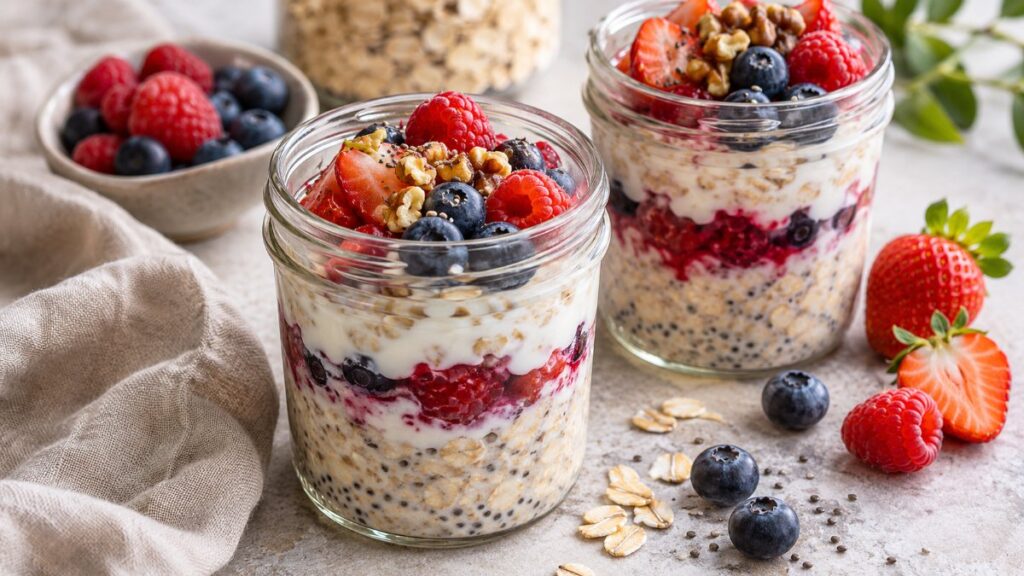
3. High-protein overnight oats (about 25 g)
50 g oats, 150 g Greek yogurt and 20 g chia seeds, loosened with milk and left in the fridge overnight. Top with grated apple in the morning.
4. Three-egg omelette with spinach and feta (about 21 g)
Three medium eggs and 30 g crumbled feta, folded around wilted spinach. Feta is salty, so skip extra salt.
5. Cottage cheese on rye toast (about 21 g)
200 g cottage cheese spread over two slices of rye, with sliced tomato, black pepper and fresh dill or chives.
6. Tempeh breakfast sandwich (about 20 g)
100 g tempeh sliced thin, pan-fried with a splash of soy sauce, tucked into wholegrain bread with avocado and leaves. A small bowl of edamame on the side adds more plant protein.
7. Peanut butter and hemp porridge (about 23 g)
50 g oats cooked in water or milk, stirred with 2 tablespoons peanut butter and 3 tablespoons hemp seeds. Warm, filling and ready in five minutes.
If you want more classic breakfast staples to rotate in, see our 7 healthy foods to eat for breakfast. And if your real goal is steadier mornings rather than more protein, our piece on foods for energy without caffeine looks at the rest of the plate.
What does Ayurveda say about a protein-rich breakfast?
In the traditional Ayurvedic view, the early morning belongs to kapha, the dosha associated with heaviness and stability, while agni, the digestive fire, is still waking up. Classical advice is a warm, cooked breakfast that is nourishing but not heavy, eaten when you are actually hungry, with the main meal at midday when agni is considered strongest.
Tradition favours mung beans as the easiest legume to digest, so a savoury mung dal pancake (chilla) is a classic protein-rich morning dish. Cold, thick yogurt is seen as heavy and kapha-increasing, which is why Ayurvedic cooks tend to prefer it at lunch, thinned with water and spiced, rather than straight from the fridge at dawn. Warming spices like ginger, cumin and black pepper are added to support digestion. A vata type might be steered toward warm spiced oats with nuts, a kapha type toward a spiced tofu scramble with plenty of vegetables. This is traditional guidance, not tested science.
How do you make a savoury tofu scramble?
This is the recipe to master if you want a high-protein vegetarian breakfast without eggs. It takes about 15 minutes and serves two, at roughly 26 g of protein per serving from the tofu alone.
Ingredients (2 servings)
- 300 g firm tofu, calcium-set, drained
- 1 tablespoon olive oil
- 1 small onion, finely chopped
- 1 ripe tomato, diced
- 2 handfuls of fresh spinach
- 1/2 teaspoon ground turmeric
- 1/2 teaspoon ground cumin
- Black pepper and salt to taste
- Optional: 30 g crumbled feta (not vegan), chopped parsley or chives
Steps
- Pat the tofu dry with a clean towel and crumble it with your fingers into uneven, egg-sized pieces.
- Warm the olive oil in a frying pan over medium heat and cook the onion for 4-5 minutes until soft.
- Add turmeric, cumin and a pinch of black pepper and stir for 30 seconds until fragrant.
- Add the tofu and cook for 5-6 minutes, turning occasionally, until it is golden in places and coated in spice.
- Stir in the tomato and spinach and cook for 1-2 minutes until the spinach just wilts.
- Season with salt, scatter over feta and herbs if using, and serve with wholegrain toast.
Make it part of your routine: our morning routines guide has ideas for fitting a cooked breakfast into a busy start.
Who should be careful with a high-protein breakfast?
- Kidney or liver disease. Harvard’s Nutrition Source notes that people with certain conditions, including kidney and liver disease, need to monitor protein intake. Follow your doctor’s or dietitian’s target rather than raising protein on your own.
- Allergies. Soy (tofu, tempeh, edamame), egg, milk and peanut are common allergens. Swap freely between the ideas above.
- Salt. Feta contains about 1,140 mg of sodium per 100 g, so 30 g adds roughly 340 mg. Balance it with unsalted foods for the rest of the meal.
- Pregnancy and breastfeeding. Protein needs rise, especially in the third trimester. A protein-rich breakfast helps, but discuss your overall diet with your midwife or doctor.
Related reading: plant-based meals for weight loss.
FAQ
How much protein should a vegetarian breakfast have?
There’s no official per-meal figure. The best-known trial on protein timing used about 30 g per meal, and 20-30 g is a practical target for most adults. What matters most is reaching your daily total, which EFSA puts at 0.83 g per kg of body weight.
What is a good high-protein vegan breakfast?
A tofu scramble is the easiest: 150 g of firm tofu gives about 26 g of protein. A tempeh sandwich (about 20 g) or porridge with peanut butter and hemp seeds (about 23 g, cooked in water or soy drink) also work without eggs or dairy.
Is Greek yogurt or cottage cheese higher in protein?
They’re very close. By USDA data, nonfat Greek yogurt has about 10.2 g per 100 g and 2% cottage cheese about 10.4 g. Pick whichever you enjoy more, or mix them.
Is a high-protein vegetarian breakfast good for weight loss?
It can help if it keeps you satisfied and stops mid-morning snacking, but no single meal decides weight loss; your overall diet does. Choose unsweetened yogurt and keep nut butters to a measured spoonful.
Sources
- EFSA Panel on Dietetic Products, Nutrition and Allergies. Scientific Opinion on Dietary Reference Values for protein. EFSA Journal, 2012;10(2):2557. efsa.europa.eu
- European Food Safety Authority. EFSA sets population reference intakes for protein. EFSA news, 2012. efsa.europa.eu
- Mamerow MM, Mettler JA, English KL, et al. Dietary protein distribution positively influences 24-h muscle protein synthesis in healthy adults. The Journal of Nutrition, 2014. PMC4018950
- Jespersen SE, Agergaard J. Evenness of dietary protein distribution is associated with higher muscle mass but not muscle strength or protein turnover in healthy adults: a systematic review. European Journal of Nutrition, 2021. link.springer.com
- Harvard T.H. Chan School of Public Health. Protein. The Nutrition Source, 2025. nutritionsource.hsph.harvard.edu
- U.S. Department of Agriculture, Agricultural Research Service. FoodData Central, SR Legacy (FDC IDs 170894, 171284, 172182, 171287, 172475, 174272, 173904, 172470, 170148, 173420, 170554). fdc.nal.usda.gov
This article is for information only and is not medical advice. If you have a health condition, are pregnant or take medication, talk to your doctor or pharmacist before changing your diet or starting a supplement.


 English
 Deutsch
 Español
 Français

