
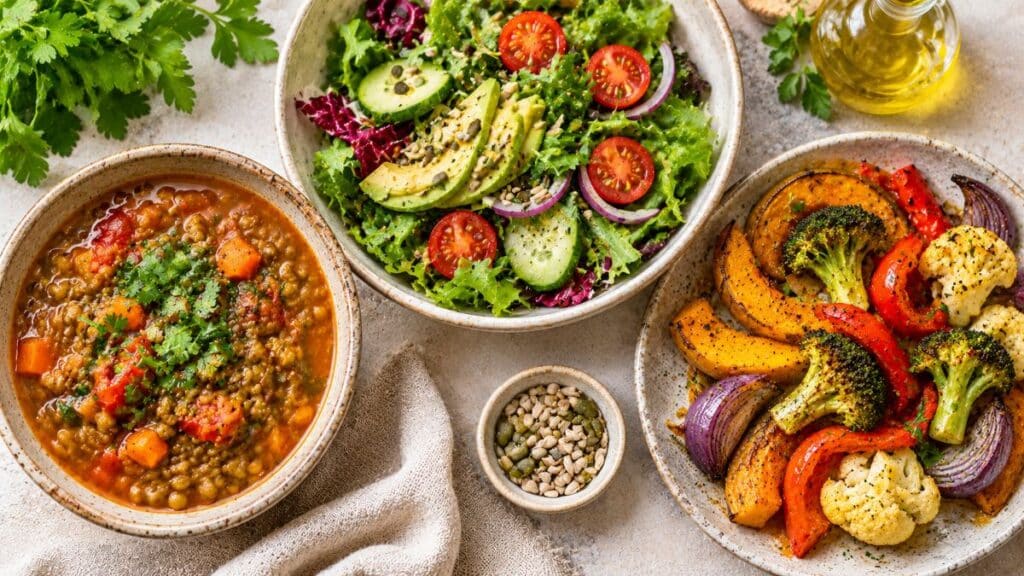
Plant-based meals built on vegetables, beans, lentils, whole grains and fruit help with weight loss mainly because they are filling for relatively few calories: they are rich in water and fibre and low in energy density. A 2016 meta-analysis of 12 randomised trials found that people on vegetarian diets lost about 2 kg more than those on comparison diets, with vegan diets showing a larger effect of about 2.5 kg. Include a protein source at every meal and, if you follow a vegan diet for weight loss, a reliable source of vitamin B12.
This guide is for you if you want to lose weight by eating more plants, not by counting every bite or living on salad. You’ll see what the research shows, why some plant meals keep you full and others don’t, how to get enough protein, a one-day example menu, seven meal ideas and a chickpea stew you can batch-cook for the week.
Does a vegan or vegetarian diet help you lose weight?
The best summary of the trials is a 2016 meta-analysis by Huang and colleagues in the Journal of General Internal Medicine. It pooled 12 randomised controlled trials with 1,151 participants, followed for a median of 18 weeks.
| Comparison | Extra weight lost vs non-vegetarian diets |
|---|---|
| All vegetarian diets | 2.02 kg (95% CI 1.23 to 2.80) |
| Vegan diets | 2.52 kg (95% CI 1.98 to 3.02) |
| Lacto-ovo vegetarian diets | 1.48 kg (not statistically clear) |
| With calorie restriction | 2.21 kg |
| Without calorie restriction | 1.66 kg |
| Follow-up under 1 year | 2.05 kg |
| Follow-up 1 year or longer | 1.13 kg |
Source: Huang RY, et al. J Gen Intern Med, 2016. Values are differences between groups, not total weight lost.
Read this calmly. Two kilograms more over a few months is a real but modest difference. The trials varied a lot, few were blinded, none lasted longer than 18 months, and the advantage shrank in longer studies. What it tells you is that a well-built plant-based pattern is a reasonable way to lose weight, even without strict calorie counting. It is not a shortcut, and it is not the only way. If you want the bigger picture on long-term weight, see our weight loss habits that actually work.
Why do plant-based meals fill you up with fewer calories?
The key idea is energy density: the number of calories in a given weight of food. Nutrition researcher Barbara Rolls explains in a 2009 review that water lowers energy density because it adds weight without adding energy, while fat raises it most (9 kcal per gram versus 4 for carbohydrate and protein). People tend to eat a fairly consistent weight of food, so swapping to lower-density meals cuts calories without shrinking the plate.
In a year-long trial described in that review, 97 women with obesity were counselled either to eat more water-rich foods such as fruit and vegetables while cutting fat, or to cut fat and restrict portions. The water-rich group lost 7.9 kg versus 6.4 kg, reported eating about 25% more food by weight, and felt less hungry.
Here is how calories and fibre compare per portion for some plant foods:
| Food (cooked unless stated) | Portion | Calories | Fibre (g) |
|---|---|---|---|
| Broccoli | 1 cup | 54 | 5.2 |
| Raspberries, raw | 1 cup | 64 | 8.0 |
| Brussels sprouts | 1 cup | 65 | 6.4 |
| Artichoke | 1 cup | 89 | 9.6 |
| Black beans | 1/2 cup | 114 | 7.5 |
| Lentils | 1/2 cup | 115 | 7.8 |
| Chickpeas | 1/2 cup | 135 | 6.3 |
| Sweet potato | 1 cup | 190 | 6.3 |
| Chia seeds | 1 tablespoon | 58 | 4.1 |
| Pumpkin seeds | 1 ounce (28 g) | 126 | 5.2 |
| Almonds | 1 ounce (28 g) | 164 | 3.5 |
Source: Dietary Guidelines for Americans 2020-2025, “Food Sources of Dietary Fiber”, based on USDA FoodData Central. 1 US cup is about 240 ml.
A full cup of broccoli has fewer calories than a small handful of almonds. Nuts and seeds are nourishing, but they are dense, so use them as a topping, not a bowlful. Fibre-rich beans and vegetables also feed your gut bacteria, which is the subject of our guide to gut health foods.
How do you get enough protein on a plant-based diet?
Plant-based plates can end up low in protein when they are mostly vegetables and grains. EFSA sets the population reference intake for adults at 0.83 g of protein per kilogram of body weight per day. For an adult weighing 70 kg, that is about 58 g a day.
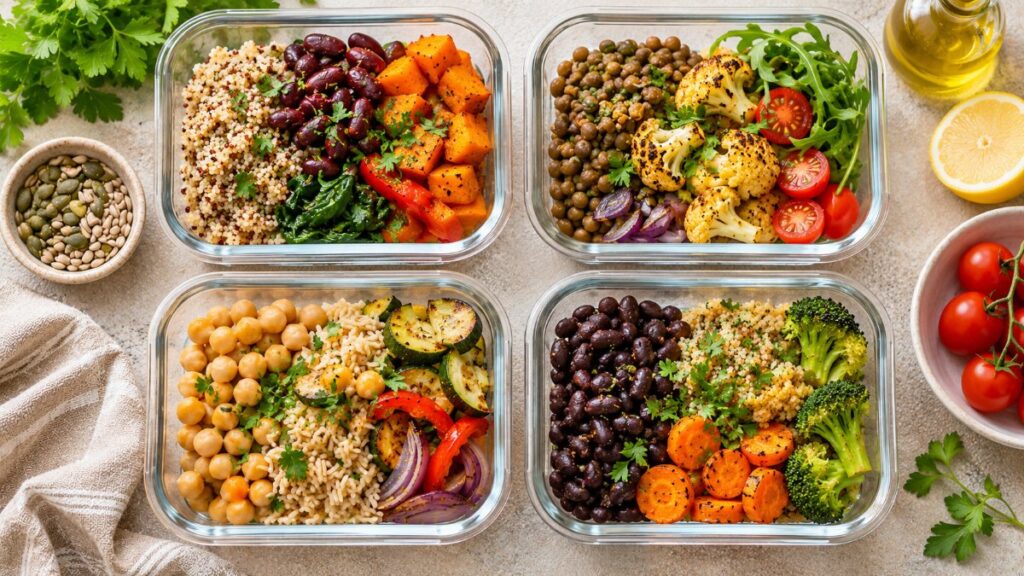
The simplest rule: put a protein food on the plate at every meal. Good plant options are lentils, beans, chickpeas, split peas, tofu, tempeh and edamame. If you eat dairy and eggs, plain yogurt, cottage cheese and eggs make breakfast easy; our high-protein vegetarian breakfast ideas give you a week of options. For the wider debate on protein and weight, see our encyclopedia entry on high-protein diets.
What does a one-day vegan weight loss meal plan look like?
This example uses ordinary portions and no calorie target, because needs differ widely between people. Adjust amounts to your hunger.
- Breakfast: porridge made with oats and water or soy milk, a cup of raspberries and a tablespoon of chia seeds.
- Lunch: a big bowl of lentil soup with carrots and celery, a slice of wholegrain rye bread, a tomato and cucumber salad.
- Snack: an apple or pear with a few almonds.
- Dinner: chickpea, spinach and tomato stew (recipe below) with a small portion of bulgur.
Notice the pattern: half the plate vegetables or fruit, a quarter legumes or tofu, a quarter whole grains, fats in spoonfuls. To compare breads, grains and potatoes, see our glycemic index table.
What are the best plant-based meals for weight loss?
All seven are vegan, filling and easy to batch-cook, the kind of healthy vegan recipes for weight loss you can repeat without getting bored.
- Lentil and vegetable soup: red or green lentils with onion, carrot and spices. Soup is one of the easiest ways to eat a large, low-density meal.
- Bean chilli: black and kidney beans, peppers, tomatoes and cumin, served over cauliflower rice or a small portion of brown rice.
- Tofu and vegetable stir-fry: firm tofu, broccoli, peppers and cabbage with ginger, garlic and a splash of soy sauce.
- Chickpea salad bowl: chickpeas, cucumber, tomatoes, parsley, red onion, lemon and a spoon of olive oil.
- Roasted vegetable tray with white beans: zucchini, eggplant, peppers and onions roasted, then tossed with beans and herbs.
- Split pea dal with spinach: yellow split peas cooked with turmeric and cumin, finished with a handful of spinach.
- Stuffed peppers: peppers filled with bulgur, lentils, tomatoes and herbs, baked until soft.
Recipe: chickpea, spinach and tomato stew
Serves 4. About 35 minutes. Keeps 3 days in the fridge.
- 2 tins (400 g each) chickpeas, drained, or about 500 g home-cooked
- 1 onion, chopped
- 2 garlic cloves, sliced
- 1 red pepper, diced
- 1 tin (400 g) chopped tomatoes
- 200 g fresh spinach
- 1 tablespoon olive oil
- 1 teaspoon each of ground cumin and sweet paprika
- 300 ml water or vegetable stock
- Salt, pepper, juice of half a lemon
- Warm the oil in a wide pan and soften onion and pepper for 6 to 8 minutes.
- Add garlic, cumin and paprika and stir for 1 minute.
- Add tomatoes, chickpeas and water. Simmer for 15 minutes, lightly crushing some chickpeas to thicken the sauce.
- Stir in the spinach until it wilts, about 2 minutes.
- Season with salt, pepper and lemon juice.
What does Ayurveda say about eating for weight loss?
In traditional Ayurveda, excess weight is usually linked to an excess of kapha, the dosha associated with earth and water: heavy, slow, cool and stable. The traditional advice is to favour foods with pungent, bitter and astringent tastes (rasa), which are considered light and drying. Legumes such as lentils and mung beans are classed as astringent, which is one reason dal sits at the centre of so many Ayurvedic meals.
Tradition also recommends the largest meal at midday, when agni, the digestive fire, is said to be strongest, a lighter early dinner, warm food over cold, and warming spices like ginger, black pepper and turmeric. These ideas come from tradition, not trials, but they line up neatly with a plant-heavy, home-cooked way of eating.
Who should be careful with a plant-based weight-loss plan?
- Vitamin B12 if you are vegan. The NIH Office of Dietary Supplements notes that only animal foods contain B12 naturally and plant foods have none unless fortified. Adults need 2.4 mcg a day. Use fortified foods or a supplement and ask your doctor about testing.
- No crash diets. Very restrictive plans are hard to keep up. Aim for meals you would happily eat in a year’s time.
- “Vegan” is not automatically light. Pastries, crisps and sweetened plant drinks can be fully plant-based and very energy-dense.
- Medication and health conditions. If you take medication for diabetes or blood pressure, a big shift in diet and weight can change what you need. Talk to your doctor first.
- Pregnancy, breastfeeding and eating disorders. Pregnancy is not the time for a weight-loss diet unless your doctor advises it, and if you have a history of disordered eating, work with a professional rather than following a plan alone.
Related reading: our encyclopedia entry on the benefits and risks of a vegan diet, and basal metabolic rate and weight loss.
FAQ
Does a vegan diet help you lose weight faster?
In the 2016 meta-analysis, vegan diets showed the largest average effect, about 2.5 kg more than comparison diets. The difference is modest and shrank in longer trials, so the best plant-based diet is the one you can keep.
Can you lose weight on plant-based meals without counting calories?
Many people can, because low-energy-density meals rich in vegetables and legumes fill the stomach with fewer calories. In the meta-analysis, vegetarian diets led to more weight loss even in trials without calorie restriction.
What are good high-protein vegan meals for weight loss?
Build meals around lentils, beans, chickpeas, split peas, tofu, tempeh or edamame: a lentil soup, a tofu stir-fry or a chickpea stew. If you are vegetarian rather than vegan, plain yogurt, cottage cheese and eggs also help. Aim for a protein food at every meal.
Do I need supplements on a plant-based diet?
If you eat no animal foods at all, yes for vitamin B12, through fortified foods or a supplement. For anything else, ask your doctor or a dietitian before adding supplements.
Sources
- Huang RY, Huang CC, Hu FB, Chavarro JE. Vegetarian Diets and Weight Reduction: a Meta-Analysis of Randomized Controlled Trials. J Gen Intern Med, 2016;31(1):109-116. PMC4699995
- Rolls BJ. The relationship between dietary energy density and energy intake. Physiology and Behavior, 2009;97:609-615. Full text (PDF)
- EFSA Panel on Dietetic Products, Nutrition and Allergies. Scientific Opinion on Dietary Reference Values for protein. EFSA Journal, 2012;10(2):2557. efsa.europa.eu
- NIH Office of Dietary Supplements. Vitamin B12: Fact Sheet for Consumers. ods.od.nih.gov
- U.S. Department of Agriculture and HHS. Food Sources of Dietary Fiber. Dietary Guidelines for Americans 2020-2025 (data: USDA FoodData Central). dietaryguidelines.gov
This article is for information only and is not medical advice. If you have a health condition, are pregnant or take medication, talk to your doctor or pharmacist before changing your diet or starting a supplement.
 English
 Deutsch
 Español
 Français

