
← EncyclopediaEncyclopedia of food
By Nikola · Precision Nutrition L1 · Updated 5 November 2026
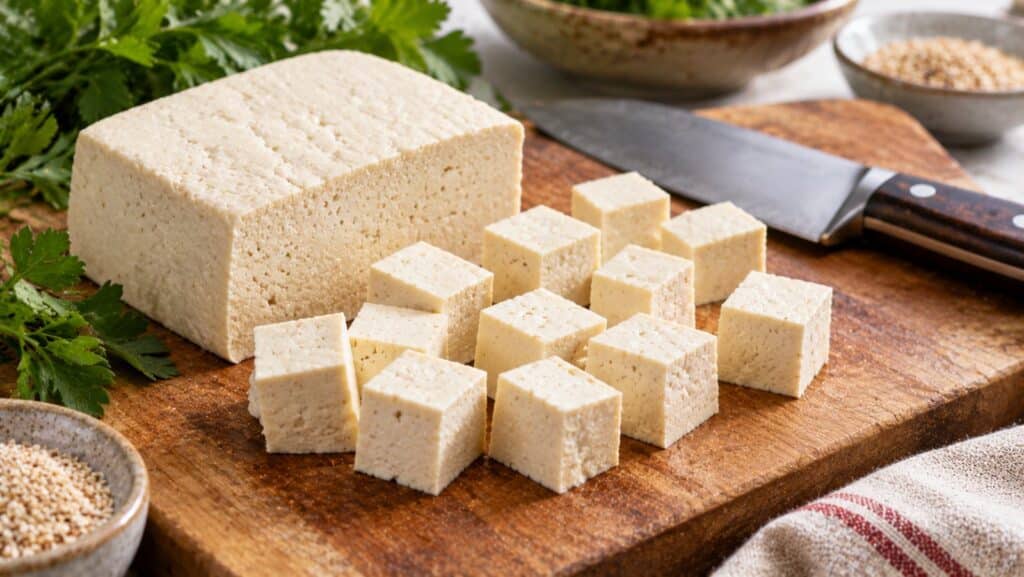
Tofu is soy milk that has been curdled and pressed into a block, a bit like a fresh cheese made from soybeans. Firm tofu set with calcium sulfate gives 17 g of protein and 683 mg of calcium per 100 g, with only 144 kcal and almost no carbohydrate. It has a mild taste and takes on the flavour of whatever you cook it with, which is why it works in stir-fries, curries, salads and even scrambled “eggs”. Soy is one of the 14 allergens that must be declared on food labels in the EU.
Tofu nutrition per 100 g and per portion
| Nutrient | Firm tofu, 100 g | Portion: 81 g (1 block, USDA) |
|---|---|---|
| Energy | 144 kcal | 117 kcal |
| Protein | 17.3 g | 14.0 g |
| Fat | 8.7 g | 7.1 g |
| of which saturated | 1.3 g | 1.0 g |
| of which polyunsaturated | 4.9 g | 4.0 g |
| Carbohydrate | 2.8 g | 2.3 g |
| Fibre | 2.3 g | 1.9 g |
| Calcium | 683 mg | 553 mg |
| Iron | 2.7 mg | 2.2 mg |
| Magnesium | 58 mg | 47 mg |
| Phosphorus | 190 mg | 154 mg |
| Manganese | 1.2 mg | 0.96 mg |
| Selenium | 17.4 µg | 14.1 µg |
| Sodium | 14 mg | 11 mg |
Source: USDA FoodData Central, SR Legacy: “Tofu, raw, firm, prepared with calcium sulfate” (FDC 172475), checked 5 November 2026. The 81 g “block” is a USDA portion; the portion column is calculated. The record also lists 0.58 g of ALA (plant omega-3), 0.38 mg copper and 29 µg folate per 100 g, and 0 µg vitamin B12. Values rounded.
Compared with the EU reference intakes (Regulation (EU) No 1169/2011, Annex XIII), 100 g of this tofu covers about 85% of the calcium (800 mg), 59% of the manganese (2 mg), 32% of the selenium (55 µg) and 19% of the iron (14 mg). The calcium figure belongs to tofu set with calcium sulfate. Tofu made with other coagulants can have quite different values, so check the nutrition label of the tofu you buy.
Glycemic index
Tofu is not listed in the international GI tables (Atkinson 2008), and with 2.8 g of carbohydrate per 100 g it has very little that could raise blood sugar. For context, boiled soya beans, the raw material of tofu, have one of the lowest values in those tables: 16 ± 1.
Health benefits: what the evidence says
- Plant protein. 17 g of protein per 100 g makes tofu one of the most protein-dense plant foods. Under EU rules, protein contributes to a growth in muscle mass and to the maintenance of normal bones (Regulation (EU) No 432/2012).
- Calcium for bones. Calcium-set tofu is a real calcium source for people who eat little dairy. Calcium is needed for the maintenance of normal bones (Regulation 432/2012).
- Cholesterol. According to the US National Center for Complementary and Integrative Health (NCCIH), consuming soy protein in place of other proteins may lower cholesterol levels to a small extent, while isolated soy isoflavones may not have the same effect. Swapping some red or processed meat for tofu is the practical version of this.
- Breast cancer questions. NCCIH notes that observational studies in Asian and Asian-American women link higher dietary soy intake with a lower risk of breast cancer, but soy supplements have not been shown to reduce that risk. EFSA reviewed isoflavone supplements in post-menopausal women in 2015 and found no evidence of harm to the breast, uterus or thyroid at the doses and durations studied.
- Menopause and bones. NCCIH also reports that soy isoflavones or soy protein may help reduce the frequency and severity of hot flashes, though results are not fully consistent, and that isoflavones probably have a beneficial effect on bone density after menopause.
How to eat it
- Pick the right type. Firm and extra-firm tofu hold their shape for frying, baking and grilling. Silken tofu is soft and suits smoothies, sauces and desserts.
- Press it. Wrap firm tofu in a clean towel, put something heavy on top for 15-20 minutes and you remove a lot of water. Pressed tofu browns better and soaks up marinades.
- Season boldly. Tofu on its own tastes of very little. Marinate cubes in soy sauce, garlic and ginger, then bake or pan-fry until golden.
- Everyday ideas: crumble it with turmeric and black pepper for a scramble; add cubes to a vegetable stir-fry with peppers and broccoli; drop small cubes into miso soup; blend silken tofu with cocoa for a quick mousse.
- Storage: keep opened tofu in the fridge covered with fresh water, change the water daily and use it within a few days or by the date on the pack. Tofu can be frozen; it turns spongier and chewier after thawing.
Who should be careful
- Soy allergy. NCCIH notes that some people are allergic to soy, and MedlinePlus lists soy among the most common food allergies, mostly in children. In the EU, soy must be declared on the label.
- MAO inhibitor antidepressants. NCCIH reports interactions between monoamine oxidase inhibitors and certain soy products containing high amounts of tyramine. If you take one of these drugs, ask your doctor which soy foods are safe for you.
- Pregnancy. NCCIH states that soy during pregnancy may be unsafe in amounts greater than those commonly found in foods. Tofu as a normal food is a different matter from concentrated soy supplements.
- Digestive comfort. Side effects of soy listed by NCCIH include bloating, constipation, diarrhoea and nausea. Start with modest portions if you are new to it.
Traditional view (Ayurveda)
In Usha and Vasant Lad’s food guidelines, tofu is to be eaten in moderation for Vata, is favourable for Pitta, and for Kapha cold tofu is best avoided while hot tofu is fine in moderation. This is a traditional view, not a clinical finding.
Related entries and articles
- Miso – another soy food, fermented and salty
- Edamame – young soybeans in the pod
- Lentils and chickpeas – other plant proteins
- Spirulina
- Plant-based meals for weight loss
- Which foods reduce inflammation naturally?
FAQ
Is tofu a good source of protein?
Yes. Firm tofu has 17.3 g of protein per 100 g, so an 81 g block gives about 14 g. It is one of the easiest ways to get a solid protein portion from a plant food.
Is tofu safe for women with breast cancer concerns?
According to NCCIH, observational studies in Asian and Asian-American women link higher dietary soy intake with a lower breast cancer risk, while soy supplements have not been shown to lower it. EFSA found no evidence that isoflavone supplements harm the breast in post-menopausal women, but had no data for women with a personal or family history of cancer. If that applies to you, talk to your doctor.
How much calcium is in tofu?
It depends on how the tofu was set. Firm tofu made with calcium sulfate has 683 mg of calcium per 100 g in the USDA data, about 85% of the EU reference intake. Tofu made with other coagulants can have much less, so read the nutrition label.
Sources
- USDA FoodData Central, SR Legacy: Tofu, raw, firm, prepared with calcium sulfate (FDC 172475). fdc.nal.usda.gov
- NCCIH: Soy. nccih.nih.gov
- EFSA (2015). Isoflavones in food supplements for post-menopausal women: no evidence of harm. efsa.europa.eu
- MedlinePlus Medical Encyclopedia: Food allergy. medlineplus.gov
- Regulation (EU) No 1169/2011, Annex II (allergens) and Annex XIII (reference intakes). legislation.gov.uk
- Regulation (EU) No 432/2012, authorised health claims (protein, calcium). legislation.gov.uk
- Atkinson FS, Foster-Powell K, Brand-Miller JC. International Tables of Glycemic Index and Glycemic Load Values: 2008. Diabetes Care 2008;31(12):2281-2283. PMC
- Lad U, Lad V. Food Guidelines for Basic Constitutional Types, from Ayurvedic Cooking for Self-Healing, 2nd ed. The Ayurvedic Institute. ayurveda.com
This page is for information only and is not medical or dietary advice.
Статии по темата
- High-Protein Vegetarian Breakfast Ideas
- What Foods Should You Eat on the Zone Diet?
- The Low Carb Lifestyle: A Guide to Nourishing Your Body and Achieving Weight Loss
- Recharge Your Life: Strategies for Balanced Energy
- Secret tips on how to lose weight in a month
- 11 Most Common “Healthy” Foods That Are Actually Unhealthy
- What is a vegan Diet, What are benefits and risks of vegan diet
 English
 Deutsch
 Español
 Français

