
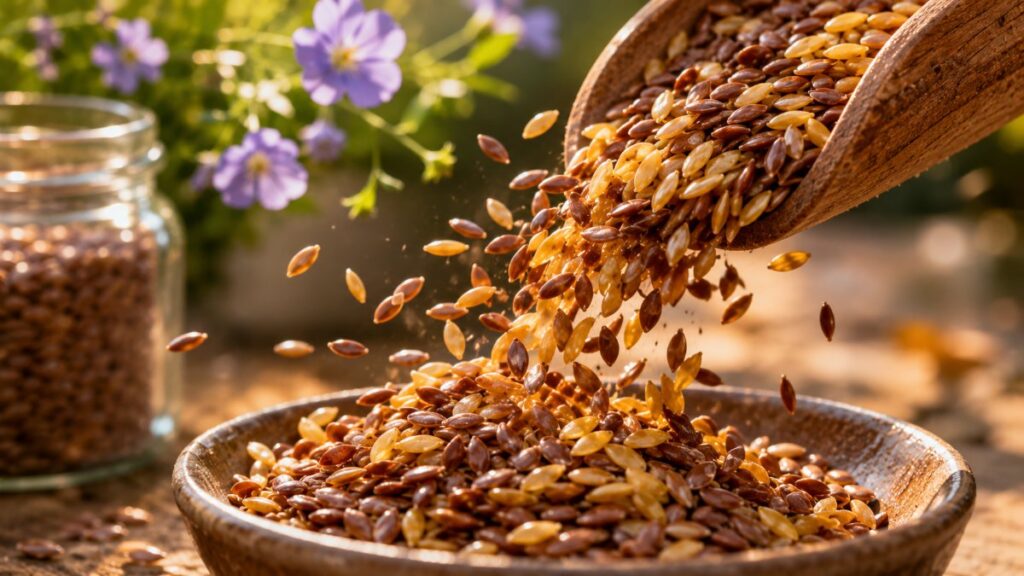
Flaxseed gives you three things in a small spoonful: ALA, a plant omega-3 fat, fibre and lignans. One tablespoon of ground flaxseed (7 g) has about 1.6 g of ALA and 1.9 g of fibre (USDA data), and flaxseed is by far the richest food source of lignans. A 2023 meta-analysis of 33 trials found modest drops in blood pressure, about 3 mmHg systolic and 2.6 mmHg diastolic. Eat it ground and mixed into food, and keep raw ground flaxseed to about 15-20 g (2-3 level tablespoons) a day, as Germany’s Federal Institute for Risk Assessment advises.
This guide is for you if there is a bag of linseed in your cupboard and you are not sure whether to grind it, soak it or bake with it. You will find the real numbers per tablespoon, what the research shows and does not show, the honest story about cyanide in raw flaxseed, the Ayurvedic view, an easy breakfast and who should be careful.
What nutrients are in flaxseed?
Flaxseed and linseed are the same seed, Linum usitatissimum. The table shows USDA values per 100 g and per tablespoon. Notice that a tablespoon of ground flaxseed weighs less than a tablespoon of whole seeds, because the powder is fluffier.
| Nutrient | Per 100 g | 1 tbsp ground (7 g) | 1 tbsp whole (10.3 g) |
|---|---|---|---|
| Energy | 534 kcal | 37 kcal | 55 kcal |
| Protein | 18.3 g | 1.3 g | 1.9 g |
| Fat, total | 42.2 g | 3.0 g | 4.3 g |
| ALA omega-3 (18:3 n-3) | 22.8 g | 1.6 g | 2.3 g |
| Carbohydrate | 28.9 g | 2.0 g | 3.0 g |
| Fibre | 27.3 g | 1.9 g | 2.8 g |
| Magnesium | 392 mg | 27 mg | 40 mg |
| Potassium | 813 mg | 57 mg | 84 mg |
| Calcium | 255 mg | 18 mg | 26 mg |
| Thiamin (vitamin B1) | 1.64 mg | 0.11 mg | 0.17 mg |
| Lignans, total | about 300 mg | about 21 mg | about 31 mg |
Source: USDA FoodData Central, SR Legacy, “Seeds, flaxseed” (FDC ID 169414), including its tablespoon weights; lignans from the Linus Pauling Institute (85.5 mg per 1 oz of flaxseed). Per-tablespoon and per-100 g lignan values are our calculation, rounded.
Almost all of the carbohydrate is fibre: 27.3 g of 28.9 g. That leaves very little digestible carbohydrate to raise blood sugar, so the glycemic index of flax seeds matters far less than for grains or fruit.
What are the health benefits of flaxseed?
Does flaxseed lower blood pressure?
This is the best-studied benefit. A 2023 systematic review and dose-response meta-analysis by Li and colleagues pooled 33 trials with 2,427 participants. Flaxseed lowered systolic blood pressure by 3.19 mmHg and diastolic by 2.61 mmHg on average. Effects were larger in trials lasting more than 20 weeks, with 30 g a day or more, in people with a BMI of 25-30 and in people with hypertension.
Two caveats keep this in proportion. The trials varied a lot (heterogeneity above 90%), and the authors framed flaxseed as a supplement alongside routine medication, not a replacement. A DASH-style pattern of eating, described in our DASH diet entry, does more than any single seed.
Is flaxseed good for cholesterol and the heart?
Less clear. The Linus Pauling Institute notes that flaxseed trials on LDL cholesterol have given inconsistent results. Diets rich in lignan-containing foods are linked with lower cardiovascular risk, but those foods bring many other nutrients too, so lignans alone cannot take the credit. Flaxseed fits well into an eating pattern built on high-quality fats.
Are flax seeds good for gut health?
Flaxseed has been used as a laxative since ancient Greece, NCCIH notes. Its fibre adds bulk, and soaked seeds form a soft gel. The Linus Pauling Institute reports that 45-50 g a day can increase stool frequency or cause diarrhoea in adults, which tells you two things: it works on the bowel, and more is not better. For a wider view, see our guides to gut health foods and natural remedies for digestion.
Is flaxseed anti-inflammatory, and does it help weight loss?
Flaxseed is often sold as anti-inflammatory, but the sources we reviewed do not establish that, so treat it as unproven. On weight, NCCIH reports that one trial suggests flaxseed mucilage powder might support weight loss in adults with overweight, while flaxseed lignan extract and flaxseed oil do not seem to help.

Ground or whole flaxseed: which is better?
Ground, for nutrition. The Linus Pauling Institute notes that crushing or milling flaxseed improves lignan bioavailability. Whole seeds have a hard, shiny coat, and grinding breaks it open.
There is one trade-off. Germany’s Federal Institute for Risk Assessment (BfR) explains that hydrocyanic acid is released when the seeds are chewed, ground or crushed, because enzymes in the seed act on its natural cyanogenic glycosides. Swallowed whole, they do not release it in the same way. So grinding unlocks both the good and the less good, which is why the amount matters.
Is raw flaxseed safe? Cyanogenic glycosides and the EFSA view
In 2019 the European Food Safety Authority (EFSA) updated its opinion on cyanogenic glycosides in foods. EFSA set an acute reference dose of 20 micrograms of cyanide per kilogram of body weight for a single occasion and concluded that exposure below it should not cause acute effects. The European Commission summarised the opinion when setting legal limits in 2022: exposure above that dose is possible with foods high in these compounds, such as linseed, almonds and cassava, and ground linseed raises exposure more than whole or heat-treated linseed.
Since 1 January 2023, linseed sold to consumers in the EU may contain at most 150 mg of hydrocyanic acid per kg. Batches above that can be sold only with the warning “Only to be used for cooking and baking. Do not consume raw!” If you see that line on a pack, follow it.
The BfR’s practical advice (2026) is clear:
- Adults: up to 15-20 g of raw ground flaxseed a day, about 2-3 level tablespoons, is considered safe. It also suggests no more than 20 g a day because of cadmium.
- Toddlers: better no raw ground flaxseed at all. For a 15 kg toddler, 6 g already uses up the acute reference dose.
- Children from four years: no more than about 4 g a day, one level teaspoon.
- Heat helps: baking and cooking let the gas escape and inactivate the enzymes that release it.
How much flaxseed should you eat per day?
For most adults, 1-2 tablespoons of ground flaxseed a day stays well inside the BfR’s 15-20 g guidance and adds about 1.6-3.2 g of ALA and 2-4 g of fibre. Higher amounts used in blood pressure trials (30 g or more) are best baked or cooked, and best discussed with your doctor if you take medication.
What does Ayurveda say about flaxseed?
In Ayurveda flaxseed is called atasi and appears in the Charaka Samhita in the group of pulses (shami dhanya), as a source of oil and in warm poultices. Its traditional profile: sweet and bitter in taste (rasa), heavy and unctuous (guru, snigdha), heating in potency (virya) and pungent after digestion (vipaka).
Heavy, oily and warming are the qualities that calm vata, the dry and airy dosha, so flaxseed fits naturally into a vata-balancing kitchen. If you tend to run hot, tradition would pair it with cooling foods and keep portions moderate. This is the traditional view, not scientific evidence.
How do you eat flaxseed? An easy flax and oat breakfast
Stir ground flaxseed into porridge, yogurt, smoothies, soups or bread dough, or use it in our no-bake energy balls with oats and dates. This overnight bowl takes three minutes at night.
Ingredients (1 serving)
- 40 g rolled oats
- 1 tablespoon ground flaxseed (7 g)
- 150 g plain yogurt or plant-based yogurt
- 80 ml milk or water
- 1 handful of berries or 1 grated apple
- 1 pinch of cinnamon
- 4 walnut halves, broken
Steps
- Mix the oats, flaxseed, yogurt, milk and cinnamon in a jar.
- Cover and refrigerate overnight, or at least 4 hours.
- In the morning, stir, add a splash of milk if it is too thick, and top with fruit and walnuts.
- Drink a glass of water with it, as with any fibre-rich breakfast.
Grind small batches in a coffee or spice grinder and keep them in a closed jar in the fridge. For more ideas, see our anti-inflammatory breakfast ideas.
Who should be careful with flaxseed?
- Pregnancy and breastfeeding. NCCIH says some studies suggest flaxseed may be unsafe in pregnancy, though the evidence is not conclusive, and little is known about breastfeeding. Ask your doctor or midwife first.
- Blood thinners. NCCIH names anticoagulant and antiplatelet drugs as a theoretical interaction. If you take one, talk to your doctor before eating flaxseed daily in large amounts.
- Other regular medication. Ask your pharmacist whether to space flaxseed apart from your tablets.
- Sensitive digestion. Higher doses can cause uncomfortable digestive symptoms. Start with one teaspoon and build up.
- Young children. Follow the BfR limits above.
Related reading: chia seeds benefits, prebiotic foods list, vegan diet basics.
FAQ
Chia seeds or flax seeds: which is better?
Per 100 g, USDA data give flaxseed more ALA (22.8 g vs 17.8 g) and chia more fibre (34.4 g vs 27.3 g). Chia works well whole once soaked, while flax is best ground. Pick the one you will eat regularly, or use both.
Does flaxseed oil have the same benefits?
Not quite. The oil is a concentrated source of ALA, but it has no fibre, and the Linus Pauling Institute notes that flaxseed oils do not typically provide lignans. NCCIH also reports that flaxseed oil supplements do not seem to help with weight loss.
Can you eat flaxseed every day?
Yes, for most healthy adults, in sensible amounts. The BfR considers up to 15-20 g of raw ground flaxseed a day safe for adults, which is about 2-3 level tablespoons. Baked or cooked flaxseed is of less concern for cyanide.
Should you soak flaxseed?
Soaking is optional. Ground flaxseed stirred into yogurt or porridge softens on its own. Whole seeds soaked overnight turn gel-like, but it is grinding, not soaking, that the Linus Pauling Institute links to better lignan uptake.
Sources
- U.S. Department of Agriculture, Agricultural Research Service. FoodData Central, SR Legacy: Seeds, flaxseed (FDC ID 169414) and Seeds, chia seeds, dried (FDC ID 170554), 2019. fdc.nal.usda.gov
- Linus Pauling Institute, Oregon State University. Lignans. Micronutrient Information Center, 2021. lpi.oregonstate.edu
- Li L, Li H, Gao Y, Vafaei S, Zhang X, Yang M. Effect of flaxseed supplementation on blood pressure: a systematic review, and dose-response meta-analysis of randomized clinical trials. Food & Function, 2023;(2):675-690. doi:10.1039/d2fo02566c. pubs.rsc.org
- EFSA Panel on Contaminants in the Food Chain (CONTAM). Evaluation of the health risks related to the presence of cyanogenic glycosides in foods other than raw apricot kernels. EFSA Journal, 2019. efsa.europa.eu; as summarised in Commission Regulation (EU) 2022/1364. eur-lex.europa.eu
- Bundesinstitut für Risikobewertung (BfR). Blausäure und Cadmium in Leinsamen. Mitteilung Nr. 034/2026, 2026. bfr.bund.de
- National Center for Complementary and Integrative Health (NCCIH). Flaxseed and Flaxseed Oil, 2025. nccih.nih.gov
This article is for information only and is not medical advice. If you have a health condition, are pregnant or take medication, talk to your doctor or pharmacist before changing your diet or starting a supplement.


 English
 Deutsch
 Español
 Français

