
← EncyclopediaEncyclopedia of food
By Nikola · Precision Nutrition L1 · Updated 5 November 2026
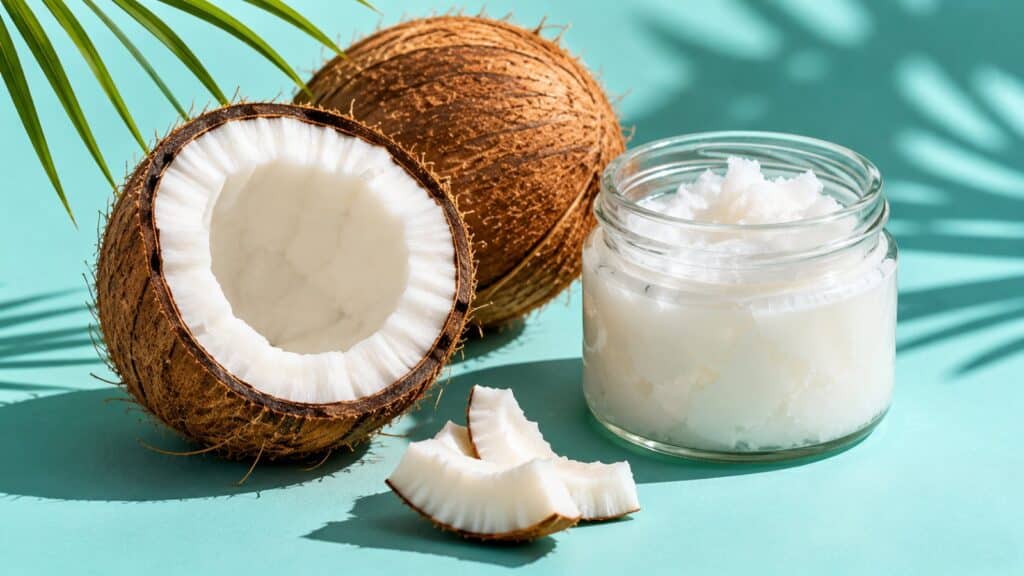
Coconut oil is the fat pressed from the flesh of the coconut, and it is the most saturated common cooking fat: 82.5 g of every 100 g is saturated fat, more than in butter. One tablespoon (13.6 g) gives 121 kcal and 11 g of saturated fat, about half of what WHO’s limit allows on a 2,000 kcal diet. It is useful for taste and for some dishes, but WHO lists it with butter, ghee, lard and palm oil as a fat to limit, not as a health food.
Coconut oil nutrition per 100 g and per spoon
| Nutrient | Coconut oil, 100 g | 1 tablespoon (13.6 g) | 1 teaspoon (4.5 g) |
|---|---|---|---|
| Energy | 892 kcal | 121 kcal | 40 kcal |
| Fat | 99.1 g | 13.5 g | 4.5 g |
| of which saturated | 82.5 g | 11.2 g | 3.7 g |
| of which monounsaturated | 6.3 g | 0.9 g | 0.3 g |
| of which polyunsaturated | 1.7 g | 0.2 g | 0.1 g |
| Cholesterol | 0 mg | 0 mg | 0 mg |
| Protein, carbohydrate, fibre | 0 g | 0 g | 0 g |
| Vitamin E | 0.11 mg | 0.01 mg | 0 mg |
| Vitamin K | 0.6 µg | 0.1 µg | 0 µg |
Source: USDA FoodData Central, SR Legacy, “Oil, coconut” (FDC 171412), checked 5 November 2026. The spoon weights are USDA portions; the per-spoon values are calculated. The record does not say whether the oil is virgin or refined, and it does not break down the individual saturated fatty acids, so this entry gives no figure for lauric acid or for “MCTs”.
To put the saturated fat in context with figures from the same database: salted butter has 51.4 g of saturated fat per 100 g, coconut oil 82.5 g. Coconut oil has no cholesterol because it is a plant fat, but that does not change its saturated fat content. Apart from fat and energy, it contains almost no vitamins or minerals.
Glycemic index
The glycemic index does not apply: coconut oil contains no carbohydrate and does not raise blood sugar by itself.
Health benefits: what the evidence says
- What WHO says. WHO advises that no more than 10% of total energy should come from saturated fat, for adults and children from age 2. Its 2023 guideline on fats names “hard fats and oils such as butter, ghee, lard, palm oil and coconut oil” as sources of saturated fat, and recommends replacing them with polyunsaturated or monounsaturated fats from plant sources, or with carbohydrate from fibre-rich foods. On a 2,000 kcal diet, 10% is about 22 g of saturated fat a day; one tablespoon of coconut oil supplies 11 g.
- What EFSA says. In its reference values for fats, EFSA states that saturated fat intake should be as low as possible within a nutritionally adequate diet. In the EU the authorised health claim is about replacing saturated fats with unsaturated fats to maintain normal blood cholesterol (Regulation (EU) No 432/2012). Coconut oil, being mostly saturated, is the fat this claim is about replacing, not the replacement.
- The popular claims. Coconut oil is often marketed for weight loss, “boosting metabolism” or heart health, usually because of its medium-chain fatty acids. I could not open a source from the official bodies or reviews used for this encyclopedia that supports these claims for ordinary coconut oil, so they are not repeated here. Note also that “MCT oil” sold separately is a different product from coconut oil in a jar.
- Where it fits. None of this makes coconut oil dangerous in small amounts. It has a clear place in cooking where its flavour or texture matters, as one fat among several, while plant oils such as olive oil stay the everyday choice.
How to eat it
- Virgin or refined: virgin coconut oil tastes and smells of coconut; refined oil is neutral. Choose by flavour; the fat profile in the USDA record applies to coconut oil in general.
- Solid or liquid: coconut oil is solid at cool room temperature and melts on a warm day. Both are normal and do not mean the oil has gone off.
- Measure it: one teaspoon (4.5 g, 40 kcal) is often enough to fry spices or an onion for a curry. Scooping from the jar without measuring makes it easy to use two or three tablespoons.
- Good uses: Thai and Indian curries, dal tempering, vegan baking where a solid fat is needed, and roasting sweet potato or pumpkin for a coconut note.
- Better choices for daily cooking: extra virgin olive oil for most frying and salads, and nuts such as walnuts for unsaturated fat in snacks.
- Storage: keep the jar closed, away from heat and light, and use a clean, dry spoon.
Who should be careful
- High LDL cholesterol or heart disease. If your doctor has advised you to reduce saturated fat, coconut oil should be limited in the same way as butter and lard, and replaced with plant oils high in unsaturated fat.
- Vegan and plant-based eaters. Coconut oil is plant-based, but plant-based does not mean low in saturated fat. In vegan baking and desserts it can quietly become the main fat of the day.
- Weight management. At 121 kcal per tablespoon it is as energy-dense as any oil.
- Coconut allergy. Coconut is not one of the 14 allergens in EU Regulation 1169/2011, Annex II, but individual allergy is possible. MedlinePlus lists symptoms such as hives, itching in the mouth and swelling of the lips or throat; swelling of the throat is an emergency.
Traditional view (Ayurveda)
In Usha and Vasant Lad’s food guidelines, coconut oil is listed for external use only for Vata and Pitta and is best avoided by Kapha. This is a traditional system, not evidence from clinical studies.
Related entries and articles
- Butter – the other common hard fat
- Ghee – clarified butter, also high in saturated fat
- Extra virgin olive oil – the everyday plant oil
- High-quality fats
- Walnuts – a whole-food source of unsaturated fat
- All about high-quality fats
FAQ
Is coconut oil healthy?
It is not a health food. Coconut oil is 82.5% saturated fat (USDA), and WHO lists it among the fats to limit, with butter and palm oil. In small amounts as one of several fats it is fine; as your main cooking fat it makes it hard to stay within WHO’s saturated fat limit.
Is coconut oil better than butter?
Not for saturated fat: per 100 g, coconut oil has 82.5 g and salted butter 51.4 g. Coconut oil has no cholesterol and suits vegan cooking, while butter contains vitamin A. For everyday cooking, a plant oil high in unsaturated fat, such as olive oil, is the choice that fits WHO and EFSA advice.
How much coconut oil per day is OK?
There is no official amount for coconut oil itself. WHO’s limit for all saturated fat is about 22 g a day on a 2,000 kcal diet, and one tablespoon of coconut oil already gives 11 g. Using it by the teaspoon, not the tablespoon, leaves room for the rest of your diet.
Sources
- USDA FoodData Central, SR Legacy: Oil, coconut (FDC 171412). fdc.nal.usda.gov
- USDA FoodData Central, SR Legacy: Butter, salted (FDC 173410), for comparison. fdc.nal.usda.gov
- World Health Organization: WHO updates guidelines on fats and carbohydrates (2023). who.int
- World Health Organization: Healthy diet, fact sheet. who.int
- EFSA Panel on Dietetic Products, Nutrition and Allergies (2010). Scientific Opinion on Dietary Reference Values for fats. EFSA Journal 8(3):1461. efsa.europa.eu
- Regulation (EU) No 432/2012, Annex: list of permitted health claims (replacing saturated fats). legislation.gov.uk
- Regulation (EU) No 1169/2011, Annex II: substances or products causing allergies or intolerances. legislation.gov.uk
- MedlinePlus: Food allergy. medlineplus.gov
- Lad U, Lad V. Food Guidelines for Basic Constitutional Types, from Ayurvedic Cooking for Self-Healing, 2nd ed. The Ayurvedic Institute. ayurveda.com
This page is for information only and is not medical or dietary advice.
Encyclopedia of food
Butter Ghee Extra Virgin Olive Oil High-quality fats Walnuts Butter
Статии по темата
- Kapha Diet: Foods That Balance Kapha Dosha
- Pitta Diet: Foods to Cool and Balance Pitta Dosha
- Kitchari: Ayurvedic Recipe and Benefits
- Golden Milk: Recipe and Benefits
- Healthy Desserts Without Sugar
- Is Coconut Oil Healthy?
- What Foods Should You Eat on the Zone Diet?
- The Low Carb Lifestyle: A Guide to Nourishing Your Body and Achieving Weight Loss
 English
 Deutsch
 Español
 Français

