
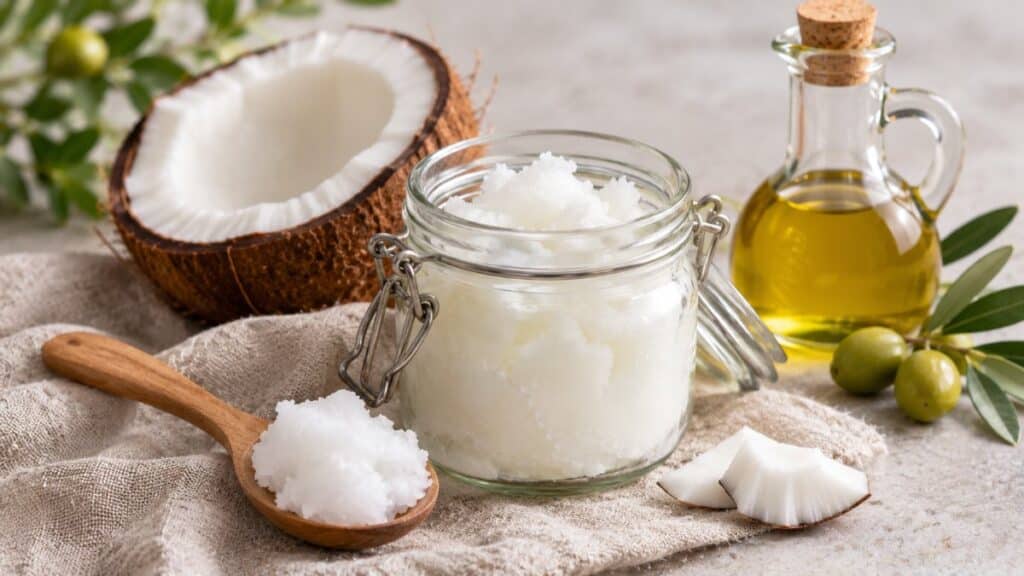
Coconut oil is not a health food, but a little now and then is fine for most people. It contains about 82.5 g of saturated fat per 100 g, or roughly 11 g in a single tablespoon, and a 2020 meta-analysis of 16 clinical trials found it raised LDL (“bad”) cholesterol by about 10 mg/dL compared with non-tropical vegetable oils. For everyday cooking, olive oil is the better default.
Few foods have swung so fast from “wonder fat” to “pure poison” in the headlines. If you like the taste of coconut oil in a curry or a batch of granola, you don’t have to throw the jar away. But if you started using it because someone told you it protects your heart or melts belly fat, the evidence points the other way. Below you’ll find the actual numbers, what the trials show, why the MCT story is mostly about a different oil, whether virgin or refined coconut oil is better for cooking, how coconut oil compares with olive oil, butter and ghee, and how Ayurveda sees it.
What is coconut oil made of?
Coconut oil is almost pure fat: USDA FoodData Central lists 99.1 g of fat per 100 g, with no cholesterol, no fiber and no protein worth mentioning. What makes it unusual is the type of fat. Of those 99.1 g, 82.5 g are saturated, only 6.3 g are monounsaturated and 1.7 g are polyunsaturated. That makes it more saturated than butter, lard or beef fat.
The single biggest fatty acid is lauric acid (C12), at 41.8 g per 100 g. Then come myristic acid (16.7 g) and palmitic acid (8.6 g), two saturated fats with a well-known LDL-raising effect. The shorter caprylic (C8) and capric (C10) acids together add up to about 12 g.
How much saturated fat is in a tablespoon of coconut oil?
A level tablespoon weighs 13.6 g and gives you about 121 kcal and 11.2 g of saturated fat. For people who need to lower their LDL, the American Heart Association suggests keeping saturated fat to 5-6% of daily calories. Harvard’s Nutrition Source translates the 6% figure into about 13 g on a 2,000-calorie day. One generous spoonful in your morning coffee nearly uses it up.
Does coconut oil raise LDL cholesterol?
Yes, compared with most other cooking oils. The clearest answer comes from a systematic review and meta-analysis by Neelakantan, Seah and van Dam, published in Circulation in 2020. They pooled 16 clinical trials that ran for at least two weeks and compared coconut oil with other fats.
- Against non-tropical vegetable oils (such as olive, sunflower or rapeseed), coconut oil raised LDL cholesterol by 10.47 mg/dL on average.
- It also raised HDL (“good”) cholesterol by about 4 mg/dL.
- It had no significant effect on body weight, blood sugar or C-reactive protein, a marker of inflammation.
The rise in HDL is often quoted as a plus. It is a weak argument: LDL is the number that drives cardiovascular risk, and the authors concluded that coconut oil should not be viewed as heart-healthy. Earlier, in 2017, the American Heart Association’s presidential advisory on dietary fats (Sacks and colleagues) reached the same verdict. It noted that about 82% of the fatty acids in coconut oil are saturated, and advised against using it because it raises LDL and has no known offsetting benefits. The same advisory reported that in randomized trials, replacing saturated fat with polyunsaturated vegetable oil cut cardiovascular events by about 30%.
Is coconut oil worse than butter?
Not clearly. In the short trials summarized by Harvard’s Nutrition Source, coconut oil did not raise cholesterol more than butter did, and it acted much like beef fat and palm oil. So the fair comparison is this: coconut oil belongs on the same shelf as butter, a fat to enjoy in small amounts, not the shelf with olive oil.
Is MCT oil the same as coconut oil?
This is where most of the confusion starts. Many of the studies on weight, satiety and energy used a specially made oil that is 100% medium-chain triglycerides (MCTs). A bottle labelled MCT oil (sometimes sold as “MCT coconut oil”) is that kind of product; the jar of coconut oil in the supermarket is not. Its main fat, lauric acid, is the longest of the medium-chain group, and Harvard’s Nutrition Source notes that the body absorbs and handles it more like a long-chain fat. The shorter C8 and C10 fats that behave most like “true” MCTs make up only about 12 g of every 100 g.
So results from MCT oil trials don’t transfer to the jar in your kitchen. If you follow a ketogenic diet and want MCTs, coconut oil is a poor substitute for the real thing, and it still carries the full saturated fat load.
Coconut oil vs olive oil, butter and ghee: how do they compare?
Here is what one tablespoon of each fat gives you (tablespoons of different fats weigh slightly differently).
| Per 1 tablespoon | Weight | Calories | Saturated fat | Monounsaturated fat | Polyunsaturated fat | Cholesterol |
|---|---|---|---|---|---|---|
| Coconut oil | 13.6 g | 121 kcal | 11.2 g | 0.9 g | 0.2 g | 0 mg |
| Olive oil | 13.5 g | 119 kcal | 1.9 g | 9.9 g | 1.4 g | 0 mg |
| Butter, salted | 14.2 g | 102 kcal | 7.3 g | 3.0 g | 0.4 g | 31 mg |
| Ghee (anhydrous butter oil) | 12.8 g | 112 kcal | 7.9 g | 3.7 g | 0.5 g | 33 mg |
Source: USDA FoodData Central, SR Legacy (Oil, coconut, FDC 171412; Oil, olive, salad or cooking, FDC 171413; Butter, salted, FDC 173410; Butter oil, anhydrous, FDC 173412). Per-tablespoon values calculated from the per-100 g data.
Coconut oil has about six times the saturated fat of olive oil, and more than butter or ghee. Olive oil, by contrast, is mostly monounsaturated fat, the backbone of the Mediterranean diet. Our entry on high-quality fats and the older post all about high-quality fats explain which fats to lean on. For a closer look at the dairy fats, see the salted butter entry and our new guide to ghee and how to use it.
What does Ayurveda say about coconut oil?
In the Ayurvedic tradition, coconut (narikela) and its oil (narikela taila) are described as sweet in taste (madhura rasa), heavy and unctuous, and cooling in potency (sita virya). Classical texts, as summarized in a 2022 review by K.B. Bibin, describe the oil as calming to Vata and Pitta. On Kapha the sources disagree: some call it Kapha-reducing, others say it increases Kapha.
That is why it is traditionally linked with hot weather and Pitta, and it has a long history as a hair and skin oil. If you are new to these ideas, our Ayurvedic diet for beginners explains the doshas and tastes in plain terms. Keep in mind that this is a traditional framework, not scientific evidence, and it does not cancel out the LDL data above.
How should you use coconut oil for cooking?
Think of coconut oil as a flavour, not a health habit. Pick unrefined (virgin) coconut oil when you want the coconut taste, refined coconut oil when you want a neutral one. Use it where its taste matters, such as a Thai-style curry, a tray of roasted squash or a batch of granola, and keep olive oil for daily cooking and dressings. When you swap it for butter in baking, Harvard’s Nutrition Source suggests using about 25% less. A pot of golden milk made with coconut milk is another way to enjoy the flavour without spooning in the oil.
Recipe: roasted pumpkin with coconut oil and cumin (serves 4)
One tablespoon of coconut oil shared between four plates comes to about 2.8 g of saturated fat per serving.
- 800 g pumpkin or butternut squash, peeled and cut into 3 cm cubes
- 1 tablespoon virgin coconut oil, melted
- 1 teaspoon cumin seeds
- Half a teaspoon ground turmeric
- A pinch of chili flakes and a pinch of salt
- A handful of fresh coriander and a squeeze of lime to serve
- Heat the oven to 170 °C (fan). This stays below the roughly 175 °C (350 °F) smoke point Harvard gives for virgin coconut oil.
- Toss the pumpkin with the melted coconut oil, cumin seeds, turmeric, chili and salt on a lined tray.
- Roast for 30-35 minutes, turning once, until the edges are golden and a fork slides in easily.
- Finish with chopped coriander and lime juice. Serve with lentils or rice.
Who should be careful with coconut oil?
- People with high LDL cholesterol or heart disease. The AHA advises keeping saturated fat to 5-6% of calories and recommends against coconut oil. Replace it with olive or rapeseed oil, not with white bread and sweets: Harvard’s Nutrition Source notes that swapping saturated fat for refined carbohydrates does little for your heart.
- Anyone counting calories. At about 121 kcal per tablespoon, it is as energy-dense as any oil, and the 2020 meta-analysis found no effect on body weight.
- Buyers of processed foods. Partially hydrogenated coconut oil contains trans fats, which Harvard’s Nutrition Source advises avoiding completely. Check ingredient lists on biscuits and non-dairy creamers.
- High-heat cooks. Virgin coconut oil starts to smoke at about 175 °C (350 °F); refined coconut oil copes with roughly 205-230 °C (400-450 °F).
For more foods that look healthier than they are, see our older post on “healthy” foods that are actually unhealthy.
FAQ
Is coconut oil bad for your heart?
Regular, generous use is not a good idea for heart health. Coconut oil raises LDL cholesterol more than non-tropical vegetable oils, by about 10 mg/dL in a 2020 meta-analysis, and the American Heart Association advises against it. A teaspoon now and then in an otherwise balanced diet is unlikely to matter much.
Is virgin coconut oil healthier than refined coconut oil?
Virgin, or unrefined, coconut oil (often labelled cold pressed) keeps more of the coconut flavour and aroma, but both types are mostly saturated fat. There is no strong evidence that the virgin version protects your heart. Refined coconut oil tolerates higher heat.
Does coconut oil help you lose weight?
The evidence says no. In the 2020 meta-analysis of 16 trials, coconut oil had no significant effect on body weight, waist size or body fat compared with other vegetable oils. At about 121 kcal per tablespoon, it adds calories like any other fat.
Is coconut oil better than butter for cooking?
Not for your cholesterol. Short trials found coconut oil raised cholesterol about as much as butter, and it contains more saturated fat per tablespoon. Choose either by taste and use both sparingly; olive oil is the better everyday option.
Sources
- U.S. Department of Agriculture, Agricultural Research Service. FoodData Central, SR Legacy: Oil, coconut (FDC 171412); Oil, olive (FDC 171413); Butter, salted (FDC 173410); Butter oil, anhydrous (FDC 173412). Coconut oil, Olive oil, Butter, Butter oil
- Neelakantan N, Seah JYH, van Dam RM. The Effect of Coconut Oil Consumption on Cardiovascular Risk Factors: A Systematic Review and Meta-Analysis of Clinical Trials. Circulation, 2020;141(10):803-814. PubMed 31928080
- Sacks FM, Lichtenstein AH, Wu JHY, et al.; American Heart Association. Dietary Fats and Cardiovascular Disease: A Presidential Advisory From the American Heart Association. Circulation, 2017. AHA: Top things to know
- Harvard T.H. Chan School of Public Health. Coconut Oil. The Nutrition Source. nutritionsource.hsph.harvard.edu
- Harvard T.H. Chan School of Public Health. Types of Fat. The Nutrition Source. nutritionsource.hsph.harvard.edu
- Bibin KB. A review on Narikela Thaila and Narikela regarding its use and properties. Journal of Ayurveda and Integrated Medical Sciences, 2022;7(2):107-112. jaims.in
This article is for information only and is not medical advice. If you have a health condition, are pregnant or take medication, talk to your doctor or pharmacist before changing your diet or starting a supplement.


 English
 Deutsch
 Español
 Français

