
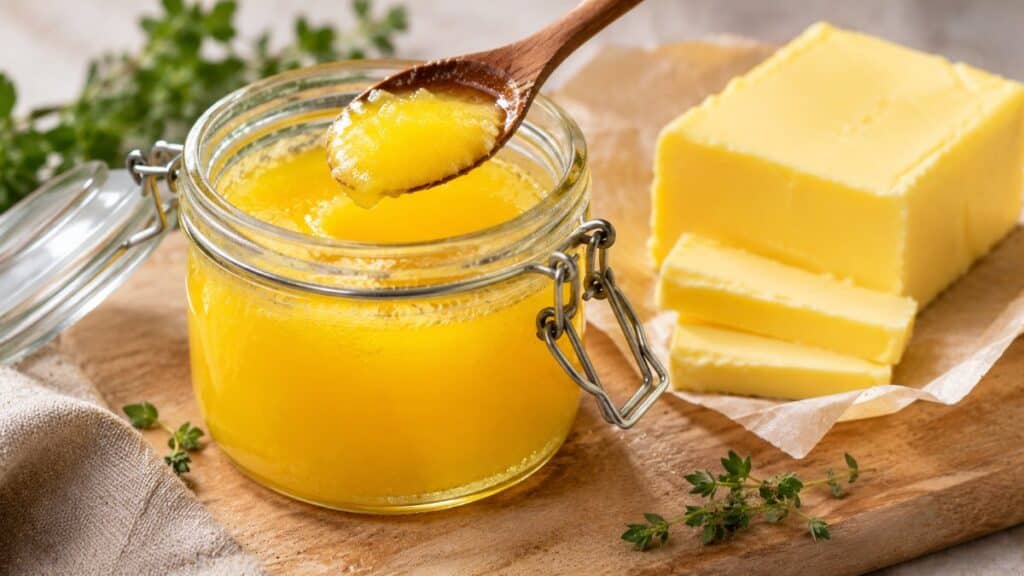
Ghee is butter that has been gently simmered until its water evaporates and its milk solids are strained out, leaving almost pure butterfat. One tablespoon gives about 112 kcal and 7.9 g of saturated fat, so it is not lighter than butter, but it handles high heat well and contains only traces of lactose and milk protein. In Ayurveda it is one of the most valued foods; in modern nutrition it is a flavourful fat best used in small amounts.
Stir a spoonful of ghee into hot rice and you’ll smell why people love it: toasted nuts and caramel. This guide is for anyone curious about ghee, whether you cook Indian food, follow Ayurveda or are wondering whether ghee butter is really the “healthier butter” some labels suggest. You’ll find the nutrition numbers, what the research does and doesn’t show, the Ayurvedic view, a simple way to make ghee at home, and how to use and store it.
What is ghee and how is it different from butter?
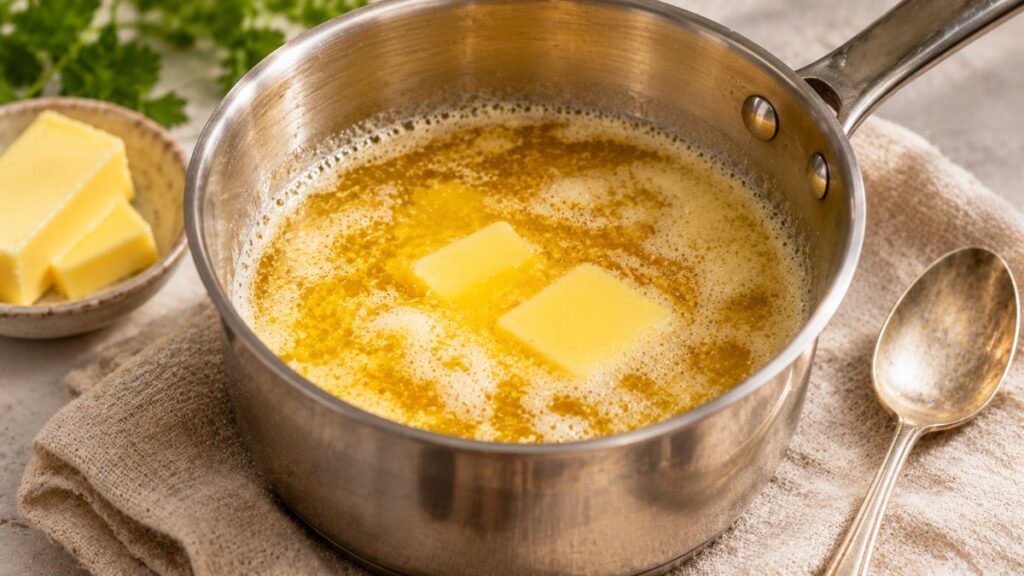
Butter is about 81% fat, 16% water and a small amount of milk protein and sugar. When you heat it slowly, the water boils off and the proteins and milk sugar separate out as solids. Strain those away and what remains is ghee: according to USDA FoodData Central, 99.5 g of fat per 100 g, with almost no water, protein or sugar.
In the traditional Ayurvedic method described in a 2024 review in the Journal of Ayurveda and Integrative Medicine (Kataria and Singh), milk is first fermented into curd, the curd is churned into butter, and that butter is then heated until the water is gone. A second method churns butter straight from cream, without fermentation. In India, real dairy ghee is often called desi ghee, to set it apart from vegetable fats. Plain clarified butter is close to ghee; ghee is usually cooked a little longer, until the solids turn golden and give it its nutty taste.
What nutrients are in a tablespoon of ghee?
With the water gone, ghee is more concentrated than butter:
| Per 1 tablespoon | Ghee (12.8 g) | Butter, salted (14.2 g) |
|---|---|---|
| Calories | 112 kcal | 102 kcal |
| Total fat | 12.7 g | 11.5 g |
| Saturated fat | 7.9 g | 7.3 g |
| Monounsaturated fat | 3.7 g | 3.0 g |
| Polyunsaturated fat | 0.5 g | 0.4 g |
| Cholesterol | 33 mg | 31 mg |
| Vitamin A (RAE) | 108 µg | 97 µg |
| Protein | 0.04 g | 0.12 g |
| Water | 0.03 g | 2.3 g |
Source: USDA FoodData Central, SR Legacy (Butter oil, anhydrous, FDC 173412; Butter, salted, FDC 173410). Per-tablespoon values calculated from the per-100 g data.
So spoon for spoon, ghee has slightly more fat, saturated fat and calories than butter, plus a little more vitamin A. About 62% of its fat is saturated. Labels such as grass fed ghee or organic ghee describe how the cows were raised; the USDA figures are for standard butter oil. For a closer look at the original, see our salted butter entry.
Is ghee lactose-free and casein-free?
Almost. USDA lists 0 g of sugars (lactose is milk’s sugar) and 0.28 g of protein per 100 g of anhydrous butter oil, so a tablespoon carries only a trace of milk protein, which is mostly casein. With so little milk sugar left, ghee is unlikely to bother most people with lactose intolerance. “Trace” is not “zero”, though. If you have a diagnosed cow’s milk protein allergy, don’t assume ghee is safe; ask your allergist first.
What is the smoke point of ghee?
The Kataria and Singh review puts it at about 250 °C, higher than most edible oils, citing earlier studies. Exact figures vary with how the ghee is made. You can see why in your own pan: the milk solids that brown and burn in hot butter have been strained out of ghee, so it can take the heat of frying spices or searing vegetables. (For comparison with another popular “high-heat” fat, see our guide Is coconut oil healthy?)
Does ghee raise cholesterol?
The honest answer is: it can, and the human evidence is thin. Ghee is mainly saturated fat, and the American Heart Association’s 2017 advisory on dietary fats (Sacks and colleagues) recommends limiting saturated fat, to 5-6% of calories for people with raised LDL cholesterol. The same advisory found that replacing saturated fat with polyunsaturated vegetable oils lowered cardiovascular events by about 30% in randomized trials. Harvard’s Nutrition Source adds that the swap matters: trading saturated fat for refined carbohydrates does little for your heart.
Research on ghee itself is mixed. The 2024 review by Kataria and Singh describes the findings as conflicting: some studies, many of them in animals, show a drop in LDL at modest intakes, while others feeding ghee at 10% of energy show rises in triglycerides, LDL and total cholesterol. A 2010 rat study by Sharma and colleagues found that a diet with 10% ghee raised triglycerides but did not change total cholesterol over four weeks. Observational studies from rural India linked higher ghee intake with less heart disease, but those studies cannot separate ghee from everything else in people’s lives. The 2024 review calls for larger, longer human trials.
The sensible reading: treat ghee like butter. Enjoy it, but keep most of your daily fat from olive oil, nuts and seeds, the kind of pattern described in our entries on high-quality fats and the Mediterranean diet, and in the older post all about high-quality fats.
What does Ayurveda say about ghee?
Few foods hold a higher place in Ayurveda. Ghee (ghrita) is listed in the classical text Charaka Samhita among the foods recommended for daily use, and Ayurvedic writing describes some 55-60 medicated ghees, each one ghee cooked with specific herbs. The traditional picture, from the two reviews in our Sources:
- Taste and energy. Cow ghee is described as sweet in taste (madhura rasa), heavy (guru), cooling in potency (sita virya) and sweet after digestion (madhura vipaka).
- Doshas. Ghee is said to calm Vata and Pitta. Sources differ on Kapha: one review calls it acceptable for Kapha in moderation, another lists cow ghee as balancing all three doshas. Either way, the traditional advice for a Kapha-dominant person is moderation.
- Agni, the digestive fire. Ghee is traditionally said to kindle agni and help the body absorb food.
- A carrier for herbs. Ghee is valued as an anupana, a vehicle that carries herbs and spices deeper into the tissues, which is why turmeric is so often cooked in it.
- Aged ghee. Old ghee (purana ghrita) is especially prized in classical texts.
Ayurvedic texts also credit ghee with supporting memory and intellect. The review by Kataria and Singh notes that modern studies on these claims are not conclusive. Read this as tradition, not scientific proof. If you want to bring these ideas into your own kitchen, start with our Ayurvedic diet for beginners. For the turmeric connection, see the turmeric entry, our guide on how to take turmeric for best absorption and our golden milk recipe, which works beautifully with half a teaspoon of ghee.
How do you make ghee at home?
You need one ingredient and about half an hour. Good unsalted butter makes good ghee.
- 500 g unsalted butter
- A heavy-bottomed saucepan
- A fine sieve lined with muslin, a clean thin cotton cloth or a coffee filter
- A clean, completely dry glass jar
- Cut the butter into cubes and melt it in the saucepan over low heat.
- Let it simmer gently, uncovered. It will foam and crackle as the water evaporates. Don’t stir much; skim off the top foam if you like.
- After roughly 15-25 minutes the crackling quietens, the liquid turns clear and golden, and pale solids settle on the bottom. Watch closely now.
- When the solids turn light golden brown and the kitchen smells of toasted nuts, take the pan off the heat. Dark brown solids mean it has gone too far and will taste bitter.
- Let it cool for 5 minutes, then pour it slowly through the lined sieve into the jar, leaving the solids behind.
- Leave the jar open until the ghee is at room temperature, then close it. Since butter is about 81% fat, 500 g gives you roughly 400 g of ghee.
How do you use and store ghee?
Use ghee where its flavour shines and its heat tolerance helps:
- Toast cumin, mustard seeds and curry leaves in a teaspoon of ghee and pour over dal (a tadka).
- Roast vegetables or sear mushrooms in a thin film of it.
- Stir half a teaspoon into kitchari, rice or porridge.
For storage, keep ghee in a clean, airtight jar away from heat and light. Always use a dry spoon: water or crumbs are what spoil it. A cool cupboard is fine for a jar you use regularly; the fridge keeps it longer, and it firms up there. If it smells sour or sharp, throw it out.
Who should be careful with ghee?
- People with high LDL cholesterol or heart disease. Ghee counts toward your saturated fat limit just like butter. One teaspoon (about 4 g) carries roughly 2.6 g of saturated fat.
- Anyone with a milk protein allergy. Traces of milk protein remain. Check with your allergist.
- Anyone watching calories. At about 112 kcal per tablespoon, ghee adds up fast.
- Anyone cooking with vanaspati. This hydrogenated vegetable fat is used like ghee in South Asian cooking, and Sharma and colleagues note it can contain up to 40% trans fats. Real ghee lists only butter, cream or milk fat on the label.
FAQ
Is ghee healthier than butter?
Not in any major way. Ghee has slightly more saturated fat and calories per tablespoon, while butter has a bit more water and milk protein. Ghee’s real advantages are its heat tolerance, its rich flavour and its near absence of lactose.
Is ghee dairy-free?
No. Ghee is made from milk, so it is a dairy product, even though almost all of the lactose and protein is removed. It is not suitable for a vegan diet. Products sold as vegan ghee are made from plant oils, so check their fat profile on the label.
Does ghee need to be refrigerated?
Not necessarily. Well-made ghee in a clean, closed jar keeps in a cool cupboard, as long as you use a dry spoon. The fridge extends its life further.
How much ghee can you eat per day?
There is no official limit for ghee itself. Count it within your saturated fat budget: for most people, a teaspoon or two a day used for flavour fits comfortably. If your LDL is high, talk to your doctor before making it a daily habit.
Sources
- U.S. Department of Agriculture, Agricultural Research Service. FoodData Central, SR Legacy: Butter oil, anhydrous (FDC 173412); Butter, salted (FDC 173410). Butter oil, anhydrous, Butter, salted
- Kataria D, Singh G. Health benefits of ghee: Review of Ayurveda and modern science perspectives. Journal of Ayurveda and Integrative Medicine, 2024;15(1):100819. PMC10789628
- Sharma H, Zhang X, Dwivedi C. The effect of ghee (clarified butter) on serum lipid levels and microsomal lipid peroxidation. Ayu, 2010;31(2):134-140. PMC3215354
- Sacks FM, Lichtenstein AH, Wu JHY, et al.; American Heart Association. Dietary Fats and Cardiovascular Disease: A Presidential Advisory From the American Heart Association. Circulation, 2017. AHA: Top things to know
- Harvard T.H. Chan School of Public Health. Types of Fat. The Nutrition Source. nutritionsource.hsph.harvard.edu
This article is for information only and is not medical advice. If you have a health condition, are pregnant or take medication, talk to your doctor or pharmacist before changing your diet or starting a supplement.


 English
 Deutsch
 Español
 Français

