
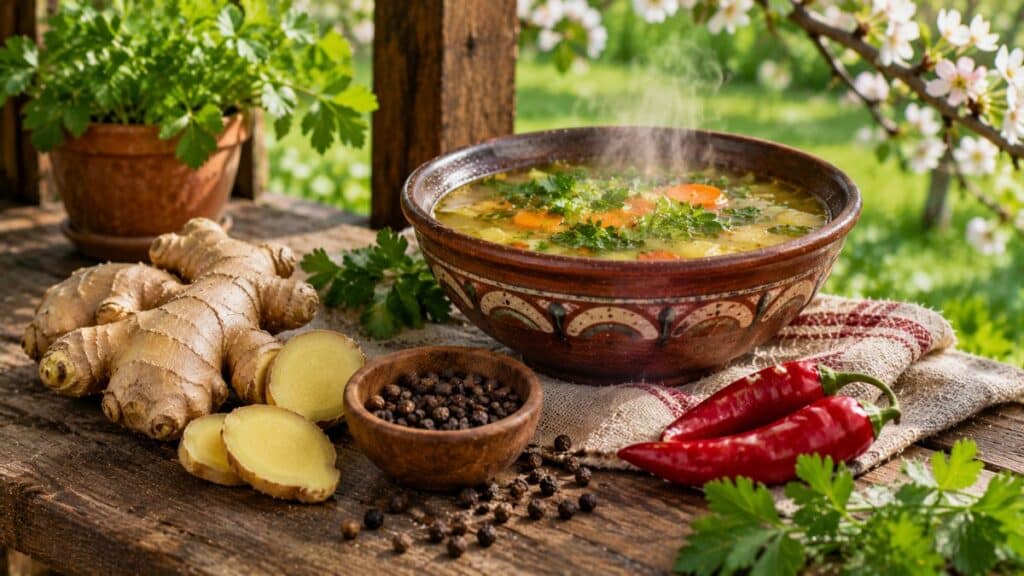
A kapha diet favours light, warm and dry foods with pungent, bitter and astringent tastes: lentils and beans, leafy and bitter greens, cabbage, coliflor, apples, pears, buckwheat, millet and barley, cooked with jengibre, black pepper, mustard seeds and cúrcuma. It cuts back on heavy, cold, oily and sweet foods, so less cheese, cream, sugar, fried food, white bread and large late dinners. These are traditional Ayurvedic rules, not proven science, but the plate they produce is high in fibre and low in added sugar, which matches mainstream advice.
This guide is for you if you lean towards Kapha, or you simply feel heavy and slow after meals and sluggish through grey, damp months. You will find a food table by taste and quality, a fibre table, a sample day, a warm buckwheat bowl recipe, seasonal notes and a frank look at where modern nutrition agrees.
What is kapha dosha, and what are the signs of excess kapha?
In Ayurveda, Kapha is the dosha of earth and water. It is said to give the body structure, stamina and lubrication, and its qualities are heavy, slow, cool, oily, smooth and stable. A typical kapha body type is solid and broad, with smooth skin, deep sleep, steady energy and a calm, loyal temperament. For the bigger picture, see our guide to the three Ayurveda doshas and how to recognise yours.
Balanced Kapha looks like endurance and calm. In excess, tradition says, the same qualities turn into heaviness: a slow, dull appetite, sleepiness after meals, a stuffy nose and mucus in damp weather, gaining weight easily, oversleeping and low motivation. Ayurveda’s fix follows the rule of opposites: heavy is balanced by light, cold by warm, oily by dry, slow by stimulating.
What foods balance kapha dosha? A table by taste and quality
Each taste (rasa) carries qualities in Ayurveda. Pungent, bitter and astringent tastes are light and drying and are said to reduce Kapha. Sweet, sour and salty tastes are heavy or moistening and increase it. Lists differ between teachers, so read this as the shared core.
| Food group | Favour (light, warm, dry: pungent, bitter, astringent) | Reduce (heavy, cold, oily: sweet, sour, salty) |
|---|---|---|
| Grains | Buckwheat, millet, barley, rye, maíz, toasted oats | Lots of wheat, white bread, pasta, pastries, large portions of rice |
| Verduras | Leafy and bitter greens, cabbage, cauliflower, brócoli, puerros, cebollas, rábano, apio, pimientos, espárragos, coles de Bruselas | Batata, pepino y calabacín in large amounts, palta, olives |
| Fruit | Apples, pears, pomegranate, berries, cranberries | Bananas, melons, coconut, dates, figs, fruit juice |
| legumbres | Red and brown lentils, mung beans, chickpeas, split guisantes, black beans | Large portions of tofu, rich creamy bean dishes |
| Lácteos | Small amounts of low-fat milk, thin buttermilk, a little ghee | Cheese, cream, ice cream, butter, yogurt at night |
| Oils, nuts and seeds | Small amounts of sunflower or aceite de oliva, calabaza and sunflower seeds | Most nuts in large portions, coconut oil, deep-fried food |
| Herbs and spices | Ginger, black pepper, mustard seeds, cumin, turmeric, cinnamon, cloves, ajo | Lots of salt |
| Sweeteners and drinks | Warm water, ginger tea, spiced herbal teas, a little raw honey | Sugar, syrups, sweet and iced drinks, beer |
Source: traditional Ayurvedic food guidance for Kapha, summarised by Nutriveda. These are traditional associations, not measured effects.
Look at the “favour” column and you will see a kitchen built on vegetables, legumes and whole grains. Alforfón is a classic kapha grain, coliflor and cabbage take spices well, and cúrcuma goes into almost every pot.
Which kapha foods are highest in fibre?
Kapha’s favourite foods happen to be some of the best fibre sources there are. Harvard’s Nutrition Source says adults need at least 25 to 35 grams of fibre a day, while most Americans get about 15 grams. A few servings from this table close the gap fast.
| Food (standard portion) | calorías | Fibre (g) |
|---|---|---|
| Split peas, cooked (1/2 cup) | 116 | 8.2 |
| Lentils, cooked (1/2 cup) | 115 | 7.8 |
| Mung beans, cooked (1/2 cup) | 106 | 7.7 |
| Chickpeas, cooked (1/2 cup) | 135 | 6.3 |
| Nettles, cooked (1 cup) | 37 | 6.1 |
| Pear (1 medium) | 103 | 5.5 |
| Broccoli, cooked (1 cup) | 54 | 5.2 |
| Cauliflower, cooked (1 cup) | 34 | 4.9 |
| Apple, with skin (1 medium) | 104 | 4.8 |
| col rizada, cooked (1 cup) | 43 | 4.7 |
| Pomegranate seeds (1/2 cup) | 72 | 3.5 |
| Barley, pearled, cooked (1/2 cup) | 97 | 3.0 |
Source: Dietary Guidelines for Americans, Food Sources of Dietary Fiber (USDA FoodData Central, 2019). Daily target: Harvard T.H. Chan School of Public Health.

Does modern nutrition agree with the kapha diet?
On the food itself, mostly yes. On the dosha logic, the evidence is thin. NCCIH notes there is little scientific evidence on Ayurveda for most health issues and that most trials are small or poorly designed. A 2014 review in the Journal of Ayurveda and Integrative Medicine proposed that prakriti types may be distinct phenotypes linked to genotypes, a hypothesis that still needs testing.
| Kapha rule | What mainstream sources say | Match |
|---|---|---|
| More legumes, vegetables and whole grains | Harvard: high fibre intake is linked to lower heart disease risk; soluble fibre may help curb hunger and blood sugar surges | Good |
| Less sugar and sweets | WHO: keep free sugars under 10 percent of energy, ideally under 5 percent (about 25 g, or 6 teaspoons, a day) | Good |
| Honey as the “best” sweetener | WHO counts sugars in honey and syrups as free sugars | Partial: still sugar |
| Cut back on dairy | Dietary Guidelines name calcium as a nutrient of public health concern | Conflict, unless you replace the calcium |
| An Ayurvedic weight programme | Pilot study, 17 adults: average loss of 5.9 kg six months after a 3-month programme of diet and yoga | Promising, too small to judge |
Sources: Harvard T.H. Chan School of Public Health, Fiber; WHO sugars guideline, 2015; Dietary Guidelines for Americans; Rioux et al., 2019; NCCIH; Dey and Pahwa, 2014 (full references below).
That pilot combined individual Ayurvedic diet advice with yoga three times a week, and 12 of the 17 participants completed follow-up. It shows the approach is feasible, not that the dosha element made the difference.
What does Ayurveda say about the kapha season?
In the traditional calendar, Kapha builds up in late winter and peaks in spring, when the world is cold, wet and heavy. That is when this diet matters most:
- Late winter: keep meals warm and well spiced, with soups, lentils, roasted roots in modest portions and plenty of ginger.
- Spring: lean on bitter greens such as nettles, dandelion and cohete, and make dinner the lightest meal of the day.
- Summer: a kapha type copes well with heat, so cooling foods are fine. If you lean Pitta-Kapha, take the cooling list from our pitta diet guide and keep portions light.
- Autumn: if you lean Vata-Kapha, wind and cold call for warm, moist meals, as in our vata diet guide, but with less oil and sugar.
What does a kapha diet look like for one day?
- On waking: a cup of warm water, or fresh ginger tea.
- Breakfast (light, or skip it if you are not hungry): a baked apple with cinnamon, or a small bowl of buckwheat porridge cooked in water with a few pumpkin seeds.
- Lunch (main meal): red lentil dal with black pepper and cumin, millet or barley, steamed broccoli and cabbage with mustard seeds, a handful of bitter leaves.
- Afternoon: a pear or an apple, and ginger tea.
- Dinner (early, before 7 pm): the buckwheat bowl below, or a vegetable soup.
- After dinner: a 10 to 15 minute walk.
A pot of kitchari with extra ginger and less ghee also suits a light kapha dinner. For the general habits behind the plan, start with our Ayurvedic diet for beginners.
Recipe: warm buckwheat bowl with roasted cauliflower and chickpeas (serves 2)
- 120 g buckwheat groats
- 240 ml water
- 1/2 small cauliflower (about 300 g), in small florets
- 240 g cooked chickpeas, drained
- 1 tablespoon sunflower or olive oil, divided
- 1/2 teaspoon ground turmeric
- 1/2 teaspoon freshly ground black pepper
- 1 teaspoon mustard seeds
- 1 teaspoon cumin seeds
- a thumb-sized piece of fresh ginger, grated
- 2 handfuls of rocket
- juice of 1/2 lemon and a pinch of salt
- Heat the oven to 220°C. Toss the cauliflower and chickpeas with half the oil, the turmeric, pepper and salt. Roast for 20 to 25 minutes, until browned at the edges.
- Rinse the buckwheat, toast it in a dry pan for 2 minutes, add the water, cover and simmer for 10 to 12 minutes. Rest for 5 minutes.
- Warm the rest of the oil in a small pan. Add the mustard and cumin seeds and cook until the mustard seeds pop, about 30 seconds. Stir in the ginger for 30 seconds more.
- Mix the buckwheat with the spiced oil, top with the roasted cauliflower and chickpeas and the rocket, and squeeze over the lemon. Eat warm.
Who should be careful with a kapha diet?
- Diabetes or blood sugar medication. Skipping breakfast or eating very light dinners can change how your medication works. Talk to your doctor first.
- Cutting dairy. If you drop most milk, cheese and yogurt, replace the calcium with other sources and check with a dietitian.
- More beans than usual. Increase legumes gradually and drink enough water if they give you gas or bloating.
- Ayurvedic weight-loss products. NCCIH warns that some Ayurvedic preparations contain lead, mercury or arsenic. Food and kitchen spices are the safer route.
- Restrictive eating. If food lists start to cause anxiety or guilt, drop them and keep only the core habits: lighter dinners, more vegetables and legumes, a daily walk.
- Pregnancy, children, medication. Talk to your doctor before major diet changes.
FAQ
What should kapha dosha eat for breakfast?
Something light and warm, or nothing if you are not hungry: a baked apple with cinnamon, a small bowl of buckwheat or millet porridge, or ginger tea. Tradition advises against heavy, sweet breakfasts like pastries or creamy yogurt bowls.
Is the kapha diet good for weight loss?
The food pattern, rich in vegetables and legumes and low in sugar, fits mainstream weight advice. Direct evidence is limited to small studies, such as a 2019 pilot of 17 adults combining Ayurvedic diet advice with yoga.
Can kapha types eat dairy?
Yes, in small amounts. Tradition prefers warm, low-fat milk with ginger or thin buttermilk over cheese, cream and cold yogurt, and suggests keeping dairy away from dinner.
What is a kapha body type?
In Ayurvedic tradition, a kapha body type has a solid, broad frame, smooth skin, thick hair, deep sleep and good stamina, and gains weight easily. It is a descriptive type, not a medical diagnosis.
Sources
- National Center for Complementary and Integrative Health (NCCIH). Ayurvedic Medicine: In Depth. NIH, updated 2019. nccih.nih.gov
- Dey S, Pahwa P. Prakriti and its associations with metabolism, chronic diseases, and genotypes: possibilities of new born screening and a lifetime of personalized prevention. Journal of Ayurveda and Integrative Medicine, 2014. PubMed 24812471
- U.S. Department of Agriculture and U.S. Department of Health and Human Services. Food Sources of Dietary Fiber. Dietary Guidelines for Americans (data: USDA FoodData Central, 2019). dietaryguidelines.gov
- Harvard T.H. Chan School of Public Health. Fiber. The Nutrition Source. nutritionsource.hsph.harvard.edu
- World Health Organization. WHO calls on countries to reduce sugars intake among adults and children. 2015. who.int
- Rioux J, et al. Outcomes from a Whole-Systems Ayurvedic Medicine and Yoga Therapy Treatment for Obesity Pilot Study. Journal of Alternative and Complementary Medicine, 2019. PubMed 30870013
This article is for information only and is not medical advice. If you have a health condition, are pregnant or take medication, talk to your doctor or pharmacist before changing your diet or starting a supplement.
 Español
 English
 Deutsch
 Français

