
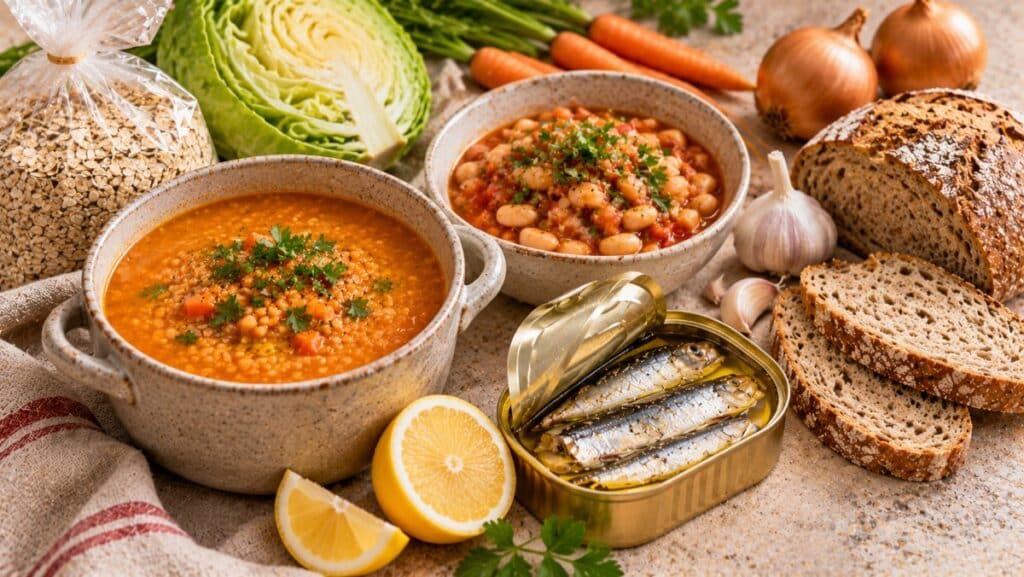
You can follow the Mediterranean diet on a budget by building the week on the cheapest foods in the pattern: dried or tinned legumes, oats, bulgur and rice, seasonal and frozen vegetables, tinned sardines or mackerel, eggs and olive oil used by the spoonful. Studies from Spain, Italy, Belgium and the UK find that eating more Mediterranean costs about the same or slightly more per day than eating less Mediterranean, and in one Italian study high-adherence households spent less. What drives the bill is mainly how much meat, ready meals and snacks you buy.
Contents 9
- Is the Mediterranean diet expensive?
- How do you cost a Mediterranean meal in euros?
- Which Mediterranean foods give the most protein for the money?
- Where does the money go, and how do you save it?
- What does Ayurveda say about eating well on little money?
- A Mediterranean week on a budget
- Who should be careful?
- FAQ
- Sources
This guide is for you if you want to eat the Mediterranean way and keep the shopping bill under control. Food prices change from country to country and from week to week, so instead of printing euro prices that would be out of date tomorrow, we show you what the research says about cost, how to cost any meal yourself in two minutes with the unit price on the shelf label, which staples give you the most protein per gram, and a full budget week to cook from.
Is the Mediterranean diet expensive?
Not by much, according to the research. A 2024 update of a systematic review in Nutrients by Colaprico and colleagues collected 15 studies on the cost of the Mediterranean diet. Most compared people who follow the pattern closely with people who follow it less closely. The European results look like this:
| Study (country) | What they found |
|---|---|
| Tong et al. 2018 (UK) | High adherence: GBP 4.47 a day; low adherence: GBP 4.26, a difference of about GBP 0.20 a day |
| Schröder et al. 2016 (Spain, young people) | High adherence was EUR 0.71 a day more expensive than low adherence |
| Pedroni et al. 2021 (Belgium) | Mean daily diet cost USD 6.51 (EUR 5.79); top third of Mediterranean score USD 6.78 vs USD 6.29 in the bottom third |
| Rubini et al. 2022 (Spain) | Average monthly cost EUR 203.6, rising with adherence |
| Gualtieri et al. (Italy) | High-adherence households about EUR 47.70 a week vs about EUR 58.30 for medium or low adherence |
| Schröder et al. 2021 (Spain, adults) | Daily diet cost per 8.36 MJ (2,000 kcal) rose from EUR 3.68 to EUR 4.97 across adherence levels |
Source: Colaprico C, et al. Cost and Cost-Effectiveness of the Mediterranean Diet: An Update of a Systematic Review. Nutrients, 2024. Figures as reported in the review; some studies report cost per 1,000 kcal and are not shown here.
Read the table as a range, not a verdict. In most studies a more Mediterranean diet costs a little more, roughly the price of a coffee a day at most, and the Italian households show it can also cost less. The difference depends on what you buy: fresh fish, nuts and a premium bottle of olive oil push the bill up, while legumes, oats, frozen vegetables and tinned fish bring it down. For the full pattern, see our entry on the Mediterranean diet.
How do you cost a Mediterranean meal in euros?
Every supermarket in the EU must show a unit price: under Directive 98/6/EC this is the final price including VAT for one kilogram, one litre or another standard unit. That number is all you need.
- Find the unit price per kilogram on the shelf label or in the online shop.
- Decide the portion in grams (the tables below and in our encyclopedia entries help).
- Price per portion = price per kg ÷ 1,000 × grams in the portion.
So a food at EUR 3.00 per kilogram costs EUR 0.24 for an 80 g portion, and one at EUR 12.00 per kilogram costs EUR 0.96 for the same portion. Write the per-portion cost of your ten most bought foods on a note once, and you will know the price of most meals without a calculator.
Which Mediterranean foods give the most protein for the money?
Protein foods are usually the most expensive part of a meal, so it pays to know how many grams of each you need. The table shows how much of each staple, as bought, gives 20 g of protein. Multiply the grams by the unit price on your shelf and you can compare them directly.
| Food, as bought | Protein per 100 g | Amount for 20 g protein |
|---|---|---|
| Lentils, dried | 24.6 g | about 81 g |
| Small white beans, dried | 21.1 g | about 95 g |
| Chickpeas, dried | 20.5 g | about 98 g |
| Sardines, canned in oil, drained | 24.6 g | about 81 g |
| Oats, dry | 13.2 g | about 152 g |
| Eggs, whole | 12.6 g | about 159 g (3 large eggs) |
| Chickpeas, canned, drained and rinsed | 7.0 g | about 286 g |
Source: USDA FoodData Central (FDC 172420, 173749, 173756, 175139, 173904, 171287, 2644288). Amounts calculated from the 100 g values and rounded.
Dried legumes stand out: about 80-100 g of dried lentils, beans or chickpeas gives as much protein as a small tin of sardines, and they also bring fibre and iron. Tinned chickpeas are more convenient but you need about three times the weight, because they already contain water. More detail in our entries on lentils, white beans and eggs.

Where does the money go, and how do you save it?
- Cook legumes from dry in batches. Soak a big pot of chickpeas or beans on Sunday, cook them, and freeze portions. Red lentils need no soaking and cook in about 15 minutes.
- Choose tinned oily fish. Sardines and mackerel in tins cover the two fish meals a week the Mediterranean pattern suggests and keep for months.
- Buy vegetables by the season, and frozen out of season. Cabbage, carrots, onions, leeks and squash in winter; tomatoes, peppers and courgettes in summer. Frozen spinach, peas and green beans fill the gaps.
- Use olive oil by the spoonful. One tablespoon is 13.5 g. A one-litre bottle goes a long way if you measure instead of pouring.
- Buy nuts plain and in larger bags, and keep them in a closed jar. A portion is a small handful, about 28 g.
- Cut what sits at the top of the pyramid. Red and processed meat, pastries, biscuits, sweets and soft drinks are often the most expensive items per meal. Fewer of them is the biggest saving and the biggest health change at once.
- Plan, then shop. A written list from a weekly plan means less waste. Our Mediterranean diet shopping list is organised by aisle.
What does Ayurveda say about eating well on little money?
Traditional Ayurvedic cooking is, at its core, an economical cuisine: grains and legumes cooked together, seasonal vegetables, spices and a little fat. Kitchari, rice and split mung beans simmered with cumin, ginger and turmeric, is the classic example of a cheap, complete and easily digested meal. Ayurveda also values freshly cooked food over leftovers kept for days, so in this tradition batch cooking is best limited to a day or two, or to freezing ready portions. This is a traditional view, not a scientific finding. See our recipe for kitchari and the Ayurvedic diet for beginners.
A Mediterranean week on a budget
The plan uses the same core shopping all week and two batch-cooking sessions. Quantities are for one adult; adjust to your appetite.
| Day | Breakfast | Lunch | Dinner |
|---|---|---|---|
| Monday | Oat porridge with grated apple and cinnamon | Red lentil soup with lemon, bread | Chickpeas with tomato and spinach, bulgur |
| Tuesday | Plain yogurt, oats and a few walnuts | Leftover chickpeas in a wrap with salad | Sardines on wholemeal toast, cabbage and carrot salad |
| Wednesday | Oat porridge with banana | Red lentil soup, bread | Omelette with frozen peas and onions, potatoes |
| Thursday | Wholemeal toast, egg, tomato | Bean salad with onion, parsley and olive oil | Batch 2: white bean and vegetable stew |
| Friday | Yogurt with seasonal fruit | White bean stew | Mackerel with roast squash and onions |
| Saturday | Oat porridge with grated apple | Bulgur salad with chickpeas, cucumber and lemon | Wholewheat pasta with tomato, garlic and frozen spinach |
| Sunday | Eggs, bread, olives | White bean stew, salad | Vegetable soup and bread with feta |
Batch 1 (Sunday or Monday): red lentil soup with lemon
- 1 tablespoon extra virgin olive oil
- 1 onion and 1 carrot, chopped
- 2 garlic cloves
- 1 teaspoon cumin, ½ teaspoon paprika
- 250 g red lentils, rinsed
- 1.2 litres water or stock
- Juice of 1 lemon, salt and pepper
- Soften the onion and carrot in the oil for 5 minutes.
- Add garlic and spices, stir for 30 seconds.
- Add the lentils and water, bring to the boil and simmer for 15-20 minutes, until the lentils fall apart.
- Blend roughly if you like, add lemon juice, season. Makes 4 portions; keep 2 in the fridge for up to 2 days and freeze the rest.
Snacks through the week: fruit, a small handful of nuts, yogurt, or carrot sticks. Water, tea and coffee as drinks.
Who should be careful?
- Digestive comfort. If you are not used to legumes, increase them gradually, rinse tinned ones and cook dried ones well. Plenty of water helps with the extra fibre.
- Salt in cheap convenience foods. Tinned fish, stock cubes, olives and white cheese can be salty. Compare the salt line on labels, especially if you have high blood pressure.
- Pregnancy. The NHS advises no more than 2 portions of oily fish a week for girls and women who are pregnant, breastfeeding or may become pregnant.
- Special diets. If you have kidney disease, diabetes treated with insulin or another condition that needs a planned diet, check big changes with your doctor or dietitian.
Related reading: a 7-day anti-inflammatory meal plan and plant-based meals for weight loss.
FAQ
Is the Mediterranean diet more expensive than a typical diet?
Usually only slightly. In a 2024 review of 15 studies, closer adherence often cost a little more per day, for example about GBP 0.20 a day more in a UK study, and in one Italian study high-adherence households spent less per week.
What are the cheapest Mediterranean diet foods?
Dried lentils, beans and chickpeas, oats, bulgur and rice, onions, cabbage, carrots and other seasonal vegetables, frozen vegetables, eggs and tinned sardines or mackerel. Check the unit price per kilogram to compare them in your shop.
How much does a Mediterranean diet cost per day in euros?
It depends on the country and your choices. In the studies in the 2024 review, average daily costs ranged from about EUR 3.68 (per 2,000 kcal, Spain) to EUR 5.79 (Belgium), with monthly costs around EUR 200 in another Spanish study. Use the unit price method above to cost your own week.
Can I follow the Mediterranean diet without fresh fish?
Yes. Tinned sardines, mackerel and tuna count as fish meals and cost less than fresh fillets. A small tin of sardines gives about 22.6 g of protein.
Sources
- Colaprico C, Crispini D, Rocchi I, Kibi S, De Giusti M, La Torre G. Cost and Cost-Effectiveness of the Mediterranean Diet: An Update of a Systematic Review. Nutrients, 2024;16(12):1899. PMC11206702
- Hu FB, Drescher G, Trichopoulou A, Willett WC, Martínez-González MA. Three decades of the Mediterranean diet pyramid: A narrative review of its history, evolution, and advances. The American Journal of Clinical Nutrition, 2025;122:17-28. doi.org
- Directive 98/6/EC on consumer protection in the indication of the prices of products offered to consumers, Article 2. legislation.gov.uk
- USDA FoodData Central: Lentils, raw (FDC 172420); Beans, small white, raw (FDC 173749); Chickpeas, raw (FDC 173756); Sardine, canned in oil (FDC 175139); Oats (FDC 173904); Egg, whole, raw (FDC 171287); Chickpeas, canned, drained and rinsed (FDC 2644288). fdc.nal.usda.gov
- NHS. Fish and shellfish. nhs.uk
This article is for information only and is not medical advice. If you have a health condition, are pregnant or take medication, talk to your doctor or pharmacist before changing your diet or starting a supplement.
Terms in this article
CucumberZucchiniCarrotMediterranean DietWhite BeansPeasSpinachTomatoesGarlicOnionsGreen beansLeeksParsleyGingerTurmericLentils

 English
 Deutsch
 Español
 Français

